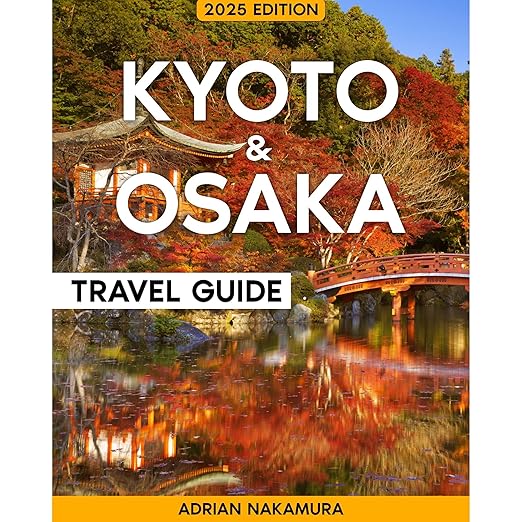
Quick Take
- Narration: This audiobook uses an AI-generated voice (Virtual Voice), which delivers the text clearly but without the texture, pacing instinct, or cultural sensitivity that a human narrator familiar with Japanese geography and food culture would bring.
- Themes: Kyoto temples and spiritual sites, Osaka street food and urban energy, itinerary planning for first-time Japan visitors
- Mood: Practical and descriptive, best used as reference rather than continuous listening
- Verdict: A serviceable organizational framework for a Kyoto and Osaka trip, but the AI narration and some credibility concerns from reviewers mean this works better as a supplement to more authoritative sources than as a standalone guide.
Travel guides present a particular challenge as audiobooks. Unlike narrative nonfiction, where the listening experience often exceeds the page, a practical guide depends on reference, the ability to jump to a section, reread a passage, check a map. Still, a well-produced travel audiobook can work for long commutes or trip preparation, and Kyoto and Osaka are cities rich enough in history, food culture, and navigational complexity that a comprehensive audio introduction has genuine appeal.
I want to be upfront about something before going further. The narrator listed for this title is Virtual Voice, which is Audible’s designation for AI-generated narration. That matters for this particular book. A human narrator familiar with Japanese place names, Fushimi Inari, Kinkaku-ji, Kiyomizu-dera, Dotonbori, would bring a quality of pronunciation and cultural attunement that no current text-to-speech system fully replicates. Listeners who have been to Japan, or who have any familiarity with Japanese phonology, will notice the difference.
Our Take on Kyoto and Osaka Travel Guide
The content, as described in the synopsis and supported by the more positive reviews, is organized clearly. The guide covers Kyoto’s spiritual sites, the red torii gates of Fushimi Inari, the golden pavilion of Kinkaku-ji, the hillside Kiyomizu-dera, alongside Osaka’s urban character: Dotonbori’s neon-lit energy, Umeda’s shopping, Shinsekai’s retro charm. The food sections address both high-end kaiseki and street-level takoyaki and okonomiyaki. Curated itineraries for three, five, and seven days are included, along with transportation guidance and cultural etiquette tips.
One reviewer specifically appreciated the cultural etiquette section, the guidance on shoe removal, temple behavior, and local customs, as particularly well-researched. Another valued the hidden gems recommendations that went beyond the standard tourist circuit. These are the guide’s genuine strengths, and for a first-time Japan visitor in the planning phase, they represent real value.
Why Listen to Kyoto and Osaka Travel Guide
The most practical use case for this audiobook is pre-trip orientation during a commute or exercise session. The organized structure, city by city, experience type by experience type, works for audio consumption when you are trying to build a mental map of what you want to prioritize. The itinerary framework, which accounts for different traveler types including history lovers, foodies, photographers, and first-timers, is a thoughtful organizing principle that helps listeners self-sort before committing to a day-by-day plan.
At five hours and thirty-six minutes, the runtime is manageable for a week of commutes. The bonus chapter on Kansai region destinations beyond Kyoto and Osaka adds value for listeners who want to extend their trip to Nara, Himeji, or the quieter towns of the region.
What to Watch For in Kyoto and Osaka Travel Guide
The concerns raised by critical reviewers deserve honest acknowledgment. One reviewer suggested the content reads as AI-generated and offers no more detail than a web search. Another found editing rough and production values inconsistent. These are not universal reactions, the majority of reviewers found the content useful, but they reflect real limitations that prospective buyers should weigh.
The absence of images is also a genuine constraint. Travel guides rely heavily on visual reference, and while the descriptions of Fushimi Inari’s torii gates and Osaka’s Dotonbori canal are vivid enough to orient a listener, they cannot substitute for photographs. This guide works best alongside a visually rich companion resource rather than as a standalone.
Who Should Listen to Kyoto and Osaka Travel Guide
First-time visitors to Japan who want a structured audio overview of Kyoto and Osaka during pre-trip preparation will find this useful, with the caveat that it works best as one resource among several rather than a definitive guide. The AI narration is a real limitation for a destination where Japanese phonology matters, and listeners who will be navigating temples, transit systems, and restaurant menus will benefit from the phonetic accuracy that a human narrator brings. Travelers who want a more authoritative, human-narrated guide to Japan should also explore well-established travel publishers. Those who have already visited and want deep local knowledge will find this too introductory.
Frequently Asked Questions
Is the narration for this Kyoto and Osaka Travel Guide done by a human narrator?
No. The narrator is listed as Virtual Voice, which is Audible’s AI-generated narration technology. Japanese place names and food terms may not be pronounced with the accuracy or cultural attunement that a human narrator familiar with Japan would provide.
How does this guide handle the practical logistics of getting between Kyoto and Osaka?
The guide includes transportation guidance covering trains, buses, and walking routes. The Kansai region transit options relevant to moving between the two cities are addressed, along with day-trip logistics.
Is this guide suitable for a return visitor to Japan looking for deeper local knowledge?
Probably not. The content is pitched at first-time visitors, covering the major sites and standard itinerary planning. Repeat visitors looking for off-the-beaten-path depth will find it too introductory.
What is included in the bonus Kansai chapter?
The guide describes a bonus chapter covering Hidden Kansai Gems, destinations beyond Kyoto and Osaka proper, including quieter trails, small towns, and local secrets in the broader Kansai region.