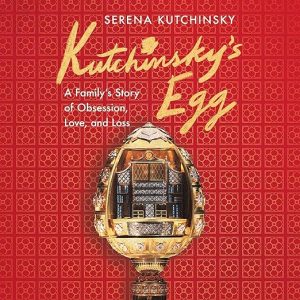
Eleven years old is where this memoir sets its clock, and the audiobook holds that vantage far longer than the jacket copy prepares you for. Serena Kutchinsky was eleven when her father, Paul, who owned the high-end jewelry company the House of Kutchinsky, set out to build the largest jeweled egg in the world, one meant to rival Faberge's masterpieces. He built it. The Argyle Library Egg stood two feet tall, made of solid gold and dripping with pink diamonds, and when no buyer came forward the house collapsed, the marriage fell apart, and Paul went into a spiral of drink and drugs. Within ten years he was dead. The egg was seized by business partners and disappeared without a trace.
Author and Narrator Share One Identical Line
Begin with the credit block, because it carries the one genuine oddity on this listing. The reader slot repeats the byline character for character: Serena Kutchinsky is named as the author and again as the narrator. That would make this an author-read memoir, which is the natural casting for a book whose method is a daughter interrogating her own memory, and nothing else on the page confirms it. No second performer appears, no production note explains the decision, and Simon and Schuster Audio has left the two lines identical without comment. If hearing the author is part of why you would buy this, verify it on the product page before you commit.
Naming your own competition in the jacket copy is a risk, and this description takes it. The memoir is pitched as echoing the intimacy of The Hare with Amber Eyes, which is a bold comparison to hand a listener inside the first minute, and it sets an expectation the book then has to meet: an object-led family history in which the object is never merely a prop. On the evidence of the description, the structure supports the claim. The egg is not a keepsake that happened to survive a century. It was commissioned by the man at the center of the story, and its failure to find a buyer is the hinge on which an entire family turns.
What gives the book its reach is the line it draws backward. The search starts in the slums of London's East End, where Serena's great-great-grandparents arrived as Jewish immigrants from Russia, and runs forward to a jewelry house grand enough to attempt a two-foot golden egg. Four generations separate the arrival from the ambition. Read along that axis, Paul's gamble stops looking like simple vanity and starts looking like a second act of arrival, an attempt to make a family name permanent in gold. The memoir does not announce that reading. The chronology makes it available.
Two Stories Running in Parallel
Two stories run in parallel across eleven and a half hours, and the audio format suits the way they cross. One is a business failure with dates, partners and creditors attached. The other is a daughter reconstructing a father from what he left behind, which amounts to debt, rumor and an object nobody can locate. A search narrative rewards being heard straight through rather than skimmed, because you cannot flick forward to check whether the egg turns up, and the description is candid enough to promise that it does.
Money is what keeps the hunt from feeling like a private grief. The egg is estimated to be worth more than 30 million pounds today, a figure that converts family history into a live commercial question and explains why the trail runs through dealers, former partners and the corners of the high-end jewelry trade that prefer not to be described in print. Kutchinsky writes about that world from inside it, as the child of a house that competed there, and the access is the most valuable thing this memoir owns.
Eleven hours and thirty minutes is a generous allowance for one family, and the runtime tells you what kind of book was intended. A shorter version of this material would have been a magazine feature about a missing treasure. At this length the memoir has room for the East End, the rise of the house, the marriage, the drinking years, the decade after the death, and the search itself, and the proportion between those parts is what will decide whether you finish. Arrive for the mystery and you will be asked to sit with a great deal of grief on the way to it.
Stop Reading the Copy After the Collapse
Publisher copy gives away more shape here than it should. It confirms that the search concludes, announces in advance that the ending is unexpected, and specifies where the journey begins, which hands the listener a map of the book before the first chapter opens. Stop reading the copy after the paragraph about the collapse. Everything past that point is information a listener is better off earning at the pace the author set.
No score sits beside this title and no written response has appeared either, which is worth knowing more than four months after a March 31, 2026 release from a major audio publisher. That is not a verdict on the book. It means the usual second opinion is simply unavailable: nobody has yet reported how the reading holds up across a long runtime, how the archival material is handled aloud, or how the closing revelation lands. Buyers who normally scan the star column before committing eleven hours will be deciding on the description alone.
Category placement is the last flag. The record sits under arts and entertainment first, carrying a single tag that reads Art, with biographies and memoirs second. A listener browsing art history surfaces a bereavement memoir; a listener browsing family memoir may never surface this at all. The subject genuinely spans both shelves, but the ordering pushes the wrong one forward, and one word is doing very little work for a book concerned with addiction, bankruptcy and inheritance at least as much as with goldsmithing.
The Mystery Functions as a Frame
Object-led family history is the shelf this belongs on, and the people who go looking for that shelf know exactly what they want: one artifact, a family archive, a century of movement, and a narrator willing to be implicated in the story rather than hovering above it. Listeners drawn to accounts of craft at its extreme end, where technical ambition tips over into ruin, will find the Argyle Library Egg an unusually literal case study. Anyone who has spent years asking questions about a parent they could not quite reach should recognize the method within the first hour.
Pass if what you want is the heist. The description promises a lost treasure worth tens of millions and a resolution in an unexpected place, but the eleven and a half hours between those two poles are spent on a marriage, an addiction and a company's paperwork, and the mystery functions as a frame rather than an engine. Wait for the response column to fill if you want an outside opinion before committing eleven and a half hours to somebody else's grief.
How long is the Kutchinsky's Egg audiobook, and when was it released?
It runs eleven hours and thirty minutes and was published by Simon and Schuster Audio on March 31, 2026. That puts it at roughly a dozen commutes, or a week of evenings, and the length is standard for a full-scale family memoir rather than for the shorter investigative books this one shares a subject with.
Does the audiobook come with any pictures of the Argyle Library Egg?
Nothing on the listing advertises a companion PDF or image file, which matters for a book whose subject is a two-foot object made of gold and pink diamonds. You get the piece in words only. If seeing it is part of the appeal, plan on searching for photographs separately as you listen.
Is this part of a series, or does it stand alone?
It stands alone. The series fields on the record are empty, no companion volumes are linked, and the description points at no earlier or later book. What you are buying is a single self-contained memoir, which also means no back catalog exists to sample before deciding.