
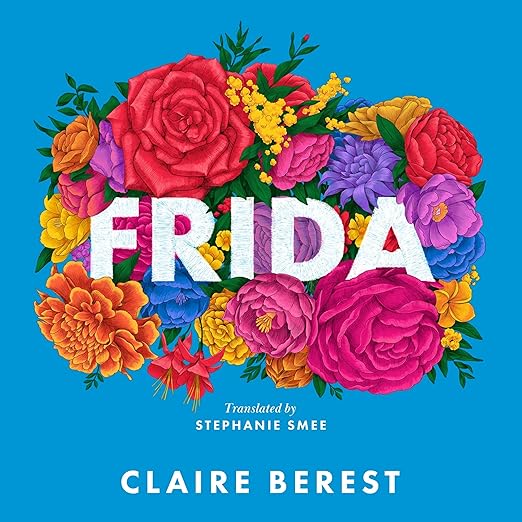
Claire Berest wrote this in French, and the audiobook arrives on the back of a line buried in its own copy: translated into English for the first time. That single clause carries more weight than the three press quotes stacked above it, because it tells you that whatever you have already read about Frida Kahlo in English, you have not read this. What the listing does not tell you is who did the translating. It does not tell you who reads it either.
A Novel of Two Accidents, Filed as Biography
Frida is a novel. The prize says so, the closing paragraph of the description says so, and the phrase it uses is a striking fictional imagining of a marriage. Anyone arriving from the biography shelf should hold that thought, because the record files this under biographies and memoirs, and the two categories ask for completely different reading. Berest is not reconstructing a documented life from letters and dates but writing Frida and Diego as characters, with a novelist's freedom about interior weather.
Two great accidents, the copy says: a streetcar, and a man. Everything the pitch chooses to show sits on that axis. She is twenty years his junior. She is from Coyoacán. She has a broken spine before the marriage even begins, and she paints anyway. He is already Mexico's greatest artist and already a legend, arriving at that meeting without having heard her name. That imbalance is the engine of the whole thing, and it is a much better subject than the paintings would have been.
Opening at a party is the copy's own choice, and the framing in that scene deserves notice: she knows everything about him, about his mythology, and he knows nothing of her, she is nobody. A novelist who starts there has decided the book is about attention, about who gets looked at and who does the looking. For a subject whose face now sells tote bags, beginning at the last moment before anyone was looking is a genuinely interesting decision, and it explains why the marriage carries the plot instead of the work.
Flat Delivery Would Flatten It, Archness Spoil It
Ten hours is a generous runtime for prose this compressed, and compression is what the sample sentences promise. The lines quoted in the description are short, declarative and physical: she drinks like a sailor, she wears flowers in her hair, she talks openly about sex, she goes to protests and to parties to wake the dead. Writing like that reads fast on the page and asks for real commitment out loud. Flat delivery would flatten it, and archness would spoil it faster still.
Worth reading closely is the comparison set the publisher offers, because it mixes two kinds of thing. The Artist and The Safekeep are titles; Tracy Chevalier and Ali Smith are names. Chevalier points toward the painter-adjacent historical novel, Smith toward something formally restless. Frida is being sold to both audiences at once, which is either confident or unresolved depending on how the sentences behave once the plot settles.
Ten Hours With No Field to Guess the Voice
French reception is the other argument on offer. This took the Grand Prix des Lectrices at Elle France, a readers' prize by name, and all three quotes the publisher selected come from magazines: Elle, Grazia, Paris Match. That adds up to a coherent picture of a book that sold hard to general readers in its own language and is only now crossing over, rather than a critical darling arriving with a jury citation.
Audio applies one pressure the description cannot answer for. Mexican and French names, art-world vocabulary and a heroine whose body hurts continuously all have to survive being spoken at a fixed pace. Physical pain in particular resists reading aloud, since on the page you can slow down over a paragraph about a damaged spine while a recording moves at whatever speed it was set to. Ten hours either earns that length through voice or exposes it, and no field on this record lets you guess which.
No Reader, No Translator, Then a Wall of Quotes
No reader is credited anywhere on this record. The narrator field sits empty, and for a translated novel that gap matters, because the voice doing the translating and the voice doing the reading are the two decisions that shape every sentence you will hear. Uncredited too is the translator, which is the sharper omission: a first English translation is the entire selling proposition here, and the person who made it does not appear on the page.
Shelving is the second thing to check. Arts and entertainment fits. Biographies and memoirs does not, and buying on that basis while expecting sourced biography leads to irritation inside the first hour. Berest is inventing scenes and the book is open about it; the category is the part that is not.
Promotional apparatus takes up the third slot on the watch list. Three magazine quotes, a prize line and a comparison list occupy the top of the description before a single event is described, and the plot summary that follows fits into a couple of short paragraphs. You are buying largely on reputation and on the Kahlo name. The rating column is empty as well, carrying neither a number nor a single comment, so nothing on the page corroborates the magazines.
A Marriage Novel That Happens to Be About Painters
Readers who came to Kahlo through the paintings and want the marriage rather than the catalogue will get what they came for, particularly if they like historical fiction close-focused and unsentimental about its subjects. The Chevalier audience is the safest bet, and so is anyone who reads translated fiction on purpose and has been waiting for Berest to appear in English at all.
Listeners who want the paintings explained are in the wrong place, and that is not a flaw. The description mentions Frida painting exactly once, in a five-word clause about working while her body is wrecked. Art historians and anyone building a Kahlo reading list around technique and iconography should look for something else entirely; this is a marriage novel that happens to be about two painters.
Documented biography is the wrong expectation, and the record's own category actively encourages it, which is the one reliable way to end up disappointed by a book doing exactly what it announced. An uncredited reader may be a dealbreaker across ten hours of first-time translation, and that is a defensible line to hold. Everyone else can treat the empty narrator field as the single unknown in an otherwise well-documented package, and start with the streetcar sentence.
Key Details
- Themes: An unequal marriage, art made through chronic pain, celebrity and myth, Mexico City bohemia
- Mood: Sensual, abrasive, unsentimental
- Verdict: A French readers' prize-winner crossing into English at last, sharp on the marriage and silent about who reads it.
Is the Frida audiobook a biography or a novel?
A novel. The description calls it an award-winning novel and an award-winning novel that reimagines Frida Kahlo's marriage as fiction, and it won a French readers' prize for fiction. The record still files it under biographies and memoirs, so treat that category as a shelving error rather than a description of the contents.
Who narrates the Frida audiobook?
Nobody is credited. The narrator field on this record is empty, so the ten-hour runtime arrives without a name attached to the voice. The translator is missing too, which stings more, because the copy makes a first English translation the central selling point of the release.







