
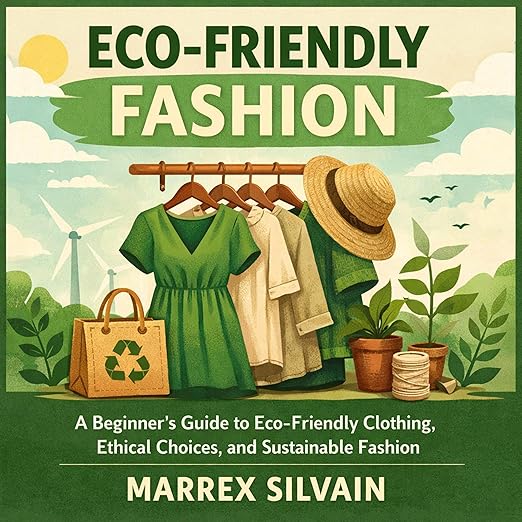
Quick Take
- Voice: Lana Adams carries three hours of explanation solo, on material that has to signpost its own structure without a page to look at.
- Big ideas: fast fashion and its true costs, fabric production, greenwashing detection, garment care, gradual change over purity.
- Atmosphere: Calm, orderly and free of guilt-tripping.
- Worth it?: A genuinely useful starting point for anyone new to sustainable clothing, and three hours of familiar ground for anyone who is not.
Three hours and twenty-three minutes is roughly the length of a long film, and this audiobook spends it the way a good documentary would: one argument, delivered in order, with enough detail to act on and no pretense of being complete. Marrex Silvain has written a beginner's guide to sustainable clothing that refuses both of the easy modes, neither shaming the listener nor handing over a shopping list of approved brands. What arrives instead is a short course in how garments are made, why the cheap ones cost more than their price tag, and how to separate a real environmental claim from a marketing one.
Neither Lecture nor Permission Slip
Coverage follows a sensible arc. Fabrics come first, where they come from and what turning them into cloth actually requires, because every later judgment depends on that. Fast fashion follows, treated as both an environmental and an ethical problem rather than only a landfill statistic. Then the definitional work: what the phrase eco-friendly is doing when a label uses it, which is a question most listeners have never been given the tools to answer. Only after all of that does the book reach the part everybody wants, which is what to buy.
Silvain's stance is the reason this holds together. The book argues for small changes over dramatic ones, for a wardrobe that reflects your taste and your values at the same time, and against the idea that anything less than perfect is not worth doing. That position is easy to state and hard to sustain across three hours without sliding into either lecture or permission slip. This one stays balanced, which is rarer in the category than it should be.
Lana Adams Carries the Signposting Alone
Greenwashing gets the most valuable stretch, and it justifies the purchase on its own. The copy promises listeners will learn to recognize the tactics brands use, and that is the single skill in this subject with a long shelf life. A soothing adjective with no certifying body standing behind it looks perfectly convincing until somebody explains what a certification is supposed to require. Brands will invent fresh tactics next season. Pattern recognition transfers. Most of the rest here is advice, and advice ages; this stretch is training, and training keeps working.
Garment care is the quieter surprise. Making clothes last is the least glamorous lever available and by a distance the most effective one, since the cheapest sustainable garment is the one already hanging in your closet. Silvain treats caring for clothes so they survive longer as a serious subject rather than as a footnote before the shopping chapter. Anyone who has thrown out a sweater that could have been saved will feel mildly accused, and then better informed.
Format shapes what the material can do. A guide with no page to glance at has to carry its own structure aloud, which means the transitions between fabric science, ethics and practical steps do all the signposting work an eye would otherwise do on a contents page. Lana Adams reads the whole thing, one voice for three hours of explanation. Instructional nonfiction of this kind lives on the pacing between sections, and the runtime is short enough that the argument never has time to drift.
A Foundation Is Exactly What Gets Delivered
Scope is the first caution and the copy is honest about it. This is a beginner's book. Anyone who already knows the difference between recycled polyester and deadstock, who follows supply chain reporting or has read anything substantial about textile waste, will spend three hours nodding at material they own. No brand directory appears, no price comparisons, no country-by-country guidance on where any of this applies. The promise is a foundation, and a foundation is exactly what gets delivered.
Verification is the second. Claims about how fabrics are produced and what they cost the environment are the sort of thing a listener may reasonably want to check, and the product page mentions no companion document, no reading list and no set of references. Whether the recording carries a bibliography read aloud or an accompanying file is not stated anywhere on the record. Anyone planning to cite this material rather than simply act on it should confirm that before buying.
Shelving is the third, and it is the record's own doing. The categories attached are Arts and Entertainment and Home and Garden, and the only tag is Art. Nothing on the page marks fashion, sustainability, consumer advice or environmental writing, which are the four terms a buyer would actually search. No ISBN or page count appears either, and the publisher field reads May June. A useful little book has been filed where almost nobody looking for it will pass by.
Habits That Cost Nothing to Adopt
Shopping with any intention at all makes this worth three hours. It suits the listener who has read one alarming article about textile waste and wants the whole picture without a reading list, the person who keeps buying things that fall apart in a season, and anyone who has stood in front of a rack wondering whether a green hangtag means anything. It also works well for a teenager building a first independent wardrobe.
Look elsewhere if you want a buying guide with names in it, because none are supplied, or if your interest is policy and industry economics rather than personal decisions, since the frame here stays firmly at closet level. Specialists will find nothing new. Everyone else gets a calm, well-ordered explanation of a subject that usually arrives either as guilt or as advertising, and three hours later a set of habits that cost nothing to adopt.
Questions Listeners Ask
How long is the Eco-Friendly Fashion audiobook and what does it cover?
The recording runs three hours and twenty-three minutes and was published in March 2026, with Lana Adams reading. The copy describes an arc that begins with how fabrics are made, moves through the problems with fast fashion, and ends on practical shopping and clothing care decisions.
Is this audiobook written for beginners or for people already following sustainable fashion?
Beginners, explicitly. The description says the book is designed for people starting out and emphasizes small changes over drastic lifestyle shifts. Anyone who already reads about textile waste, supply chains or certification schemes will recognize most of the ground being covered here.
Does the recording come with a PDF, charts or a list of recommended brands?
Nothing on the product page mentions a companion file, and no brand directory is promised anywhere in the description. The material is framed as principles and habits rather than as a shopping reference, so listeners wanting specific labels and prices should look elsewhere.
What exactly does greenwashing mean in this context?
It refers to environmental claims that sound meaningful but survive no scrutiny: vague labeling, unverified percentages, one token line marketed inside an otherwise conventional catalog. The copy promises to teach listeners how to spot the common versions, which is arguably the most transferable thing the book offers.







