
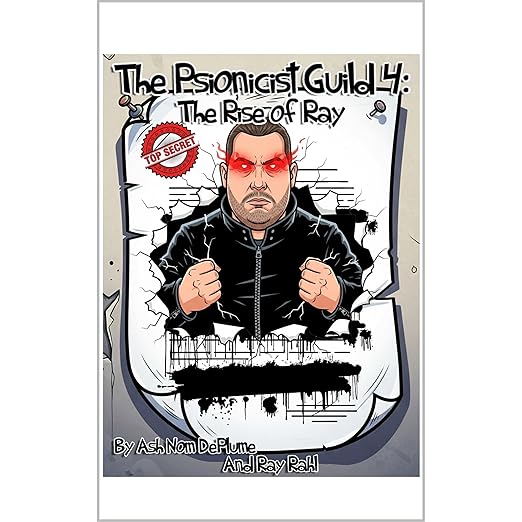
Can a background character earn the fourth book in a series? That is the question Ash Nom DePlume puts on the record for this audiobook, and it is put almost literally: the description spends most of its length arguing that Ray, previously furniture in the Psionicist Guild novels, has moved into the foreground and deserves to be there. It runs seven hours and forty-seven minutes, published independently in March 2026. Virtual Voice sits in the reader slot, which names a machine rather than a person.
An Author's Note That Compares Ray to Samwise
Description is the wrong word for what occupies that field. What the record actually carries is an author's note: one paragraph of asides about the series, its origin as a commissioned Jay and Silent Bob parody, and the technical constraint that forced the second installment to be broken into pieces in order to comply with audio book requirements. Plot, setting, stakes and every character except Ray go unmentioned. A buyer arriving here learns a good deal about how the series got made and essentially nothing about what happens in it.
Candor is the compensating virtue, and it counts for something. Most independently published fantasy copy oversells hard. This one volunteers that the whole series exists because somebody commissioned a parody, notes in parentheses that the runtime rules will probably change again now that they have been mentioned aloud, and concedes that the question of whether Ray has earned the promotion is being handed straight back to the buyer. A writer this unguarded about the machinery is not going to spring a bait and switch on anybody.
Ambition sits underneath the shrug, though, and it deserves to be taken seriously. The comparison offered is Samwise Gamgee against Frodo Baggins, the companion who turns out to carry more of the book than the nominal hero does, and the copy places Ray squarely in that tradition. As ideas go that is a real one, and a legitimate reason for a fourth volume to exist. Whether the execution reaches it is not something this record lets anyone judge, since no sample, no chapter list and no plot summary appear on it.
The Payoff Book for Readers Who Followed Ray
Continuity is the honest pitch. Ray has been rising across earlier volumes, including the one the copy calls Harvey 2, and this is the payoff book for anybody who followed that climb. At this length it is a substantial installment, longer than most independently published fantasy manages, and the arc it resolves was laid down over several titles rather than invented for the occasion. Readers who already know the Guild are the only audience the description addresses in any direct way.
Parody is the register, and knowing that sets expectations correctly. A series that began as a commissioned send-up of a pair of established comedy characters is not reaching for epic gravity, and the tone of the copy, chatty, digressive and mildly self-deprecating, is presumably the tone of the books themselves. If that sounds wearing across nearly eight hours, this is extremely useful information to have in advance. If it sounds like good company, the length turns into an argument in favor rather than a warning.
Independence shows in the production choices and in the willingness to explain them. A second book split in two to satisfy runtime limits is precisely the sort of detail a large house would never put in front of a buyer, and knowing it explains a numbering scheme that would otherwise look arbitrary. Four titles, a series that started as a commission, and a lead character who began as scenery: none of that follows a plan, and the copy makes no attempt to pretend that it did.
Eight Hours of Synthetic Delivery, Timing Is Everything
One sentence in the description does not finish itself. The line meant to hand the verdict to the reader runs, in this case you until the series becomes a mega hit movie series, you will have to decide for yourself, with a word or two missing from the middle of it. The Samwise comparison a few clauses earlier drops a preposition in the same way. Small things individually, but they are the only prose sample available to a buyer, which makes them load-bearing.
Shelving is wrong here in a way that will cost this book readers. The record files it under arts and entertainment with an art tag, which describes neither a psionics fantasy nor a comedy parody, and anyone browsing science fiction, fantasy or humor will never come across it. Correcting that would take a single field change, and it would probably do more for this book than anything else on the page. As things stand, the only people who will reach it are the ones who already know the series exists.
Machine narration is the last thing to settle before buying. Nearly eight hours of synthetic delivery is a genuinely different proposition from eight hours of a performer, especially in comedy, where timing is the entire mechanism. Disclosure is at least present and unambiguous, which is more than some records manage. The byline does something comparable in its own register, since Ash Nom DePlume announces itself as a pen name rather than affecting to be otherwise. Thirty seconds of it will settle the question for most people.
A Writer Willing to Show the Seams
Volume four is for people already three books into the Psionicist Guild, and the copy does not seriously pretend otherwise. Everything in the description assumes you know who Ray is, what the previous installment did with the character, and why a move into the foreground counts as an event worth announcing. Arrive at number four cold and none of that frame of reference exists for you to use, because nothing on the record supplies it.
Look elsewhere if synthetic narration is a deal breaker for you, and look elsewhere as well if you expect to know what happens in a book before paying for it, because this listing will not tell you. Anyone who enjoys watching an independent series work out its own shape in public, though, gets a writer unusually willing to show the seams, plus nearly eight hours in which to find out whether the sidekick can hold the middle of a book.
- What it covers: A supporting character promoted to lead, comedy parody, psionics and guild fantasy, an independent series improvising its own structure
- Feel: Chatty, self-aware and unpolished
- Our call: Volume four rewards people who already read one through three, and tells everyone else almost nothing.







