
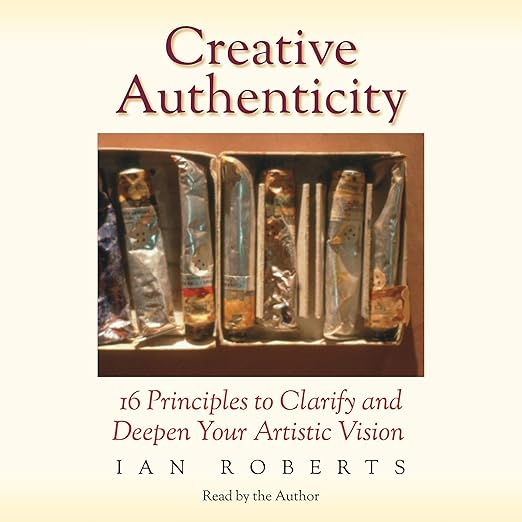
Quick Take
- Voice: Ian Roberts is credited as author and reader both, which keeps one voice throughout a book about finding yours.
- Big ideas: fear of the cliche, artistic voice, self doubt, the working artist's plateau
- Atmosphere: Calm, encouraging, studio-adjacent
- Worth it?: A short, targeted pep talk for artists stuck between competence and voice, bought entirely on faith given how little the listing discloses.
Fear of the cliche is the first problem this audiobook names, and anyone who has stood in front of their own work knowing it looks like everyone else's will recognize the diagnosis immediately. Ian Roberts has assembled a collection of short essays aimed squarely at serious working artists, and the trouble it addresses is never technical. Three hours and forty minutes, with Roberts credited as both author and reader. That is nearly everything the record will tell you, and the gaps in it are part of the story.
Roberts Reads the Book About Finding a Voice
Three problems sit at the center of the description, and the selection is a good one: a terror of the cliche, the wish to say something true, and the frustration of hunting for a voice of your own. None of those is solved by another hour of life drawing. They are the failure modes that stop people who already have the technique, which is why the intended audience is specified as working artists rather than beginners. Naming them out loud, and insisting they are ordinary rather than disqualifying, does a surprising amount of the work on its own. Most artists carry these worries privately, on the assumption that admitting them would confirm the diagnosis, and a book that says the fear is standard equipment removes the second layer of shame stacked on top of the first.
Essays suit the format better than most nonfiction shapes do. A collection of short pieces survives interruption, and this is a book aimed at people who will listen to it in a studio with their hands busy, stopping when the light changes and picking it up the next morning. Nothing depends on holding a thread across the full runtime. Roberts is credited as the reader as well as the writer, which on a book about locating your own voice is at least a consistent decision.
An Argument for Starting Before Vision Arrives
The material draws on three wells, according to the description: personal experience, the struggles of well-known artists, and the rewards of making work that comes from somewhere real. The middle one carries the weight. Learning that celebrated artists wrestled with the same doubts for years is the kind of information that changes what a bad studio week means. It reframes the doubt as a stage in the process instead of a verdict on your talent. Personal experience does the complementary job, since a writer describing their own dead ends is harder to dismiss than one issuing advice from above, and the essay length keeps those confessions from stretching into memoir.
What the collection is finally pushing toward is practical. The stated aim is to get artists focused on developing their craft and working through self doubt, which means the reassurance has a job: return you to the easel. Books in this corner often stall at consolation, and the framing here suggests something more useful, an argument against waiting for a vision to arrive before you are allowed to start. For an artist between bodies of work, or one who has quietly stopped going to the studio, that argument is worth three hours.
Reads Like a Database Import Gone Wrong
Consider the listing first, because it is in poor shape. The description has had its punctuation stripped out entirely, so clauses run into each other without a single period: the copy moves through "the fear of being cliched the desire to convey truth in art and the frustration behind trying to find an authentic voice" as one unbroken string, and self doubt arrives unhyphenated at the end. That reads as a database import gone wrong rather than anything a publicist wrote. On a product about clarity of expression, a description that cannot punctuate itself is an unfortunate first impression, and it makes the page genuinely hard to skim.
Empty fields matter more. No publisher is named, no release date is recorded, the rating field is blank, and not a single response has been left. You are buying on the description and the runtime alone, with no aggregate opinion to lean on and nobody's account of how the essays land. The copy also declines to name a single one of the famous artists whose struggles it promises to discuss, so you cannot tell in advance whether the examples come from painters, sculptors, writers or all three.
Scope is worth measuring against your own expectations before you buy. This does not teach anybody to paint. Composition, color, materials and drawing are outside its remit by design, and a listener hoping for instruction will spend the runtime on encouragement instead. Reassurance is a legitimate purpose, but it has a short shelf life if it stays general, and without any posted reaction to consult, how specific this one gets is the question you cannot answer before you press play.
Already Know the Pep Talk by Heart
Somebody mid-practice is the right listener here, not somebody starting out: a body of work behind them, a studio habit, and a growing suspicion that everything they make resembles everybody else's. Artists who have hit the wall between competence and voice are the exact audience the description describes, and the essay format lets them take one problem at a time rather than committing to a program. Teachers who spend time talking students down from perfectionism will find useful language here as well, and so will anyone who has drifted into making the work they think buyers expect. Listeners who want a companion for long, repetitive studio tasks are also well placed, since nothing in the structure punishes you for missing a paragraph.
Anyone shopping for craft instruction, a structured curriculum or a business guide to selling work should look elsewhere entirely. At that length, the cost of finding out is roughly one studio session, which is a fair trade for a collection that might get you back to the easel and a poor one if you already know the pep talk by heart.
A Few Questions About Creative Authenticity
Does the audiobook teach any painting or drawing technique?
No. The description scopes it to expressive and personal problems rather than craft: fear of cliche, the wish to convey truth, the hunt for an authentic voice. Serious working artists are named as the intended audience, which assumes the technical foundation is already in place before you start.
Who reads the audiobook?
Ian Roberts holds both credits, as writer and as reader, across a recording that lasts a little under four hours. The record stops there, with no publisher and no release date attached, so the reading credit is one of the few concrete facts the listing supplies about the production.
Is the runtime enough for a subject this big?
It is a collection of short essays rather than a course, so the runtime fits the ambition. Each piece takes one common problem and addresses it directly, which means you can dip in around studio time instead of committing to a long structured argument.
Will it help someone who paints as a hobby?
Partly. The fears described are universal to anyone making things, but the framing assumes an established practice, regular studio hours and enough finished work to see a pattern in it. A weekend painter will recognize the feelings and may find the examples pitched above their situation.







