Quick Take
- Narration: Dennis Logan reads with measured reverence, treating the catechism format as devotional rather than didactic; the short runtime means every word carries weight.
- Themes: identity and spiritual awakening, national heritage, self-knowledge
- Mood: Contemplative and ceremonial
- Verdict: An essential primary text for anyone studying Moorish Science or Black American spiritual history, best approached as a historical document alongside its surrounding tradition.
I came to this recording as a researcher rather than a practitioner, having encountered references to the Moorish Science Temple of America in the context of early twentieth-century Black nationalist movements. At under twenty minutes, the audiobook is over almost before you’ve adjusted to its register, but that brevity is part of what the text demands. Koran Questions for Moorish Americans, known within the tradition as the 101s, is not a book you read so much as one you sit with. The question-and-answer format was designed for memorization, for repetition, for communal recitation. Listening to it once is barely an introduction.
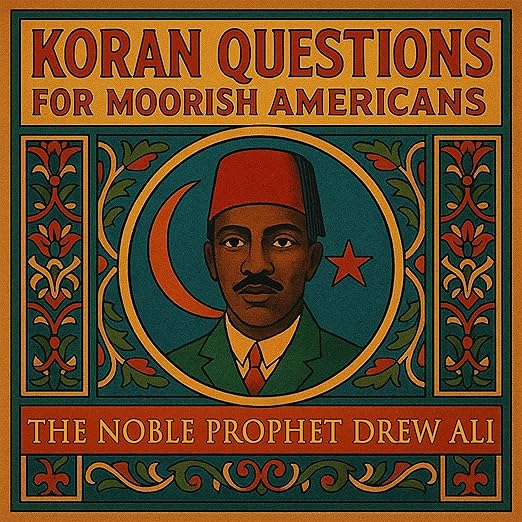
The text was revealed by Noble Prophet Drew Ali and functions as a catechism, a structured pathway into the moral and spiritual principles of Moorish American identity. The synopsis describes it as both an initiatory doorway and a historical document, and that dual status shapes how you’ll experience it depending on where you’re coming from. For scholars of African American religious history, this is a primary source of considerable significance, predating the Nation of Gods and Earths’ 120 degrees tradition and providing essential context for understanding how questions of self-knowledge and national origin became spiritualized in early twentieth-century Black American communities.
Our Take on Koran Questions for Moorish Americans
The content is organized around the foundational tenets Drew Ali believed his followers needed to internalize: knowledge of self, divine origin, national heritage, and the ethical duty to uplift humanity through love, truth, peace, freedom, and justice. These principles are not abstract in the 101s; they are grounded in specific claims about Moorish American identity, historical genealogy, and the relationship between spiritual awakening and national consciousness.
This edition is reproduced from a rare 1928 pamphlet circulated during the Prophet’s own lifetime, which lends it a documentary integrity that later printings sometimes lack. The publisher, Rolled Scroll Publishing, has maintained both the tone and instructional intent of the original. For scholars, that fidelity matters.
Why Listen to Koran Questions for Moorish Americans
Dennis Logan’s narration respects the form. He reads the questions and answers with a gravity that suits the catechistic structure without tipping into performance. The audio format works reasonably well for material designed for oral transmission, and at nineteen minutes the production is disciplined. There’s no padding, no interpretive commentary layered in, just the text, which is what both practitioners and scholars need.
Reader response to this title is polarized in ways that reflect larger debates within the Moorish American community itself. Several reviewers object to the commercialization of a text they consider sacred and freely circulating within the tradition. That tension is worth acknowledging: the 101s have historically been distributed without cost among initiated Moorish Americans, and purchasing a recorded version raises questions that vary in weight depending on your relationship to the tradition. The one-star reviews that call this a scam product are not assessing the quality of the production; they’re registering a religious objection to its commodification.
What to Watch For in Koran Questions for Moorish Americans
First-time listeners approaching this text without background in Moorish Science will need supplementary reading to fully contextualize what they’re hearing. The catechism is written for initiates, or those seeking initiation, and assumes familiarity with Drew Ali’s larger teachings, particularly the Holy Koran of the Moorish Science Temple. The questions are precise but their answers are dense with meaning that only becomes clear in relation to the broader tradition.
The nineteen-minute runtime is both the production’s strength and its limitation. You will want to listen more than once. The format rewards the kind of close, repeated engagement that audiobook platforms don’t particularly incentivize, but it is essential here.
Who Should Listen to Koran Questions for Moorish Americans
Students of African American religious history, scholars of new religious movements, and practitioners within the Moorish Science tradition will find this a worthwhile addition to their audio libraries. General listeners without a specific interest in this tradition may find the nineteen-minute running time more introduction than immersion. It pairs productively with deeper reading in Drew Ali’s Circle 7 Koran and the secondary literature on the early Moorish Science Temple movement.
Frequently Asked Questions
Do I need prior knowledge of Moorish Science to understand this audiobook?
Some background helps significantly. The catechism is written for those already engaged with or seeking initiation into Drew Ali’s teachings. Listeners without context should pair this with introductory reading on the Moorish Science Temple of America.
Why is the runtime only 19 minutes? Is that the complete text?
Yes, that is the complete text. The 101s is a short catechism, not a lengthy treatise. Its brevity is intentional, it was designed for memorization and oral repetition rather than extended reading.
Why do some reviewers object to this audiobook being sold?
Several members of the Moorish American community consider the 101s a sacred text that should be freely distributed within the tradition, not sold commercially. These objections reflect a religious principle, not a judgment on the production quality.
How does this text relate to the Nation of Gods and Earths question-and-answer tradition?
The synopsis notes that the 101s are recognized as a spiritual and cultural ancestor to the question-and-answer traditions later used by the Nation of Gods and Earths. They share a catechistic form but are rooted in distinct theological frameworks. Drew Ali’s Moorish Science tradition predates and differs substantially from the Nation of Gods and Earths.