Quick Take
- Narration: Gary Tiedemann brings the chronicle’s long march across thousands of miles to life with a sustained reliability that the 21-hour runtime requires.
- Themes: colonial violence and its long aftermath, the reconstruction of lost civilizations, the archaeology of encounter
- Mood: Scholarly and immersive, with passages of genuine narrative tension when the historical drama overtakes the academic framework.
- Verdict: The definitive account of the de Soto expedition, and essential reading for anyone who wants to understand what the American Southeast looked like before European contact remade it.
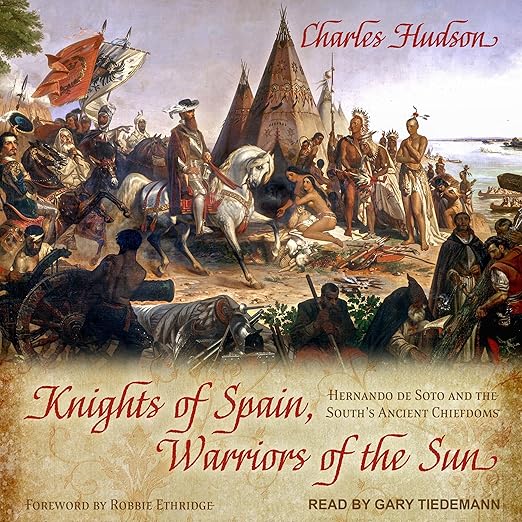
I spent most of a long drive through Virginia listening to Knights of Spain, Warriors of the Sun, and there was something appropriate about covering ground on an interstate that was once, five centuries before, part of the world Charles Hudson reconstructs with such painstaking care. The landscape outside the window had been remade beyond recognition. Hernando de Soto passed through a version of it that no longer exists in any form except in the archaeological record, the Spanish accounts, and Hudson’s synthesis of both.
Between 1539 and 1542, de Soto led a force of several hundred soldiers on a march of nearly four thousand miles across Southeastern North America, from Florida through what is now Georgia, the Carolinas, Tennessee, Alabama, Mississippi, Arkansas, and into Texas. He was looking for gold and glory on the model of the Mexican and Peruvian conquests. He found neither. He died on the banks of the Mississippi River in 1542, a failed and broken man, and his expedition is one of the most significant and least-known events in American history. Hudson’s book, first published in 1997 and now available in this Tantor Audio edition, established the route for the first time by correlating the Spanish accounts with archaeological evidence, and it remains the standard reference.
Our Take on Knights of Spain, Warriors of the Sun
What Hudson brings to this subject that previous historians lacked is the anthropological framework necessary to understand not just where de Soto went but what he found there. The chiefdoms and confederacies of the pre-Columbian Southeast were sophisticated political and social entities, and Hudson reconstructs them from the Spanish accounts, from archaeology, and from his deep knowledge of southeastern Native American cultures. The result is a dual narrative: de Soto’s expedition on one track and the world it passed through and destroyed on the other. One reviewer’s comparison to Stephen Ambrose’s Undaunted Courage in terms of the combination of historical accuracy and readability is apt, and the comparison to Tony Horwitz’s A Voyage Long and Strange captures the book’s appeal to readers who came in through popular history.
The violence of the expedition is not minimized. De Soto and his army killed, enslaved, and spread disease as they moved through the Southeast, confiscating food stores and destroying communities. Hudson documents this with the anthropologist’s commitment to completeness rather than the apologist’s inclination to soften. The greed and brutality are present in the record, and the devastation that followed, the depopulation of the Southeastern chiefdoms by disease and disruption over the following century, is part of what makes this account so melancholy even in its most archaeologically dry passages.
Why Listen to Knights of Spain, Warriors of the Sun
Gary Tiedemann’s narration is steady and clear across a runtime that demands consistency. At over twenty-one hours, this is a significant listening commitment, and Tiedemann’s approach serves the material without calling attention to itself. The book’s blend of genres, narrative history, archaeology, historical geography, and anthropology creates tonal challenges, and Tiedemann handles the shifts between narrative passages and more technical archaeological analysis competently, keeping the listener oriented through the complexity.
The sections where Hudson reconstructs the social and political structure of the chiefdoms de Soto encountered are among the most valuable and least-known parts of the book. Reviewers consistently single these out: the pre-Columbian Southeast is a largely invisible chapter of American history for most general readers, and Hudson’s careful reconstruction of what Moundville, Coosa, and Pacaha looked like as political entities gives the expedition narrative a weight it wouldn’t have if it were only about a group of desperate Spanish soldiers looking for gold.
What to Watch For in Knights of Spain, Warriors of the Sun
Hudson is an academic writing for a wider audience, and the balance tips toward the academic in certain sections. Descriptions of the archaeological evidence for specific route segments, discussions of flora, fauna, and geographic features as navigational confirmation, these passages are important to the scholarly argument but can slow the narrative momentum for listeners who came primarily for the story. One reviewer notes that “when it gets bogged down in describing the flora and fauna and a dry academic narrative takes over,” the reading experience suffers. This is accurate. The book’s excellence is not uniform across its twenty-one hours; some sections require more patience than others.
It’s also worth noting that route reconstructions for the de Soto expedition have been a matter of ongoing academic debate, and Hudson’s reconstruction, while it became standard, has not been without challengers. His work is argued from specific evidentiary bases and is not simply asserted, but listeners should know that some of the specifics remain open to revision in the scholarly literature.
Who Should Listen to Knights of Spain, Warriors of the Sun
Readers who love narrative history with serious scholarship underneath it, think David McCullough when he was working at full stretch, will find this rewarding. Anyone with a specific interest in the history of the American Southeast, in pre-Columbian Native American cultures, or in the Spanish colonial period will find it indispensable. The 21-hour runtime requires the kind of sustained investment you’d bring to a major work of serious nonfiction, not a casual audiobook. Listeners who need constant narrative momentum and won’t tolerate the archaeological passages should probably start with a more popular account of the same events before coming to Hudson.
Frequently Asked Questions
Is Knights of Spain, Warriors of the Sun accessible to readers without academic backgrounds in history or archaeology?
Largely yes, though some of the route reconstruction sections assume familiarity with specific geographic and archaeological terminology. Hudson writes with a general educated audience in mind, and the narrative sections in particular are accessible without specialist knowledge. The more technical passages are in the minority.
How does Hudson use the Spanish eyewitness accounts alongside the archaeological evidence?
The book’s central methodological contribution is correlating the expedition’s route descriptions from surviving Spanish accounts with specific archaeological sites. Hudson treats the two types of evidence as mutually reinforcing, using the archaeology to confirm geographic descriptions in the chronicles and vice versa, and explaining his reasoning throughout so the reader can follow the argument.
Does the book give substantial coverage to the Native American societies de Soto encountered, or is it primarily focused on the Spanish expedition?
Both receive substantial treatment, which is one of the book’s distinguishing qualities. Hudson is an anthropologist as well as a historian, and his reconstruction of the chiefdoms, their political structures, material culture, and the catastrophic impact of the expedition on their survival, is as thorough as his account of the Spanish march.
Is Gary Tiedemann’s narration a good match for this kind of dense historical content?
Yes. Tiedemann narrates with clarity and consistency, which is what a 21-hour work of serious history needs. He doesn’t add dramatic flourish that would feel inappropriate to the scholarly content, but he maintains enough energy to keep the long archaeological sections from becoming genuinely tedious.