
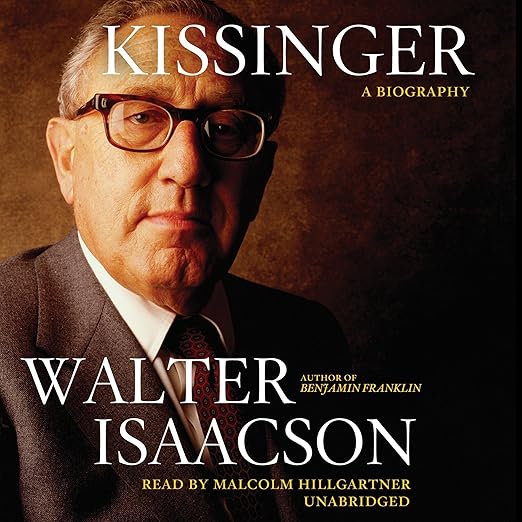
Henry Kissinger topped a 1973 Gallup poll as the most admired person in America, an extraordinary standing for a Secretary of State who was, in that very same period, reviled by liberal intellectuals and conservative activists alike for entirely different reasons. Walter Isaacson opens his account of that contradiction with the access that makes this thirty-four-and-a-half-hour audiobook worth the commitment: extensive interviews with Kissinger himself plus roughly one hundred fifty other sources, including presidents and business clients who rarely spoke this candidly elsewhere.
Where Isaacson's Biography Template Began
This is the biography that established Isaacson's now-familiar template years before he applied the same method to Benjamin Franklin, Einstein, and Steve Jobs: deep, sustained personal access to a difficult, brilliant subject, cross-checked against dozens of independent sources rather than taken at the subject's own word. Kissinger got that treatment first, and the private papers and classified memos Isaacson draws on give the book real archival weight beneath the interview material.
The arc Isaacson traces runs from a childhood as a persecuted Jew in Nazi Germany, through the defining, tortured partnership with Richard Nixon, and out the other side into decades as a globe-trotting business consultant trading on the very access and reputation his government years built. That full-circle structure, refugee to power broker to consultant monetizing his own former power, is the book's real spine underneath the individual episodes of diplomacy and controversy.
Reviewer Delta D. calls it 'comprehensive, balanced and decidedly readable,' while noting that the book makes room for readers to decide for themselves whether Kissinger's effect on people reflected staggering intellect, considerable charm, a real capacity for manipulation, or some mixture of all three. That refusal to hand down a tidy verdict is a deliberate choice, not an evasion, and it suits a subject this contested.
Just a Surname, No Subtitle at All
Two of the defining episodes any Kissinger biography has to reckon with get full treatment here: the secret diplomatic opening to China that led to Nixon's historic 1972 visit, and the Paris negotiations that ended direct American involvement in Vietnam. The second of those earned Kissinger a Nobel Peace Prize in 1973, an award so controversial at the time that two members of the Nobel committee resigned over it, and Isaacson doesn't shy away from walking through exactly why that controversy was justified as well as what the diplomacy actually achieved.
The book's own title is tellingly spare: just the surname, no explanatory subtitle promising a secret history or an untold story. That restraint matches Isaacson's actual method here, letting the documented record carry the weight rather than a marketing hook.
Hillgartner's Thirty-One Hours on Joseph Kennedy
Malcolm Hillgartner has a strong track record with exactly this kind of extreme-runtime, high-stakes political biography elsewhere, sustaining authority across nearly thirty-one hours on Joseph P. Kennedy without losing tonal control, and bringing disciplined, unflashy delivery to dense geopolitical narrative that avoids the flat lecture register academic history narrators often fall into. Reliability over sheer runtime is exactly the skill a thirty-four-hour listen like this one demands.
Reviewer Howard Schulman raises a genuinely useful framing question: the book was published in 1992, and more information has surely come out in the decades since. He also identifies the real trade-off directly: in 1992, many of the book's key figures 'were still alive and available,' a kind of contemporaneous access no later biography of the same events could replicate.
Two Contradictory Truths, Never Resolving
The scale of sourcing, Kissinger's own extended cooperation plus roughly one hundred fifty additional interviews, gives the narration genuine texture rather than a single authorial voice asserting conclusions. Listening to that range of perspective accumulate across thirty-plus hours is a different experience than reading a shorter, more thesis-driven account of the same career.
The book's real achievement is holding two contradictory truths about the same man in view simultaneously without resolving them into a single verdict: genuine diplomatic brilliance that reshaped Cold War geopolitics for a generation, and a documented willingness to deceive allies and prioritize geopolitical maneuvering over the human cost of specific decisions. Hillgartner's steady, unflashy delivery gives both sides equal narrative weight rather than editorializing toward either one.
A 4.4 rating from 765 ratings is a genuinely strong result for a biography this demanding, a format where listener fatigue typically drags average scores down well before the finish. That consistency across such a long runtime is real evidence the book sustains its quality rather than front-loading its best material into the opening hours.
Stops Decades Before His 2023 Death
This audiobook was published in 1992 and covers Kissinger's life only up through his early consulting years; it does not, and cannot, address the roughly three additional decades of public life, controversy, and eventual death in 2023 that followed. Listeners wanting a complete-life retrospective should know upfront this is a portrait of a man still very much in the middle of his story.
Reviewer Delta D. also flags a real structural weakness: excessive micro-detail on internal turf wars and bureaucratic infighting that can slow momentum for listeners more interested in the broader arc than in granular Washington power-struggle mechanics. That criticism is specific and fair rather than a vague complaint about length.
At thirty-four hours and thirty minutes, this is a genuinely demanding commitment even within the long-biography category, and Isaacson's approach to Kissinger is denser and more archivally focused than the breezier, more narrative-forward style he would develop in his later, more famous books. Listeners new to Isaacson specifically should know this earliest major biography reads as the more academically rigorous entry in his catalog.
Listeners specifically interested in the China opening or the Vietnam endgame as standalone historical episodes should know this book folds both into a much larger cradle-to-consulting-career biography rather than treating either as a self-contained set piece; a listener wanting a tighter, single-episode account of either event specifically may find a narrower book on that topic alone more satisfying than this book's full sweep.
Given the runtime, this is much better suited to sustained, session-based listening, a chapter or two at a stretch over several weeks, than to a single marathon attempt; Hillgartner's steady pacing rewards that kind of return visit rather than punishing listeners who need to step away and come back.
His Later Books Make a Gentler Entry
Readers of serious Cold War and foreign policy history will find the sourcing depth here genuinely rewarding, especially anyone who wants Kissinger's polarizing reputation examined rather than either celebrated or dismissed outright.
Listeners who already admire Isaacson's later, more famous biographies and want to hear where his method actually started will get real value from watching that template take shape here, extensive access plus independent cross-checking, in its earliest full application.
Skip it, or at least deprioritize it, if you want a single, up-to-date account of Kissinger's entire life including his final decades and 2023 death, or if thirty-four hours of dense, archivally grounded political history sounds like more commitment than the payoff justifies; Isaacson's later, more accessible biographies make a gentler entry point into his style.







