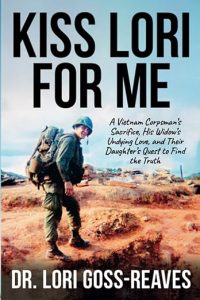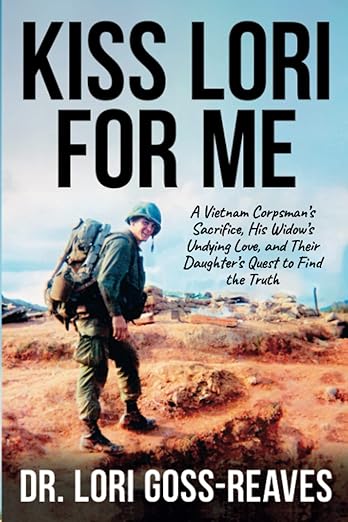
Valentine's Day 1968 is the date this audiobook turns on, and the particulars are worth having before you press play. Kilo Company 3/9 left Ca Lu on a combat patrol. Marines scaled a ridge, the North Vietnamese Army attacked, and eleven men died there, ten Marines and Senior Corpsman HM2 Larry Jo Goss, with two more Marines dying afterward. Larry's body lay in the jungle for twenty-one days. His wife Marty was told only that he was missing and possibly held, and she waited with their six-month-old daughter for news that never arrived. The daughter's name was Lori Jo, and she is the person reading this to you.
Closer to Testimony Than to Narration
Marty's twenty-one days are the stretch most books would summarize in a sentence, and Goss-Reaves refuses to. Being told your husband is missing and possibly in enemy hands is a different order of grief from being told he is dead, because it arrives with a job attached: hope, maintained daily, on no information whatsoever. She was young, she had an infant on her hip, and the news she was waiting for had already happened three weeks earlier. The response that reads the book as a family portrait says the finished thing makes you 'feel like you know the family,' which is accurate, because the marriage gets rebuilt in as much detail as the battle does.
Goss-Reaves performs the book herself, and on this title that is not a budget decision. The infant named in the description and the voice in your ears are the same person separated by more than fifty years, which puts the recording closer to testimony than to narration. It also creates the one thing worth flagging in advance: a reader whose subject is her own father's death is doing something other than a job of work, and buyers who want emotional distance from this material will not be getting it from the casting.
Two of Five Posts Call It Valentine Ridge
Corpsman is the word that should set expectations. One response, written by a reader whose own father died a few miles from that ridge to save a Marine brother, spells out what the job was: Goss served with Kilo Company, 3rd Battalion 9th Marines, as their Doc, a Navy corpsman. That means moving toward wounded men while the shooting continues, as routine rather than as heroism. The ridge itself carries a name the publisher's copy never uses. Two of the five posts on this page call it Valentine Ridge, after the date, and that naming tells you how the survivors have carried the thing since.
Cross-referencing is the method, and one response grades it the way a colleague would. That reader lists the raw material, personal accounts, letters, journal entries, after action reports and command chronicles, then observes that the fog of war stops any single one of them from telling the whole story. The book's answer is to gather enough of them to triangulate. That is a historian's procedure rather than a memoirist's, and it is why the battle chapters can be trusted in a way that a grieving daughter's recollection on its own could not be.
Veterans supplied everything the documents could not, and collecting it took decades. Two trips to Vietnam, and long conversations with men who had been on that ridge, are the elements that separate this from the shelf of family memoirs about the war. Each of those conversations ran against a deadline nobody named aloud, since the men who could answer were old by the time the questions reached them. Whatever else this edition lacks, it holds first-hand testimony that cannot be gathered a second time, and that alone earns it a place in the record.
414 Pages Cannot Fit in Two Hours
Paperback is the format this record keeps describing. The identifier attached to it is a ten-digit ISBN. A thirteen-digit ISBN sits beside that. The page count reads 414. The description announces in capitals that the book is now available in full color paperback, and the blurb above it, from a retired Army colonel, carries an uncorrected typo. And then the runtime says two hours and five minutes. Four hundred and fourteen pages do not fit inside two hours of speech at any pace a person can sustain, which means this page is describing two different products stacked on each other.
Photographs are the real casualty. A full color edition of a book about a man most listeners have never seen means images, and a project assembled from letters, documents and two journeys to Vietnam will have had a great deal to show. None of it travels into audio, and no companion document is promised anywhere here. The response that bought the full color version says the pictures help bring the story to life, and praises 'the authors voice in telling this story,' meaning the writing rather than the recording, since that reader was holding paper. Anyone who wants the images should budget for both formats.
No Comfortable Distance From a Hired Professional
Descendants of men who did not come home are the obvious audience, and this will be difficult for them in the way that useful books are difficult. The response urging a wider readership makes the case well, recommending it to anyone regardless of military ties on the grounds that the real subject is how love shown through words, emotions and touch changes a life. That balance is right. The war is the occasion. The subject is a family that had to be reassembled out of paperwork because the man it revolves around died before his daughter was old enough to remember him.
Sacrifice is a word this material has earned and the packaging leans on hard, so here are the three things that should stop a purchase. The first is the runtime measured against that page count, which anyone expecting the complete text needs to settle before paying. The second is the images, which do not exist in audio in any form. The third is proximity: a daughter is reading her own father's death aloud, and nobody should arrive here hoping for the comfortable distance that a hired professional would have supplied.
Frequently Asked Questions
Is this audiobook abridged?
Nothing on the page says either way, which is the problem. A recording this short alongside an advertised 414-page book raises the question, and no note settles it. Anyone who needs the complete text should confirm with the publisher before buying, or work through the chapter list in the sample and compare it against the printed contents.
How graphic does the battle material get?
Specific rather than spectacular. The copy names a ferocious attack, eleven dead on the ridge with two more afterward, and a body left in the jungle for three weeks. Because the account is built from documents and survivor interviews rather than imagination, the detail lands with weight and never reads as staged.
Does the audiobook cover the trips to Vietnam, or only the 1968 battle?
Both, and the search is the spine of the thing. The description frames it as a decades-long effort to find her father's comrades and the truth about his death, requiring two journeys to Vietnam and many long conversations with veterans of the fight. The battle is what gets reconstructed; the searching is what you follow.
Is this military history or family memoir?
The record refuses to choose, filing it under biographies and memoirs, history, and relationships and parenting at once, with a Military and War tag attached. That triple listing is honest. Readers arriving for unit history will get a marriage, and readers arriving for a memoir will get after action reports.