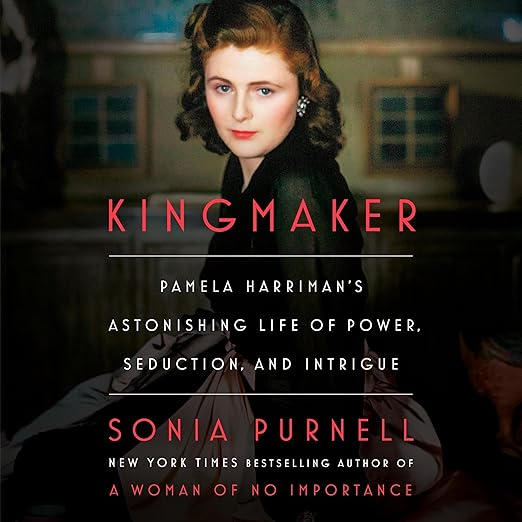
A downloadable PDF of photographs ships with this audiobook, and the description flags it with an asterisk at the very bottom of the copy, the way a footnote handles an inconvenience. Pamela Harriman's life through images, it says. Which raises the obvious question about a nearly seventeen-hour biography of a woman whose power was built on rooms, dinners, clothes and proximity: how much of the argument depends on seeing her? Sonia Purnell wrote about a person who was constantly looked at and rarely listened to, and Penguin Audio has handed you the looking as a separate file.
Courtesan, Social Climber, and a Five-Decade Career
Pamela Churchill Harriman died in 1997, and the obituaries, the description says, were predictably scathing and many of them downright sexist. Courtesan. Social climber. The premise of the book is that those two words did a job, papering over a five-decade career that ran through World War II, postwar Italy and the Democratic party in the United States. Her file, in other words, was written by people who had decided in advance what she was. At twenty she was Winston Churchill's daughter-in-law and, in Purnell's framing, a secret weapon, wining and dining and seducing diplomats and generals to pull American sentiment and American secrets toward the British side against Hitler.
Purnell's claims escalate from there, and they escalate fast. After the war, the copy says, Harriman helped turn Fiat heir Gianni Agnelli into Italy's uncrowned king on the international stage. Then she moved to the United States, revived a struggling Democratic party and picked Bill Clinton out of obscurity. Then, as Ambassador to France, she worked on the effort to bring peace to Bosnia. Each of those sentences is a book in itself, which is the first thing to understand about how nearly seventeen hours gets spent.
Sixteen hours and fifty-eight minutes is the stated runtime, and two of the five written responses push back on exactly that. Mobistar calls it well researched and overall well written, then adds that it came with some lengths that could have been done without. Moises Medina is blunter: very readable, yes, though it goes into a lot of minutia and many uninteresting details. Neither dropped below four stars for it. That combination, admiration plus fatigue, is the most useful signal this column produces.
A Review of Her Death Stops Mid-Word
The warmest entry comes from Amazon Customer, who reads it as a detailed and affecting view of a remarkable woman, singles out her contribution to US and European politics, and records that she was awarded France's highest honor. That review then reaches for the passage describing Harriman's death and calls it the saddest and most powerful wri, at which point the text stops mid-word and the sentence never arrives. Anyone who wants to know what the ending does with her is left holding a fragment.
Every name in the description is one you already know, which is either the appeal or the problem. The Kennedys. Truman Capote, Aly Khan, Kay Graham, Gloria Steinem, Ed Murrow, Frank Sinatra. Purnell's case is that Harriman touched all of them and that almost no one in twentieth-century politics, culture and fashion escaped her orbit. A biography built that way risks turning into a guest list. The counterargument, and the reason to spend the credit, is that proximity was the instrument she actually used, so the guest list is the evidence.
Two of the entries read like working historians whatever their day jobs are. Dr. Roy Schreiber, writing in October 2025, spends the visible portion of a four-star review building context instead of judging the book: through much of the twentieth century in Great Britain and the U.S., women were systematically excluded from political and financial power, with Margaret Thatcher among the few exceptions. Bright, ambitious women exercised influence through a husband. Woodrow Wilson's wife, Eleanor Roosevelt, and Clementine Churchill doing the same on the other side of the Atla, where the body runs out.
One Reader, One Accent Inventory, Seventeen Hours
Both truncated entries point at the same thing from different angles. This is a book about the mechanics of indirect power, which means the seduction is presented as method and not as scandal. The description leans hard on sex, politics, yachts, palaces and fabulous clothes, which is a publisher selling glamour, and Schreiber's framing is the corrective sitting right underneath it. Go in wanting the erotic adventures the obituaries fixated on and you will get them, wrapped in five decades of fundraising, committee work and diplomacy.
Twice now I have mentioned that PDF, and it earns one more line, because it is the only piece of information on this listing specific to the recording itself. A photographic supplement is a genuine asset for a book like this and a genuine friction for anyone listening in a car. Louise Brealey is credited alone for a cast of dozens, British and American and Italian, spanning Churchills, Kennedys, Agnellis, presidents and ambassadors. One reader, one accent inventory, close to seventeen hours of it. Whatever the recording does with that, it is doing it without a colleague to hand a scene to.
Nobody listening gets a map, and a book this crowded needs one. Purnell moves between wartime Britain, postwar Italy, a party apparatus in the United States and an embassy in France across five decades, and expects you to keep the cast straight with no family tree in reach. The photo file may help with faces. It will not help with the Churchills, of whom this story has more than one, or with telling a wartime fixer apart from a postwar ambassador. Seventeen hours is a long stretch to spend quietly lost.
An Obituary Corrected Three Decades Later
Political history readers are the obvious audience, particularly anyone drawn to the machinery working behind elected men. So is anyone who reads biographies of women written out of the record, since the premise here is an obituary being corrected nearly three decades after it ran. Readers who found Purnell through A Woman of No Importance will recognize the approach, because the copy sells this one on fresh research, new interviews and newly discovered sources, not on reinterpretation alone.
It is the wrong sixteen hours for anyone who wants a tight narrative line, since two reviewers have already flagged the minutia and the lengths, and a life this crowded resists compression. It is also the wrong purchase if you listen exclusively at the wheel, because the photographic supplement is part of what you are paying for and you cannot open it at speed. Budget seventeen hours and keep the PDF within reach.
Common Questions
How do I get the PDF that comes with the Kingmaker audiobook?
An asterisked line at the foot of the description promises a downloadable file of Pamela Harriman's life through images. Where that file actually lands depends on the retailer and the app you play it in, and this page explains none of that mechanism. Expect to go looking for it once you have bought the title.
How much of the Kingmaker audiobook covers the Clinton years?
No chapter breakdown is given, and the political material is one strand out of five decades. Harriman is presented as reviving the Democratic party and picking Bill Clinton out of obscurity, then serving as Ambassador to France and working toward peace in Bosnia. Two reviewers call parts of it overlong, which suggests generous coverage throughout.