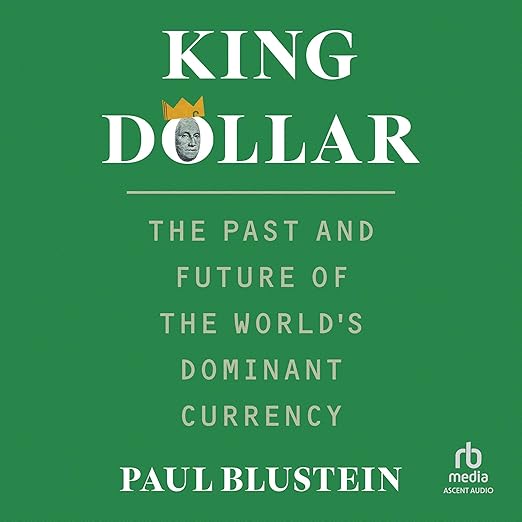
Quick Take
- Narration: David Stifel delivers Blustein’s arguments with measured authority, steady, credentialed, well-paced for dense economic material.
- Themes: Dollar hegemony, geopolitical finance, currency sanctions as foreign policy tools
- Mood: Authoritative and sobering, like a policy briefing that actually holds your attention
- Verdict: A well-researched case for why the dollar isn’t going anywhere, honest about what that power demands of American policymakers.
I started listening to King Dollar on a Tuesday morning when headlines were once again predicting the imminent collapse of dollar dominance. Bitcoin was surging. Someone on cable news was explaining the renminbi. I put in my earbuds, opened the app, and let Paul Blustein’s careful, journalist-trained voice wash over the noise. Twelve hours and forty-two minutes later, I had a significantly clearer picture of why those headlines tend to be wrong, and a more honest understanding of what the dollar’s staying power actually costs.
Blustein is an award-winning economic journalist, and that background shows in how he structures the argument. This isn’t a cheerleading book. He takes the doomsayers seriously before dismantling their claims one by one: Bitcoin, the renminbi, the erosion of confidence from mounting US debt. He’s not dismissive. He’s precise. And that precision is what gives King Dollar its credibility.
Our Take on King Dollar
Blustein’s central thesis is that the dollar’s position atop the world’s currency pyramid is effectively impregnable, barring catastrophic policy failures by Washington itself. That’s a more nuanced claim than it might first appear. He’s not saying the dollar is invincible. He’s saying that nothing currently on the horizon can dislodge it, and that the greatest threat to greenback supremacy comes from domestic choices, not foreign competition. One reviewer called the coverage “encyclopedic,” and that word fits. Blustein traces how the US has deployed the dollar as a weapon through sanctions, against Russia, against Iran, and why those financial tools retain their bite even as targets scramble to build workarounds.
The sanction chapters are genuinely revelatory. The book’s account of how Russia attempted to limit dollar-denominated exposure after 2014 is both fascinating and instructive: the workarounds exist, they have some effect, but they haven’t neutralized Washington’s leverage. Blustein explains the structural reasons why replacing dollar clearing networks is far harder than it sounds on a think-tank whitepaper.
Why Listen to King Dollar
Because the financial media is full of takes on this subject, and most of them are either alarmist or dismissive, shaped by whoever is selling gold coins or arguing for crypto. Blustein belongs to neither camp. His journalism background means he interviewed the people who actually run these systems, central bankers, Treasury officials, economists who study reserve currency dynamics for a living. The result is a book grounded in reporting, not ideology. For anyone who wants to understand the architecture of global finance without having to read an academic journal, this is the most efficient path I’ve found.
David Stifel’s narration suits the material. His delivery is composed and unhurried, which is exactly what you need for a book that asks you to hold multiple geopolitical and monetary variables in mind simultaneously. He doesn’t dramatize. He informs. A few reviewers noted that the book’s coda felt politically slanted in one direction or another, Blustein’s final section criticizing certain policy directions drew both praise and frustration depending on the reader’s priors. I’d flag that the closing chapters are more polemical in tone than the main body, which is worth knowing before you sit down to listen.
What to Watch For in King Dollar
The book was largely written before the start of certain new political dynamics, and some reviewers felt that the final sections underplayed specific fiscal risks and focused too narrowly on partisan critique. That’s a fair observation. Blustein’s expertise is clearly in international monetary economics, and when he ventures into domestic political judgment, the book is less authoritative than when he’s explaining swap line mechanics or the history of petrodollar recycling. If you’re coming to this for geopolitical and monetary analysis, you’ll find plenty. If you’re hoping for a balanced accounting of the full range of domestic risks to dollar credibility, you may finish the book feeling that some threads were left unexamined.
One reviewer with significant finance experience noted the book “gives the history of why the dollar cannot be easily replaced” while flagging that the summary section “downplays the risks.” That’s a reasonable tension. Blustein’s optimism about dollar durability is evidence-based, but the word “impregnable” is doing a lot of work in the thesis, and the coda’s political framing may frustrate readers who wanted the same rigor applied to both sides of the domestic debate.
Who Should Listen to King Dollar
This audiobook is well-matched to listeners who want a substantive, reported account of how dollar hegemony actually functions, the mechanics of reserve currency status, the history of the Bretton Woods system, the role of SWIFT and dollar-denominated commodity markets. It’s written for a general educated audience, not for economists, and Blustein has genuine skill at making complex systems accessible. If you regularly read the financial pages but have wanted a deeper framework for understanding headlines about de-dollarization, this delivers that. Listeners who prefer their economics politically neutral throughout, rather than analytically rigorous for most of the book and more pointed in the conclusion, may want to approach the final section with that in mind.
Frequently Asked Questions
Does Paul Blustein’s journalism background affect how the argument is structured?
Yes, noticeably. Rather than building a purely theoretical case, Blustein works from reported evidence, central bank decisions, sanction outcomes, interviews with practitioners. The result reads more like deep-dive journalism than an economics textbook, which makes it accessible without sacrificing rigor.
Does the book take the Bitcoin or renminbi threats to the dollar seriously?
It takes them seriously enough to address each one carefully before explaining why neither poses a near-term existential challenge to dollar dominance. Blustein’s dismissal of these alternatives is evidence-based, not dismissive.
How does David Stifel handle the density of the economic material?
Well. Stifel narrates at a composed, measured pace that gives the listener time to process complex arguments without making the book feel slow. He doesn’t editorialize or overdramatize, the tone matches the journalistic register of the text.
Is the book’s political framing a significant issue for general readers?
The main analytical body of the book is largely balanced. The final section, which several reviewers flagged, is more pointed in its political observations. If you’re listening primarily for monetary economics, this won’t undermine the core value. If you’re politically sensitive, it’s worth knowing the coda exists.