O'Reilly Reads the Way He Talks
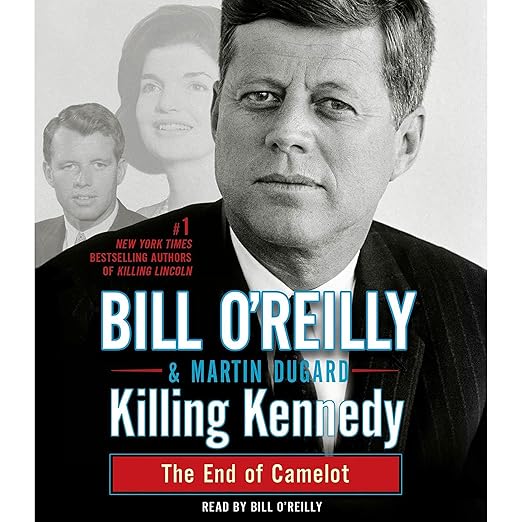
Bill O'Reilly narrating his own historical nonfiction is a particular kind of listening experience. He reads the way he talks, which means the audiobook has the cadence of a news anchor , brisk, confident, inclined toward declarative sentences , rather than the more measured pace of a literary narrator. For a book about the Kennedy assassination, a subject that has accumulated decades of competing theories and emotional freight, that directness turns out to be an asset. O'Reilly does not linger in ambiguity. He moves. The result, across 8 hours and 25 minutes, is a portrait of John Fitzgerald Kennedy and the forces that killed him that reads , or rather plays , like narrative history at its most propulsive.
The book is the second in O'Reilly's 'Killing' series, following Killing Lincoln, and it covers both the arc of Kennedy's presidency and the parallel story of Lee Harvey Oswald's radicalization and trajectory toward Dallas. One reviewer called it 'a page turning time machine,' noting that it covered Kennedy's 'rise from childhood to the Navy' and everything through the assassination. Another called it an 'objective history' told 'in extremely readable form.' The audio version translates that readability directly into listenability.
A Clipped, Clinical Register Just for Oswald
The structural approach here is what separates this from more conventional JFK books. O'Reilly runs two narrative threads simultaneously: Kennedy's life inside the White House, with the Cold War pressures, the Bay of Pigs fallout, the affair with Marilyn Monroe, the growing list of enemies from Khrushchev to the CIA's Allan Dulles to organized crime; and Oswald's story, told with the same level of scene-setting detail and moving on an independent clock toward November 22, 1963.
Both threads benefit from audio. O'Reilly reads the Oswald sections with a different register than the Kennedy sections , slightly more clipped, more clinical , and the contrast creates a structural rhythm that the book's intercut chronology amplifies. When the two threads finally converge in Dallas, the effect is genuinely cinematic. One reviewer noted that it 'held my attention' and was 'read in one afternoon' , a claim the audiobook makes equally plausible across a long drive or an extended listening session.
O'Reilly's editorial perspective is present but not intrusive. He has opinions about Kennedy's character, Oswald's psychology, and the decisions that led to the assassination, and those opinions surface in word choices and emphasis. Listeners who want pure detachment will notice them. Listeners willing to take an informed, invested narrator will find that O'Reilly's investment in the story makes it more compelling rather than less.
Neither Dismantles Camelot Nor Accepts It Whole
This is popular history, not academic history. O'Reilly writes for a general audience and the book does not engage with the historiographical debates around the assassination at any depth. If you want a thorough examination of alternative theories about a potential conspiracy, this is not your source. O'Reilly accepts the Warren Commission's conclusion and builds his narrative within that framework. This is made clear in the book's approach rather than stated as a limitation, but it is a meaningful constraint depending on what you are looking for.
The self-narration also means that O'Reilly's vocal patterns , the dropped endings, the punchy paragraph breaks, the occasional rhetorical acceleration , are in the foreground throughout. Listeners who find his broadcast style grating will likely feel that way here. Those who find it effective will have that effectiveness amplified.
The chapters covering Kennedy's first year in office are the richest in the book. O'Reilly gives real texture to the Cold War pressures of 1961: the Bay of Pigs disaster, the Vienna summit with Khrushchev, the calculation and miscalculation of a young president who came in with confidence and learned, quickly, what confidence costs without the experience to back it. Oswald's parallel thread in these same years tracks a man whose grievances are hardening into ideology, whose sense of historical significance is looking for an object. The two threads move on separate tracks at different speeds, but both accelerate visibly as November 1963 approaches.
O'Reilly's handling of the Camelot mythology is one of the book's more interesting choices. He neither dismantles it nor accepts it uncritically. Kennedy's affairs, his pain management, the political calculations that shaped his public persona: all of these appear in the narrative without becoming the story. O'Reilly seems to have decided that Kennedy's complexity makes the loss more significant rather than less, and the audiobook is built on that conviction. The man who dies in Dallas at the end of this account is someone the listener has spent eight hours coming to understand, which is the effect good narrative history achieves and this recording delivers.
The book's treatment of the Warren Commission conclusion warrants a brief note for listeners interested in how popular history handles contested ground. O'Reilly does not spend significant time on alternative theories, which some listeners will find a relief and others will find a limitation. His focus is on the people and the events rather than on the epistemological debate around what we can know about them. For the purpose of narrative history, this is a defensible choice. For listeners who specifically want a book that engages with the conspiracy literature, this is the wrong source, and knowing that in advance lets you enter the audiobook on the right terms.
Confident Popular History for Long Drives
This audiobook fits listeners who want the Kennedy story as cinematic narrative rather than scholarly investigation. Readers who found Killing Lincoln compelling will find the same approach applied here with comparable skill. It works especially well for long drives, commutes, or any listening context where momentum matters , O'Reilly's pacing keeps the story moving without sacrificing the atmospheric details that make the era feel inhabited rather than just documented.
Approach it as what it is: confident popular history told by someone who knows how to keep an audience and who has done substantial research without letting the research slow the story. On those terms, it delivers.
Before You Press Play
- Read by: O'Reilly self-narrates with the confidence and cadence of a broadcast anchor , brisk, declarative, invested , which suits the material's drive better than a neutral voice would.
- At its heart: The Cold War pressures of the Kennedy presidency, Oswald's radicalization, the mythology of Camelot
- Vibe: Fast-moving and cinematic, popular history at full pace
- Short version: O'Reilly's self-narration transforms this into genuinely compelling audio history , best consumed on a long drive or in a single extended session.
Common Questions
Does the audiobook take a position on whether Oswald acted alone?
Yes. O'Reilly accepts the Warren Commission's lone gunman conclusion and builds the entire narrative within that framework. The book does not seriously engage with conspiracy theories, so listeners looking for alternative accounts of the assassination will need to look elsewhere.
How does the audiobook handle the two parallel storylines of Kennedy and Oswald?
O'Reilly runs them simultaneously through an intercut chronology, and his self-narration differentiates the two threads with subtle shifts in register. The Kennedy sections carry more gravity; the Oswald sections are clipped and clinical. The convergence in Dallas benefits from this structural contrast.
Is this audiobook appropriate for listeners who already know the Kennedy assassination story well?
Yes, though it functions best as narrative rather than new research. O'Reilly synthesizes a large amount of documented history into a compelling story, and the audio format makes even familiar events feel immediate. Specialists may find the lack of scholarly apparatus frustrating, but general listeners who know the broad outline will still find the texture of the period vivid.
Does the Bill O'Reilly's Killing series need to be listened to in order?
No. Each book in the series is self-contained with its own subject. Killing Kennedy stands fully alone without prior knowledge of Killing Lincoln or the other volumes. Some listeners find reading Lincoln first gives useful context for O'Reilly's narrative approach, but it is not necessary.