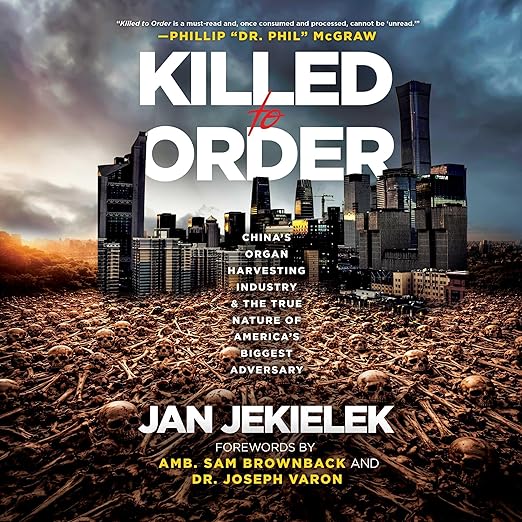
Quick Take
- Narration: Steve Quinn delivers the investigative material in a clean, journalistic style that suits the documentary register Jekielek is aiming for.
- Themes: State-sanctioned organ harvesting, CCP accountability, the limits of Western engagement with authoritarian regimes
- Mood: Disturbing and purposefully confrontational, the kind of content that stays with you
- Verdict: An important subject pursued with genuine urgency, though readers should enter knowing the author’s institutional background and factor that into their assessment.
There are books you read because you want to, and there are books you read because you believe you should. This one falls into the second category, and I want to be clear about that upfront. Forced organ harvesting from prisoners of conscience is not comfortable subject matter, and Jan Jekielek does not attempt to make it so. What he attempts is to make the case that it is real, that it is ongoing, and that Western governments and institutions have systematically underestimated or ignored it.
Jekielek is a senior editor at the Epoch Times and host of the American Thought Leaders program, which places him within a particular editorial tradition. The Epoch Times has well-documented ties to the Falun Gong spiritual movement, and one reviewer called this out directly, noting that the book’s frequent references to Falun Gong practitioners as the primary victims of organ harvesting come across as politically driven rather than objective. That is a legitimate observation, and anyone approaching this book should know it going in. It does not automatically invalidate the underlying reporting, but it is context that matters.
Our Take on Killed to Order
The core claims of the book are not Jekielek’s alone. Independent investigations by David Kilgour, David Matas, and Ethan Gutmann beginning in the mid-2000s established a substantial evidentiary record for forced organ harvesting from Falun Gong practitioners and, more recently, from Uyghur populations. The China Tribunal in London, an independent citizens’ panel, concluded in 2019 that forced organ harvesting had been committed with certainty on a substantial scale. Jekielek is writing within this documented record, not inventing it.
Where the book works best is in its structural argument: that this specific human rights crisis offers a window into the broader nature of the CCP as an institution. Jekielek is not simply cataloguing atrocities; he is arguing that how you respond to this information has downstream consequences for how you engage with China across every other domain, trade, technology, diplomacy. The organ harvesting question becomes a test case for whether the free world is willing to look clearly at what the CCP actually is and does.
Why Listen to Killed to Order
Steve Quinn narrates with the controlled, matter-of-fact delivery appropriate to serious investigative content. The material is disturbing enough that any hint of sensationalism in the narration would be deeply counterproductive; Quinn avoids that trap. His pacing is even, which allows the weight of individual testimonies and documented cases to accumulate without feeling manipulated.
At seven hours and forty-nine minutes, the book is substantial enough to develop its argument properly without feeling padded. Jekielek moves from the specific horror of organ harvesting to the broader geopolitical implications in a way that rewards listeners who engage with the full arc rather than the opening chapters alone.
What to Watch For in Killed to Order
The critical one-star review included with this edition alleges that the writing reads as AI-generated and comes across as propaganda. The first charge is difficult to evaluate without access to the full text; the second reflects a genuine tension that attentive readers will need to navigate themselves. Jekielek is an advocate with a clear institutional perspective, and this book is advocacy journalism rather than neutral analysis.
Listeners who want the most rigorous and institutionally independent documentation of forced organ harvesting should read the Kilgour-Matas-Gutmann reports alongside or instead of this book. Jekielek’s contribution is more accessible and argumentatively broader, which is both its strength and its limitation.
Who Should Listen to Killed to Order
Readers with serious interest in China policy and human rights who want a readable synthesis of the organ harvesting evidence and its geopolitical implications. Listeners who follow Jekielek’s American Thought Leaders program will find this a natural companion. Approach with awareness of the Epoch Times context. Not recommended for listeners seeking institutional neutrality or a purely academic treatment of the subject.The subject deserves serious engagement regardless of where the reader lands on questions of media objectivity, and Jekielek’s accessible writing style ensures that engagement is available to anyone willing to bring their own critical faculties to the experience.
Frequently Asked Questions
What is Jan Jekielek’s institutional background and how does it affect the book?
Jekielek is a senior editor at the Epoch Times, which has documented ties to the Falun Gong spiritual movement. Falun Gong practitioners are prominent among the identified victims of forced organ harvesting, which creates a potential conflict of interest that readers should weigh. The underlying facts the book describes are corroborated by independent investigations, but Jekielek’s framing carries his institutional perspective.
Are the claims about forced organ harvesting in China corroborated by independent sources?
Yes. The China Tribunal, an independent citizens’ panel in London, concluded in 2019 that forced organ harvesting from prisoners of conscience had been carried out at scale. Researchers David Kilgour, David Matas, and Ethan Gutmann have produced substantial documented reports. Jekielek draws on this existing record while adding his own reporting and framing.
Is this book suitable for someone unfamiliar with CCP human rights issues?
Jekielek writes accessibly for general readers rather than policy specialists. The book provides sufficient context to be followable without prior deep knowledge of China policy, though some background in the Uyghur and Falun Gong situations will help readers evaluate the sourcing more critically.
How does this book compare to other recent CCP-critical titles like Hidden Hand or Stealth War?
Killed to Order is more specifically focused on organ harvesting as both a human rights issue and a lens for understanding the CCP, while books like Hidden Hand and Stealth War take a broader approach to CCP influence operations. They address overlapping territory but from different angles of inquiry.