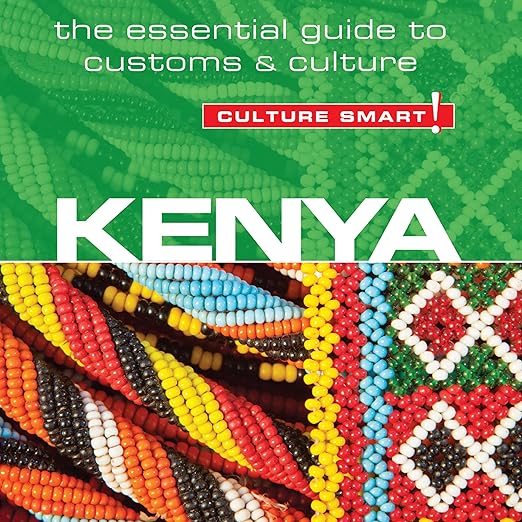
Quick Take
- Narration: Peter Noble reads the compact text cleanly and accessibly, matching the guide’s practical tone without over-dramatizing cultural anecdotes.
- Themes: Social etiquette and cross-cultural communication, Kenya’s ethnic and political complexity, business and travel protocol
- Mood: Compact and informative, friendly in register
- Verdict: A solid orientation guide for first-time Kenya visitors or anyone preparing for professional engagement with Kenyan counterparts – useful but intentionally brief.
I have a particular affection for the Culture Smart! series because it does something most travel guides avoid: it talks about social failure before it happens. Most guidebooks tell you where to eat and sleep. Culture Smart! books tell you what you are likely to get wrong and why it matters. I listened to the Kenya edition a few evenings before I was due to brief a colleague heading to Nairobi for the first time, and it gave me sharper, more specific material to pass along than anything I might have assembled from general search results.
Jane Barsby covers the landscape efficiently across just under four hours of listening. Kenya’s ethnic composition, the legacy of British colonial structures, the role of religion, attitudes toward time and hierarchy in professional settings, the protocols around visiting someone’s home, how to navigate rural versus urban social contexts. It is not a deep ethnographic study, and it does not pretend to be. What it offers is the kind of cultural map that helps a visitor stop making the same reflexive assumptions they make in familiar settings.
Our Take on Kenya – Culture Smart!
What Barsby handles particularly well is Kenya’s internal diversity. Kenya is not a monolithic culture, and the book resists treating it as one. The country has more than forty ethnic communities, and Barsby marks the meaningful differences in social practice and expectation across several of them without flattening the complexity into a single behavioral prescription. One reviewer showed the book to two Kenyan friends who confirmed its major points while noting, correctly, that no single account can characterize all Kenyans. The book itself makes that disclaimer, which is the honest approach.
The sections on business culture are particularly useful for professional travelers. Hierarchies matter in many Kenyan business contexts, decision-making may involve more consultation than a Western counterpart expects, and the pace of relationship-building before transacting is often slower than Northern European or American norms. These observations are not exotic curiosities; they are practical intelligence for anyone going into a professional relationship without this background.
Why Listen to Kenya – Culture Smart!
Peter Noble reads with the kind of warm authority that fits a cultural guide well. He is clear without being clipped, engaged without being performative. The material does not call for dramatic narration, and Noble sensibly does not attempt any. At under four hours, this is a listening project that can be completed in a single evening or across two commutes, which suits the practical orientation it offers.
The audiobook format works particularly well for the etiquette sections, where the information flows best as continuous guidance rather than a bulleted reference. Hearing social protocols explained in connected sentences, with the reasoning behind them, helps them stick better than scanning a list of dos and don’ts. One reviewer who was preparing for a group trip to Kenya the following year found it a useful and largely accurate orientation, and recommended it to fellow travelers.
What to Watch For in Kenya – Culture Smart!
The brevity that makes this guide useful also limits it. One reviewer noted it is very basic. That is accurate and intentional. If you are already familiar with Kenya and are looking for nuanced analysis of contemporary Kenyan society, politics, or regional variation, this will not satisfy you. The cultural observations are necessarily broad, and the advice tends toward the cautious and general rather than the specific and current.
The regional weather note that one reviewer flagged as insufficiently differentiated is a fair point. Kenya’s climate varies enormously between the coast, the highlands, the north, and the Rift Valley, and the book’s treatment of this is lighter than a traveler planning logistics would ideally want. For travel planning details beyond the cultural briefing, supplement with current resources.
Who Should Listen to Kenya – Culture Smart!
First-time visitors to Kenya, whether for business or tourism, will find this a genuinely useful pre-departure listen. It is also well-suited to people who have a Kenyan colleague or partner and want a structured introduction to social and professional context they may be missing. It is not designed for long-term residents or scholars of East African culture. Go in with accurate expectations about the guide’s scope and it delivers exactly what it promises.
Frequently Asked Questions
Does the book cover differences between Nairobi urban culture and rural Kenyan contexts?
Yes, Barsby addresses the urban-rural divide and the meaningful differences in social practice between Nairobi’s cosmopolitan environment and rural communities. The distinction is relevant for travelers moving between contexts, and the book gives both some attention.
How current is the cultural information in the Kenya Culture Smart! audiobook?
The audiobook was released in 2016, so some details related to Kenya’s political landscape and economic conditions will be outdated. The core cultural protocols around hospitality, hierarchy, and business etiquette tend to evolve more slowly and remain broadly applicable, but current political context should be checked elsewhere.
Is this audiobook useful for people visiting Kenya for safari tourism rather than business?
Yes, though the business protocol sections may be less relevant for purely leisure travelers. The chapters on social etiquette, appropriate behavior as a guest, attitudes toward photography and privacy, and general cultural expectations are useful for any type of visit.
How does Peter Noble’s narration handle the proper names and ethnic community names throughout the book?
Noble handles the names with reasonable accuracy and consistency. The narration does not include a pronunciation guide, so listeners who need precise pronunciation of specific community or place names should supplement with audio resources from Kenyan sources.