Quick Take
- Narration: Dan Abrams narrates his own book with the confidence of a veteran courtroom commentator, the delivery is polished, authoritative, and well-suited to trial reconstruction.
- Themes: Legal spectacle and American justice, conspiracy theories and their origins, Dallas in 1963
- Mood: Procedurally compelling and historically rich, with the energy of a well-researched courtroom drama
- Verdict: A meticulous account of the trial that almost no one remembers from the assassination aftermath, Abrams and Fisher bring genuine legal expertise to a case that illuminates both the crime and the era.
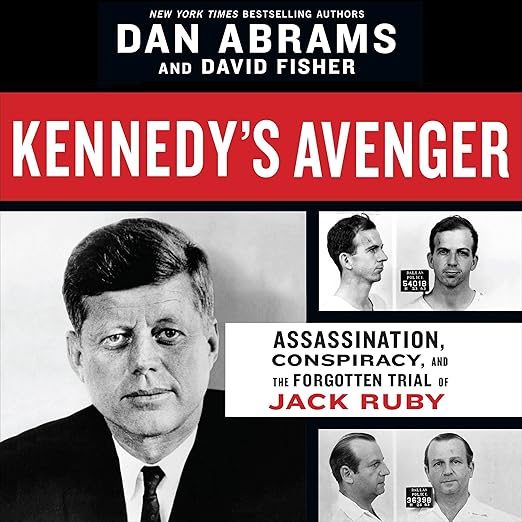
I came to Kennedy’s Avenger with something of a specific interest: I had spent several months reading around the Kennedy assassination for reasons entirely unrelated to this audiobook, and I was curious whether Dan Abrams, who I know primarily as a television legal analyst, could bring something genuinely new to a subject that has generated more books than almost any other event in American history. The answer, it turns out, is yes, but through a narrow aperture. What Abrams and co-author David Fisher have done is redirect attention from the assassination itself to the trial that followed three months later, and in doing so, they recover a story that has been almost completely overshadowed by everything surrounding it.
The setup is one of American legal history’s more remarkable paradoxes: Jack Ruby shot Lee Harvey Oswald in front of millions of television viewers. The murder was as close to an open-and-shut case as criminal law produces. And yet, as Abrams frames it early in the book, Ruby ultimately died an innocent man, his conviction was overturned on appeal before a retrial could be held, and he died of cancer in prison while the legal proceedings were still pending. How does a man pull a trigger on live television and have his conviction reversed? That question drives twelve hours of audiobook, and it is a good question.
The Lawyers Who Made History
The trial’s cast of characters is, as the synopsis promises, colorful. Defense attorney Melvin Belli was among the most flamboyant and celebrated lawyers in America, a man who understood the theater of the courtroom as well as anyone and who approached Ruby’s defense with strategies that were, even by 1964 standards, unconventional. Prosecutor Henry Wade was a tough, experienced Texas district attorney with a significant advantage: the whole world had watched his defendant commit the crime. The tension between these two figures gives the trial its dramatic structure, and Abrams, with his legal background, renders the procedural details in language that is accessible without being condescending.
Reviewer Francis O Walker described the book as dismantling the conspiracy industry "page by page", not through direct argument but by showing what the actual evidentiary record looked like and how it was handled. That is accurate. Abrams does not spend chapters arguing against conspiracy theories; he reconstructs the trial in enough detail that the gap between what people believe and what was actually established becomes apparent through the narrative itself. It is a more effective approach than direct confrontation.
The Legal Analysis That Reviewers Divided On
Reviewer C, who comes from a legal background, praised the book’s documentation and legal analysis as thorough and well-informed. Reviewer Lois Jones found the density of legal information overwhelming at times, wanting more story and less procedure. Both reactions are legitimate, and they reflect a genuine tension in the book’s design: Abrams is a lawyer writing for a general audience about a legal proceeding, and the balance between procedural rigor and narrative accessibility is one that different readers will calibrate differently.
My own reading is that the legal density is precisely the point. Ruby’s trial was the first major American trial conducted in the full glare of television, and the book’s argument is that understanding what went right and wrong, legally, procedurally, evidentially, matters for understanding both the specific case and the broader question of whether American justice could survive being judged by the world in real time. The procedural detail is not decoration; it is the substance.
Dan Abrams Reading Dan Abrams
The self-narration decision works well here. Abrams has spent his career explaining legal proceedings to television audiences, and that experience shows in the delivery. He does not read as a narrator performing a text; he reads as a knowledgeable person explaining something he has thought about at length. The confidence is not arrogance, there is appropriate uncertainty in the way he handles disputed points, but it carries the weight of genuine expertise. Reviewer LifeTrek described the legal analysis as "on point and very concise and understandable," which captures the quality of both the writing and the delivery.
At twelve hours and twenty-seven minutes, the book is substantial but not punishing for the subject matter. There are moments where the appeal proceedings, which reviewer Jatay1985 felt were glossed over too quickly, could have used more space, and the events after Ruby’s conviction are handled at a pace that some listeners will find too compressed. But the trial itself, from voir dire through verdict, is reconstructed with care and clarity.
Legal History Readers and Kennedy Obsessives
Listen if you have an interest in the Kennedy assassination and want to understand the full aftermath, including the forgotten trial that directly followed Oswald’s murder. Listen if you enjoy legal narrative nonfiction and want a book where the procedural details are handled by someone with actual courtroom expertise rather than journalistic approximation. Skip if you want the assassination itself to be the primary subject, this book is deliberately and consistently focused on the Ruby trial. Skip also if you find extensive legal procedural detail more exhausting than illuminating; those sections are substantial and central to the book’s argument.
Frequently Asked Questions
Does Kennedy’s Avenger take a position on whether Jack Ruby was part of a conspiracy to kill Oswald?
Abrams and Fisher focus on the trial itself rather than making a direct argument about conspiracy. The book’s approach is to reconstruct the evidentiary record in sufficient detail that readers can assess the conspiracy claims themselves, though the overall effect is to show how thin the evidentiary basis for many conspiracy theories is.
How did Jack Ruby’s conviction get overturned if millions of people watched him shoot Oswald on television?
The Texas Court of Criminal Appeals overturned the conviction on the grounds that the trial should have been moved out of Dallas due to pretrial publicity, and that certain jury instructions were improper. Ruby died of cancer in January 1967 before his retrial could be held. The book covers the appeal proceedings, though some reviewers felt that section was less detailed than the trial itself.
Is Dan Abrams’s self-narration effective for a twelve-hour audiobook?
Yes. Abrams brings legal credibility and practiced communication skills to the narration, he has spent his career explaining courtroom proceedings to general audiences, and that expertise carries into the delivery. Listeners who have seen him as a television legal commentator will recognize the same authoritative but accessible register.
Who co-authored this book with Dan Abrams, and what did they contribute?
David Fisher is Abrams’s co-author, a prolific collaborator on narrative nonfiction who has worked with a range of public figures. Fisher’s strength is in constructing readable narrative from documentary sources, and the book’s combination of legal precision and storytelling pace reflects that partnership.