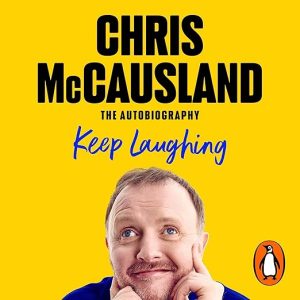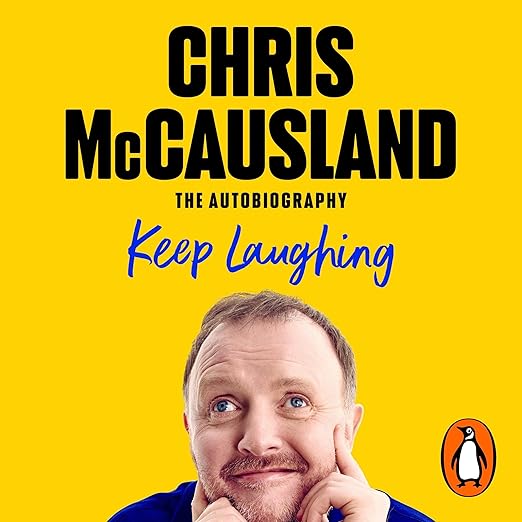
A boy who sold conkers on Liverpool streets became one of Britain's most beloved comedians long before he ever won a Glitterball Trophy on television. Keep Laughing is Chris McCausland's own account of that path, narrated in his own voice across a twenty-five-year stretch of gradual sight loss that runs alongside a genuinely improbable comedy career, complete with a stint running an amateur bootlegging operation and a brush with something resembling MI5 recruitment. This audiobook arrives from Penguin with a blurb from Richard Osman calling McCausland "funnier than everybody else," and the book itself splits its attention evenly between blindness and comedy rather than treating either as the whole story.
McCausland's structure moves roughly chronologically, from an unglamorous childhood in Liverpool through his gradual vision loss, into stand-up comedy, television panel show appearances, and eventually his widely watched turn on Strictly Come Dancing, the British ballroom competition show whose trophy, the Glitterball, gives the book its emotional high point. What keeps the material from becoming a straightforward triumph narrative is McCausland's own comedic instinct: he refuses to let sight loss become the book's only emotional register, folding genuinely funny material in alongside the harder passages rather than separating comedy and hardship into distinct sections.
Reviewer Emily specifically praises the heavy dose of eighties and nineties nostalgia woven through the childhood material, alongside real affection for the people McCausland grew up around, and that specificity is a big part of why the book works: this reads as one particular Liverpool childhood rather than a generic disability memoir with comedy bolted on. The blindness narrative gains most of its power from how ordinary and specific the surrounding life is, not from treating the condition itself as the entire subject.
The MI5 anecdote is a good example of how the book earns its comic tone honestly: McCausland presents his own life as a string of increasingly improbable turns, conker dealing, bootlegging, a brush with intelligence recruitment, stand-up, national television, that reads less like a carefully engineered success story and more like someone genuinely surprised by his own trajectory every step of the way. That structure keeps the memoir from ever feeling like a triumphant arc plotted in advance.
This is a major-publisher production, credited directly to Penguin with a Penguin Audio release date of 2025, which is worth noting in a catalog where plenty of comparable memoirs arrive through smaller or self-published channels. That backing signals real confidence from a mainstream UK publisher in McCausland's ability to carry a full-length audiobook on voice and material alone, without needing a co-writer's byline or a ghostwritten polish to smooth over the delivery.
McCausland's Own Remarks, a Deluxe Album Edition
Self-narration is close to essential here, since McCausland's comic timing is inseparable from his actual delivery, the pauses, the deadpan, the specific rhythm that made him a working stand-up comedian for years before wider fame arrived. Reviewer gembot describes laughing, learning, and crying across the listen, a genuine range that depends on hearing McCausland's own voice modulate between registers rather than a hired narrator interpreting his written jokes secondhand.
Jaimee Peck's review flags something audio-specific worth calling out directly: McCausland's own remarks on what he wrote add noticeably more than the printed page could carry alone, closer to a deluxe album edition with a few extra tracks than a straight reading of the text. That kind of self-aware, in-the-moment commentary layered onto the memoir itself is a genuine audio-first advantage, the sort of thing a listener loses entirely by choosing print instead.
McCausland's book joins a small but notable shelf of memoirs by public figures who write about disability with humor rather than solemnity, in the spirit of Michael J. Fox's memoirs about living with Parkinson's. What distinguishes McCausland's approach is how thoroughly comedy stays the default register rather than an occasional relief valve; sight loss gets folded into the same storytelling voice as the conker-dealing years, rather than shifting into a separate, more serious mode.
Roughly Equivalent to Dancing With the Stars
International listeners unfamiliar with British entertainment culture should expect a learning curve around some references. Strictly Come Dancing, the ballroom competition at the emotional center of the book's final act, is a major long-running BBC institution in the UK without a direct American equivalent, and panel shows, a British TV format built around comedians riffing on news and pop culture, may also need context that the book itself does not always pause to provide for an international audience.
The tag People with Disabilities on this listing is accurate and worth taking seriously as a content signal, but it undersells how much of the book is straightforwardly comedic rather than issue-focused. McCausland approaches his own blindness with genuine irreverence rather than solemnity, which is a real strength for readers wanting an unsentimental account, though listeners specifically seeking a more reflective, meditative disability memoir may find the comedic register lighter than expected.
For context, Strictly Come Dancing is the BBC's long-running ballroom dancing competition, first broadcast in 2004 and roughly equivalent to Dancing with the Stars for American listeners, pairing celebrities with professional dancers across a televised elimination format. Knowing that shape in advance makes the book's final act land the way it is meant to: as a genuinely unlikely, high-visibility risk for a performer who built his career on stand-up stages rather than choreography.
Pitched as the Perfect Feel-Good Gift
Fans of British comedy and panel-show culture, along with anyone who watched McCausland's Strictly run and wants the fuller story behind it, are the most obvious audience, and the self-narration makes this a strong pick for listeners who specifically enjoy comedian memoirs read by the comedian in question.
A rating count above seven hundred is unusually high for a comedian memoir this recent, suggesting reach well beyond a narrow base of existing fans tuning in out of loyalty. That scale of engagement points toward genuine crossover appeal, listeners discovering McCausland through the book itself rather than only through prior familiarity with his television work.
The synopsis explicitly pitches itself as "the perfect feel-good gift for fans of comedy and Strictly alike," and that gift-book framing is worth taking at face value; this is warm, accessible, and easy to recommend to someone outside your usual reading habits, which is precisely the quality that makes a memoir travel well as a present rather than staying a niche purchase for existing fans only.
Skip it if you have no interest in British entertainment figures or need every reference explained in full for an outside audience, since McCausland writes primarily for a UK readership already familiar with his television work, even though the underlying story of resilience and reinvention travels well regardless.
Does Chris McCausland narrate this audiobook himself?
Yes, and his own comic timing and delivery are central to how the material lands, including additional spoken asides beyond the printed text.
Do I need to know Strictly Come Dancing to enjoy this audiobook?
No, though a little context helps. It is a major British ballroom dancing competition show, and McCausland's run on it forms the book's emotional final act.
Is this audiobook mostly about blindness or mostly about comedy?
Both, deliberately intertwined. McCausland treats his sight loss with irreverence rather than solemnity, folding it into a broader story about an unlikely comedy career.