Quick Take
- Narration: Clay Lomakayu delivers a measured, contemplative performance well suited to Vivekananda’s discursive philosophical mode; the pace never rushes and the voice carries genuine reverence.
- Themes: Work as spiritual practice, detachment from results, knowledge versus pleasure as life’s organizing principle
- Mood: Quiet, methodical, and increasingly absorbing
- Verdict: A compact but dense philosophical text that rewards patient listening and has more practical application to ordinary working life than its Sanskrit vocabulary suggests.
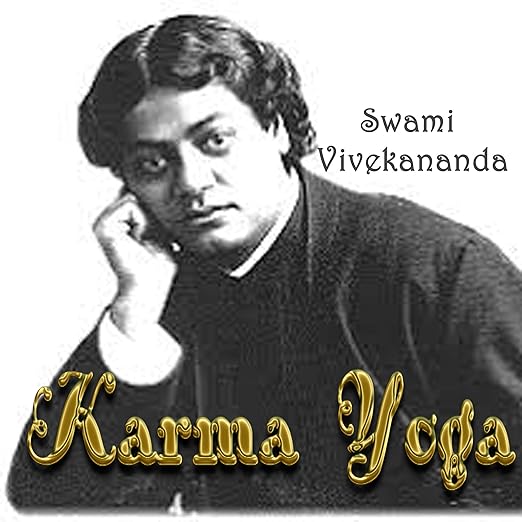
I came to Karma Yoga on a morning when I had too many tasks and a feeling of futility about all of them, which, in retrospect, was exactly the right frame of mind. Swami Vivekananda delivered these lectures in the 1890s, and the central question he returns to across three hours is one that has not aged: how do you work in the world without being destroyed by your attachment to outcomes? The Sanskrit framework is not a barrier. The ideas underneath it are available to anyone willing to follow an argument about motivation and character that is more psychologically precise than most contemporary self-help writing manages.
The audiobook is short by modern standards, just over three hours, and Vivekananda uses the space without waste. He is not a systematic writer in the Western philosophical sense; he circles his central propositions from multiple angles, approaching the same idea through different analogies and examples. This can feel repetitive in a first listen and illuminating in a second. I found myself rewinding twice in the first hour not because I was lost, but because I wanted to stay with something longer than the recording allowed.
Karma as Action, Not Consequence
The first clarification Vivekananda makes, and it is a clarification that most Western listeners need, is that karma in his framework means action in the present, not the accumulated moral ledger of past lives. Karma yoga is a practice: it is the discipline of acting fully without anchoring your identity to the results of your action. This distinction matters because it means the text is not asking you to accept a particular metaphysical worldview before its practical argument becomes available. The practical argument is this: your character is the aggregate of your responses to circumstances, and the character formed through action without attachment is freer and more stable than one formed through constant calculation of gain and loss.
Eric Dujardin’s review here touches on the renunciation element, and it is worth dwelling on. Vivekananda is not arguing for passive withdrawal from the world. He is arguing for a specific kind of engagement: full presence and full effort in action, combined with release of the outcome. That is not quietism. In some respects, it is more demanding than strategic effort, because it removes the consolation of having aimed for something specific if that thing doesn’t arrive.
What This Text Asks of Its Listener
Karma Yoga is not a self-help book, and treating it as one will produce a disappointed listener. There are no action steps, no case studies, no frameworks for implementation in a quarterly review. What there is is a philosophical argument about the relationship between human action and human character that has been refined over centuries of engagement and still holds. The reviewer who described it as very practical despite being written long ago is recognizing something genuine: the observations about how misery teaches more than happiness, how poverty develops character differently than wealth, how the experience of difficulty is morally formative rather than merely unfortunate, are not dated. They are true in ways that more contemporary motivational literature tends to avoid because they do not promise that correct behavior will produce desired outcomes.
Vivekananda also places the argument in explicit dialogue with Western materialist assumptions about pleasure as the proper goal of human life, and his disagreement with that assumption is direct and carefully reasoned. Whether or not you ultimately agree with him, the engagement with the opposing view makes the argument feel serious in a way that philosophical texts sometimes skip.
Clay Lomakayu and the Right Pace for Philosophy
Lomakayu’s narration is calibrated to the text’s requirements: deliberate, warm, and unhurried. Philosophical audio particularly rewards narrators who are willing to let ideas settle before moving on, and Lomakayu does this without the narration feeling artificially slow. His tone carries a quality of genuine engagement with the material that serves a text whose authority depends on the sense that the ideas behind it are held with real conviction. One reviewer noted a printing issue in the physical book around pages 83 to 90; no such structural problem exists in the audio, which proceeds cleanly throughout its three hours.
Three Hours of Philosophy and Who Will Use Them
Listeners curious about Indian philosophy, Vedanta, or the practical application of Hindu thought to working life will find this a valuable and accessible introduction. The lecture format and the relatively short duration make it a low-commitment entry point into Vivekananda’s thought more broadly. Those who want a systematic philosophical treatise with numbered arguments and formal structure will find the discursive style frustrating. Anyone coming from a secular background who wants access to the argument’s practical core without engaging with the spiritual framework will find that the two are woven together throughout; the practical and the metaphysical are not cleanly separable here, and Vivekananda does not offer a secular translation of his own ideas. Patient listeners willing to engage with the full framework will find the three hours genuinely rewarding.
Frequently Asked Questions
Do I need a background in Hinduism or Vedanta philosophy to get value from Karma Yoga?
No. Vivekananda introduces the core concepts in context and defines his terms as he goes. A general openness to spiritual and philosophical reasoning is more important than prior knowledge. Listeners who have some background in Indian philosophy will find additional layers of resonance, but the central argument about action, character, and detachment is accessible without it.
How does the lecture format of Karma Yoga affect the listening experience compared to a conventionally structured book?
Vivekananda’s lectures circle and return to central ideas rather than building linearly. This means the text can feel repetitive in places on a first listen and increasingly clear on reflection. The audio format suits the lecture style well because Lomakayu’s pacing gives the repetitions a cumulative quality rather than a redundant one. Some listeners may benefit from taking notes on key passages.
Is Karma Yoga relevant to non-religious listeners who are interested in stoicism or mindfulness-based approaches to work?
Meaningfully so. The core argument about acting without attachment to outcomes has clear parallels to Stoic practice and to contemporary mindfulness frameworks for dealing with work and ambition. Vivekananda’s metaphysical context is different from these traditions, but the practical observation that character is built through how you work rather than what you produce from it is compatible with secular philosophical approaches.
Is there a free audiobook version of Karma Yoga available on Audible?
Yes, Karma Yoga is available at no cost on Audible. At just over three hours, it is one of the shorter philosophical texts available in audio format, making it a genuinely low-commitment entry point for curious listeners.