Quick Take
- Narration: L.J. Ganser handles the procedural and narrative passages with clean authority, he gives the material the weight it deserves without over-dramatizing cases that are already dramatic on their own.
- Themes: Prosecutorial innovation, organized crime in Appalachia, institutional courage under threat
- Mood: Methodical and quietly gripping, with the texture of insider memoir rather than true-crime sensationalism
- Verdict: A well-documented memoir from a US Attorney who reshaped how federal prosecution worked, essential for listeners drawn to legal history and the mechanics of how justice actually gets done.
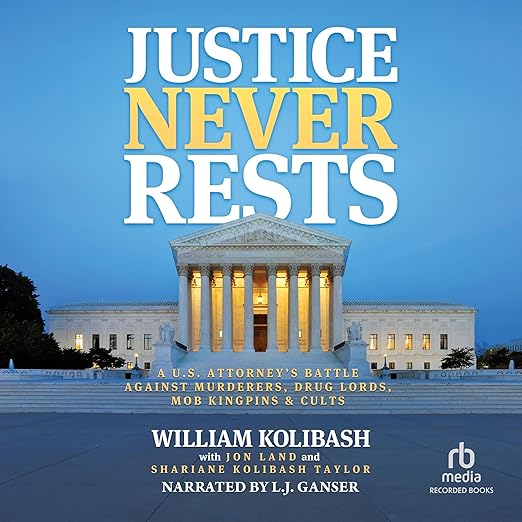
I’ve read my share of true crime and legal memoirs, enough to have developed a reliable instinct for the difference between books that are really about the author’s reputation and books that are really about the cases. William Kolibash’s Justice Never Rests is genuinely about the cases. He is in it, of course, this is memoir, but what drives the narrative forward is not self-congratulation but a specific, documented account of how federal prosecution in a small and criminally complicated district was reinvented over twenty years. That distinction makes the book considerably more interesting than its genre neighbors.
Kolibash served in the Northern District of West Virginia, first as an assistant US Attorney and eventually as the sitting US Attorney, for two decades. The district sounds unremarkable, but the criminal landscape was anything but: old-school moonshiners who had diversified into massive marijuana operations, violent Jamaican posses, a cocaine distribution network operating at the front edge of the crack epidemic, sex traffickers, and, in what is the book’s most extraordinary section, the murderous and corrupt leader of a Hare Krishna movement operating as an organized criminal enterprise. Kolibash prosecuted all of them.
Our Take on Justice Never Rests
The structural contribution that makes this book genuinely significant beyond the individual cases is Kolibash’s role in developing prosecutorial tools that are now standard federal practice. He was among the first US Attorneys to systematically apply RICO statutes to drug and organized crime cases, and he pioneered the use of multi-jurisdictional task forces and investigative grand juries before these became common practice. One reviewer, a judge who had peripheral awareness of some of the cases described, called the book a filling-in-of-blanks that made clear what was actually happening beneath the surface of events that had seemed complicated from the outside.
That sense of inside access is the book’s core value. Kolibash is not speculating about how organized crime worked in West Virginia in the 1970s and 80s, he investigated it, prosecuted it, and won. The detail about how cases were built, how task forces were assembled from agencies that didn’t naturally cooperate, and how RICO was applied creatively to situations it wasn’t originally designed for gives the book a procedural depth that most true crime lacks.
Why Listen to This Rather Than Read It
L.J. Ganser is a reliable narrator for serious nonfiction, and he handles Kolibash’s material with appropriate gravity. The pacing of the cases, how they build, how evidence accumulates, how prosecutorial strategy evolves in real time, is conveyed cleanly in audio without losing the procedural specificity that makes the book credible. At nine and a half hours, the runtime matches the scope: there’s enough here to feel substantial without the kind of repetition that can plague legal memoir.
The book opens with a scene that Ganser delivers with particular effectiveness: Kolibash describes pulling what he immediately recognizes as a bomb out of an envelope. That moment sets the stakes for what follows, this is not a book about prosecuting minor federal crimes, and Ganser communicates from the first minutes that the listener is in for something that carries genuine personal risk for its narrator.
What to Watch For in Justice Never Rests
The book is organized roughly chronologically through Kolibash’s career rather than thematically through case types, which means the rhythm shifts as the prosecutorial challenges change across decades. Some listeners will find certain case sections more compelling than others depending on their specific interests. The organized crime and RICO sections are exceptionally well-developed; the earlier moonshining cases, while historically interesting, are somewhat less dramatically propulsive.
Listeners expecting the narrative intensity of commercial true crime, the kind of book that uses cliffhangers and victim-centered emotional appeals to drive momentum, will find Kolibash’s approach more restrained. He writes as a former prosecutor, not as a crime journalist or a dramatist, and the evidentiary specificity that makes the book credible can also slow its pace in places.
Who Should Listen to Justice Never Rests
This audiobook is well-suited to listeners with an interest in legal history, federal prosecution, and the evolution of organized crime enforcement in the United States. Fans of books like James Comey’s A Higher Loyalty or Vincent Bugliosi’s Helter Skelter, memoirs from law enforcement and prosecution perspectives that carry genuine insider authority, will find Kolibash’s account substantive and credible.
Listeners looking for emotional narratives centered on victims, or for the pacing of commercial crime fiction, should look elsewhere. This is a prosecutor’s memoir: methodical, documented, and most rewarding for listeners who want to understand how the machinery of federal justice actually works.
Frequently Asked Questions
What is the RICO statute, and do I need to understand it before listening to this book?
No prior knowledge is needed. Kolibash explains the RICO (Racketeer Influenced and Corrupt Organizations) statute and his innovative applications of it as part of the narrative. One of the book’s contributions is precisely showing how RICO was expanded from its original design to cover the kinds of criminal enterprises he was prosecuting in West Virginia, the explanation is built into the story.
Is the Hare Krishna case covered in detail, or is it mentioned briefly?
It is covered in substantial detail and forms one of the book’s most striking sections. The case involves a Hare Krishna leader operating a criminal organization with murder, extortion, and corruption at its center, a genuinely extraordinary case that Kolibash treats with the same evidentiary rigor as the drug and organized crime prosecutions.
How does L.J. Ganser’s narration handle the procedural sections, which can be dense in legal nonfiction?
Ganser reads with measured authority that keeps the procedural material accessible. He doesn’t rush through the case-building sections or over-dramatize the courtroom moments. The narration suits memoir from a former prosecutor, it conveys competence and gravity without losing the listener in technical detail.
Is this primarily a West Virginia story, or does it have national relevance for understanding federal law enforcement?
Both. The specific cases are rooted in West Virginia’s criminal landscape, but Kolibash’s prosecutorial innovations, particularly his applications of RICO and his development of multi-jurisdictional task forces, had national influence. The book is a local story with national implications for how organized crime prosecution evolved in the United States.