Quick Take
- Narration: Ginsburg narrating her own work transforms this collection into something irreplaceable; her voice carries the full weight of the life it describes.
- Themes: Equality under law as an ongoing project, judicial dissent as a moral act, the relationship between personal history and legal philosophy
- Mood: Grave and precise, with warmth beneath the formality; the listen carries a weight that grows as it continues
- Verdict: An essential document that is more valuable as audio than in any other format, because hearing Ginsburg’s own voice is the experience the collection is built to provide.
There is a specific kind of listening experience that the audiobook format makes possible and that no other format can replicate: hearing a person’s words in their own voice after they are gone. I listened to Justice, Justice Thou Shalt Pursue over three evenings, and on the second evening, somewhere in the middle of one of Ginsburg’s oral arguments from the 1970s, I had to pause. Not because the argument was difficult to follow, though it was demanding, but because the voice itself carried a quality of presence that felt out of proportion to the recording technology. She was so precise, so patient, so absolutely clear about what she was trying to accomplish and why.
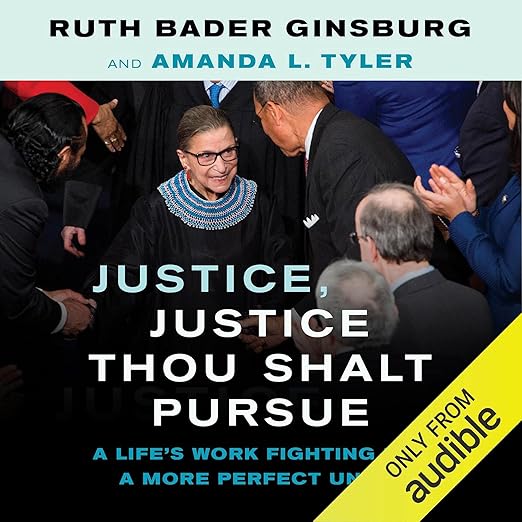
This collection was assembled by Ginsburg and Berkeley Law professor Amanda Tyler, a former Ginsburg clerk, in the final period of Ginsburg’s life. It includes opinions she wrote on the Supreme Court, many in dissent, oral arguments and briefs from her pre-SCOTUS career, her last speeches, and a long public interview at Berkeley. The collection was going into production when Ginsburg died in September 2020. That proximity to her death gives the whole enterprise a particular gravity: this is as close to a final statement as she was able to make.
The Dissents as a Formal Practice
What I found most illuminating about this collection, having read a fair amount of secondary literature about Ginsburg’s jurisprudence, was how coherent her approach to dissent becomes when you hear her describe it and then hear it in practice. The famous dissents, including those in Bush v. Gore, Ledbetter v. Goodyear, and Shelby County v. Holder, are not rhetorical performances in the mode that public mythology sometimes suggests. They are precise legal arguments delivered from a position of loss. Ginsburg’s theory of dissent, which she discusses explicitly in the Berkeley interview, is that a written dissent is sometimes addressed not to the majority but to future courts, that it plants a seed for a different resolution when legal and political conditions change.
Hearing her read those dissents in her own voice is a different experience from reading them on a page. The deliberateness of her delivery, the complete absence of theatricality, is itself an argument about what law should be. She is not performing outrage. She is recording a legal position for the future with the same care she would bring to a majority opinion, perhaps more, because she knows it may take longer to be heard.
The Personal Materials and What They Add
The collection also includes personal materials that have not appeared in other Ginsburg compilations: family anecdotes, reflections on her partnership with her husband Marty, candid views on her colleagues and on the institution of the Court itself. Ronald H. Clark, who has read and reviewed every recent book on Ginsburg, specifically calls out the personal interview at Berkeley and the tribute to her longtime collaborator Herma Hill Kay as containing perspectives he had not encountered elsewhere.
For a listener who has already worked through the biographical literature, these additions are what make Justice, Justice Thou Shalt Pursue worth the full nine-plus hours. For a listener approaching Ginsburg’s work for the first time, the collection is a rich starting point: it moves between the formal legal register of her opinions and the more personal register of interviews and tributes in a way that gives both more dimension than either would have alone.
What This Audio Edition Makes Possible
The Audible Studios production includes a PDF companion that contains supporting materials to complement the audio. The audio itself is archival: various recordings of Ginsburg at different stages of her career, with Tyler providing connective tissue in the introduction and between sections. The production is not seamless in the way a studio audiobook is seamless, but the variations in recording quality across decades of materials are a feature rather than a flaw. You are hearing a career, not a polished presentation, and that roughness is part of what makes the collection feel like a document rather than a monument.
The Case for Listening Rather Than Reading
The argument for the audio format is not about convenience but about irreplaceability. Ginsburg’s voice is the text in a way that no print edition can be. You can read the same words in the Westlaw database or in any law school casebook. What you cannot replicate in any other format is the particular quality of attention she brings to her own words, the sense that each sentence was chosen because it was the most precise available and not because it was the most memorable. This free audiobook is worth every one of its nine and a half hours for anyone who cares about the period of American legal history it documents, or simply about what it sounds like when a person has spent a lifetime thinking carefully about justice.
Frequently Asked Questions
Is this collection a good starting point for someone who knows little about Ginsburg’s legal career, or is it aimed at people already familiar with her work?
It works as a starting point but is probably most rewarding for listeners with some prior familiarity. The legal opinions assume basic familiarity with their subject matter. The Berkeley interview and personal reflections are accessible to any listener. For complete newcomers, a biographical overview first would help contextualize the legal materials.
How does the recording quality vary across the materials, and does the inconsistency impair the listening experience?
The quality varies considerably because the materials span several decades. Some recordings are clearly archival; others are studio quality. This is not a flaw in the production but a necessary feature of an archival collection. The variation becomes part of the documentary experience of tracing a career through time.
Does the collection include the famous dissents in cases like Ledbetter or Shelby County?
Yes. The collection includes opinions that Ginsburg herself selected as favorites, and the famous dissents are among them. Hearing Ginsburg read her own dissents is a substantially different experience from reading them in print, and is the primary reason to choose the audio format for this particular title.
What does Amanda Tyler’s role as curator and co-presenter add to the collection?
Tyler provides structural framing and connective context that situates each piece within Ginsburg’s career and the legal landscape of its time. As a former Ginsburg clerk and a prominent constitutional law scholar herself, Tyler’s editorial choices reflect genuine expertise. Her presence adds an interpretive layer that shapes how you encounter the primary materials without obscuring them.