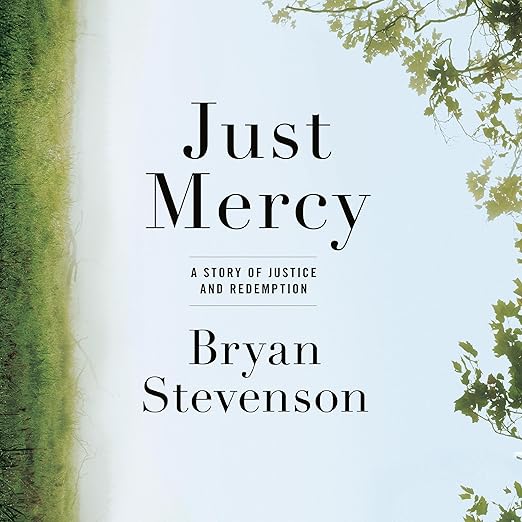
Can a memoir also serve as a legal brief without failing at both? That is the question hanging over Just Mercy, and the audiobook answers it in the most direct way available: Bryan Stevenson reads his own account, eleven hours and eleven minutes of it, in the voice that argued the cases. Random House Audio issued the recording in October 2014, years before the film adaptation arrived to reshape how the description on this listing is written.
Stevenson's Method Is to Alternate Scales
Stevenson's method is to alternate scales. He founded the Equal Justice Initiative to defend people the system had already finished with, and the copy names its clients precisely: the poor, the wrongly condemned, and women and children pushed into the farthest reaches of the criminal justice system. Against that pattern he sets individual lives, one at a time, at enough length that they stop being illustrations and become people. The alternation is what keeps the book from turning into either a policy paper or a collection of sad stories, and it is a harder structure to sustain than either of those would have been.
One Blurb Identifies the Tradition Correctly
William Capodanno, in the most considered of the written responses, notes that the word hero circulates too freely and that living an entire life heroically is rare, then places Stevenson in that category. That response also picks out the detail most listeners find hardest to absorb: clients on death row, and children tried, convicted and sentenced to life without parole, a practice the Supreme Court later ruled unconstitutional. Hearing that fact stated by the attorney who handled such cases, rather than by a reader hired to deliver it, changes its weight considerably.
Walter McMillian anchors the whole enterprise. Condemned for a murder he denied committing, his case drew Stevenson into what the copy calls conspiracy, political machination and legal brinksmanship, and the book treats it as the education that reorganized everything after it. The blurbs are extravagant, comparing the book to To Kill a Mockingbird and Stevenson to Mandela, and while I would leave that second comparison alone, the first one at least identifies the tradition correctly.
Only the Author Can Restore the Emphases
C Orr describes arriving with an inkling that American justice punishes poor people and people of color disproportionately, and leaving with the realization of not having known how broken it actually is. That is the specific work this book does. Most readers arrive persuaded of the thesis in the abstract; the cases are what convert an opinion into knowledge, and cases told aloud are hard to skim past. A page lets your eye slide over a sentencing detail. A recording makes you sit through it at the speed the writer chose.
Self-narration is the practical argument for the audio edition. Stevenson is a working advocate whose profession is persuasion in front of hostile listeners, and the memoir is built out of the rhythms of that job: the setup, the fact nobody wants to hear, the pause before the consequence. A hired reader could handle the prose perfectly well. Only the author can restore the emphases he wrote it with, and in a book whose central claim is that mercy belongs inside the law rather than outside it, emphasis is not decoration.
Eleven hours is also well judged for the material. Long enough to follow several cases to their conclusions, short enough to avoid the numbing that any sustained account of injustice risks. Keisha reaches for a short list rather than a summary, naming communication, history, resilience, culture and racism in a state of pain but also of pride, which captures how the book keeps dignity and outrage inside the same frame instead of choosing between them.
The Description Now Leads With the Film
Al, who awards four stars rather than five, raises the one real objection on the record: Stevenson lays out the injustices clearly, but is the rationale grounded in legal principle or in religious conviction? Al concludes it is both, and that the mixture costs the argument some credibility, since a secular legal system is the ground the case has to be won on. Whether or not you agree, it identifies the book's actual seam, the place where advocacy and faith run together.
Be aware too of how thin the numbers underneath this listing are. A book with a Carnegie Medal, an NAACP Image Award and a place on more best-of lists than the description can comfortably hold has collected only a few dozen ratings on this particular record. The average is high and the sample is small, so read the responses rather than the score. Nothing about a modest count reflects on the book; it reflects on how many editions the same title has been split across since 2014.
Two metadata oddities deserve a mention. The series field carries One World Essentials with no volume number, which is a publisher collection rather than a series, so nobody should go hunting for book one. And the description now leads with the film, Michael B. Jordan and Jamie Foxx before the reader learns what the book argues, on a recording that predates the movie by years. The memoir has not changed; its packaging has.
What Lingers After Eleven Hours Is Patience
Sheila Newman, writing as an Australian reader, calls it confrontational in every respect and its case against capital punishment unequivocal, then says all Americans should read it. That is the primary audience, but the reach beyond it is real: law students, anyone working in social services or education, and readers outside the United States who want to understand how a system produces outcomes that look inexplicable from a distance.
Approach with care if you are looking for balance in the political sense. Stevenson is an advocate, this is advocacy, and no attempt is made to survey opposing views. Approach with care as well if courtroom detail bores you, though I would say the legal machinery here is the least abstract you will find, since every procedural point costs somebody something concrete.
What lingers after eleven hours is not the outrage, which you can get anywhere, but the patience. Stevenson keeps returning to the same prisons, the same appeals, the same slow correction of a record that took decades to enter. That accumulation is the argument, and it is why an author-read edition of this particular book still deserves preference twelve years after it was recorded.
Quick Take
- Voice: Stevenson reads his own book, so the courtroom passages arrive from the attorney who stood up in those rooms rather than from a performer studying a transcript.
- Big ideas: Wrongful conviction and the death penalty, race and poverty in sentencing, mercy argued as a legal principle rather than a feeling
- Atmosphere: Measured, patient, quietly devastating
- Worth it?: The rare advocacy memoir that also works as narrative, and the author-read edition is the one worth choosing.