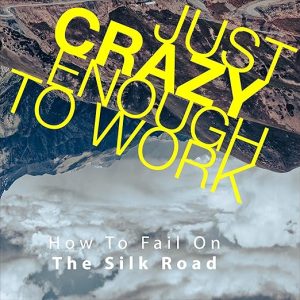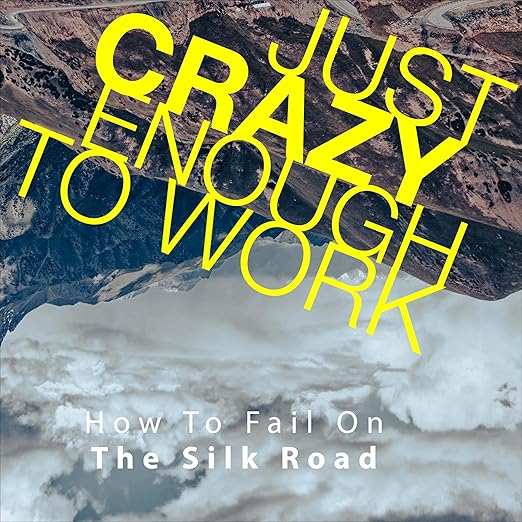
Most travel writing sells the arrival. The photograph at the summit, the meal after the last climb, the moment when all that effort finally pays. This audiobook does none of it. Stu Nugent's account opens by refusing all of it, and the refusal sits right there in the publisher's first two questions: what happens when a journey goes wrong, and what happens when a travel book does not have a happy ending. He set out to cycle the Northern Silk Road from Shanghai to Europe. He failed. The copy says so twice, in two short sentences, before it says anything else about him.
What follows in that description is a list nobody would invent for a brochure. Forced to smoke opium at gunpoint. Attacked by a snake in a remote Kyrgyz river. Robbed at gunpoint by the police. Imprisoned in an anonymous jail somewhere on the Kazakh steppe. And framing all of it, the self-assessment that he was never a good candidate for a round-the-world ride in the first place, because he was, and remains, a coward.
Is Just Crazy Enough to Work Worth Your Time?
The classification of this book is genuinely slippery, and the reviews show the strain. A five-star response filed in the United States in March 2026 is headed "Captivating adventure novel" and then, two lines later, refers to "this non-fiction". That reads less like carelessness than like a symptom. The material behaves the way a novel behaves: winding roads through dangerous mountain passes, deserts with corrupt authorities, reversals that keep arriving on schedule. The same reader stayed up "far later than I intended", which is a compliment usually paid to fiction.
Mason Brewer identifies the strongest thing in the book, and it is not the danger. That review singles out the documentation of Kyrgyzstan and calls it "a really human-centric view of a part of the world I previously knew nothing about". The distinction matters. Plenty of adventure memoirs come home with a scar count; far fewer come home with the people intact, and a cyclist crossing a country slowly ends up inside more kitchens and more roadside conversations than anyone moving faster ever will.
Tristan H., writing from Germany about the printed edition, admits to being thrown at first by "a seeming lack of structure in this book", noting among other things that it carries no page numbers, then reports being glued to it and finishing it "in one go". Both halves of that are easy to believe. A journey that collapses does not fall into three neat acts, and the same review ends up glad that "the author Stu is sharing his vulnerability", which is closer to what this book is actually doing.
Stu Nugent reads his own book, and I would call this one of the cases where that decision does real work rather than saving a fee. Isa's review is the only one in the pool that addresses the recording at all, and it makes the case plainly: the challenging events come through "highlighted exceptionally", and "narrated by the author himself it makes it very enjoyable to listen to".
The reason self-narration earns its place here is tonal. A confession of cowardice read aloud by the person confessing lands differently from the same sentence set in type. So does an account of being robbed by the police, or of smoking opium with a weapon pointed at you. On the page those are anecdotes shaped after the fact. In the voice of the man they happened to, they are testimony, and the joke at his own expense keeps its timing because the person timing it was there.
Format quietly settles the structural complaint noted above, too. The page numbers that were missing from the printed edition cannot be missed in a recording, which has no positions to lose, only a clock. You experience the route as duration instead of as progress through a block of paper, and for a book about a journey that stopped making sense somewhere in Central Asia, that is closer to the right shape. Eleven hours and twenty minutes is also a manageable commitment for a story with this many incidents in it, and the incidents are the reason people keep staying up past their bedtimes to finish it.
Before You Commit to Just Crazy Enough to Work
Content warnings belong up front, because the publisher's own summary does not soften anything. Drugs taken under duress, an armed robbery committed by police, a jail cell in a country where nobody knows where you are. A reviewer in the United Kingdom reads the whole thing as "A sobering warning as to the fragility of life and dangers of excessive drinking", which points at a thread the description never raises. If alcohol is a sensitive subject for you, know that it features before you start.
Expect no resolution, either. The final line of the description is a question rather than a conclusion, and the book is sold on the failure rather than on the recovery. That is the appeal, but it does mean the last hour will not tie anything off with a bow. Readers who need a redemption arc should recognize that this one has been withheld deliberately.
Volume is the last caution. The 4.7 average rests on twenty-eight ratings, with five written responses beneath it, filed between May 2023 and March 2026 from the United States, the United Kingdom and Germany. Wide geography, thin volume. All five of those visible reviews carry five stars while the average sits below five, so the quieter dissenting opinions, whatever they are, are not on display for you to weigh.
Should You Listen to Just Crazy Enough to Work?
Cyclists are the obvious audience, particularly anyone who has ever looked at a long route on a map and wondered whether they had the nerve. Beyond them, this suits listeners who want Central Asia delivered through the people who live there rather than through scenery, and anyone tired of the adventure format where the traveler conquers something and comes home improved. The author being his own reader makes it a good pick for long walks, which is roughly the pace the book was written at.
Route logistics, gear notes and practical planning are all absent from what the description promises, so anyone shopping for those should shop elsewhere. The run of drugs, weapons and detention may also be more than you want in your ears on a morning commute. Anyone who abandons books that refuse to answer their own closing question should know this one asks its question last and then declines to come back for it.
Good to Know
Does Stu Nugent narrate the audiobook himself?
He does, and it is the strongest argument for choosing this edition. The single review that mentions the recording credits the author's own delivery for making the whole thing enjoyable to listen to, and singles out how the worst moments of the trip come across. Self-deprecation travels better in the voice that owns it.
Is Just Crazy Enough to Work a novel or a true account?
A true account, though one reviewer headed a five-star write-up with the word novel before calling it non-fiction in the body. The confusion is a compliment to the pacing. The events described, from an opium encounter to a jail on the Kazakh steppe, are presented as things that happened to the author.
How rough does this audiobook get?
Rough enough to flag before you start. The publisher's summary lists drugs taken at gunpoint, robbery by police officers and imprisonment, while one reviewer reads the book as a warning about excessive drinking. Nothing appears gratuitous judging by the responses, but it makes poor company for a family car journey.
Do I need to know anything about the Northern Silk Road first?
Nothing at all. One reviewer describes having known nothing whatsoever about the region beforehand and coming away with a human-centric view of it. The route runs from Shanghai toward Europe, crossing Kyrgyzstan and the Kazakh steppe, and those places arrive through encounters rather than through background briefing.