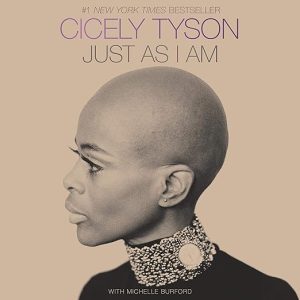
Cicely Tyson reads the memoir she wrote, a book she describes as arriving in her ninth decade, and that pairing does more for this audiobook than any production decision could. The description on the page is not a summary of anything. It consists of two quotations: one from a president at a 2016 medal ceremony, and one long statement in Tyson's own voice about what the book is and what it refuses to be.
Poverty at the Start, a Profession at Its Summit
Poverty is where the story starts and the summit of a profession is where it arrives, according to a reader who calls it the best autobiography they have ever read. That same reader identifies the second thing the book is doing: the life story doubles as a history of the Civil Rights movement, running through work with the Actors Studio and through what a Black actress had to absorb in order to keep working. That is the shape of the memoir in a sentence, and it is considerably more than the description manages.
Six decades on stage and screen is the span Tyson claims, and the memoir covers it in sixteen hours and eight minutes. That amounts to a brisk walk through a very long life, and the pace shows in the best way: the book keeps moving. A response from someone who says they rarely read books about celebrities describes it as taking a reader on a journey and putting the struggle of the period directly in front of them rather than arranging it in the background, which is the right reading of what Tyson is doing with her own chronology.
The strongest material is not the film career. A response that treats the book as a gift to its readers points instead to the stories of industry, family and the personalities who shaped how Tyson thought and acted, and singles out the point at which she began choosing roles with intention. That decision is the spine of the whole memoir. Once a person settles what they will not do, the rest of a life organizes itself around the refusal, and the book is honest about what the refusals cost.
Her Truth, Plain and Unvarnished, Glitter Set Aside
Sixteen hours and eight minutes is a substantial memoir by any measure, and the reason to take it in audio rather than in print sits in the credit field: Amistad lists Cicely Tyson as the reader. The text is written in the first person and works as direct address. Having it delivered by the person doing the addressing closes a distance that print keeps open by design, and no reading by anyone else could close it.
First-person memoir recorded by its subject is a small category with one particular property: the grammatical voice and the recorded voice become the same voice. When the description says the book is her truth, plain and unvarnished, with the glitter and garland set aside, that claim is made by the same person who then spends the whole recording assembling the evidence for it. Claims like that are cheap in cover copy and expensive to sustain out loud.
Memoir at this length has to earn its hours, and the description leaves one clue about how this one does it: the title comes from an old hymn Tyson says she took solace in as a teenager. A book named for a hymn about being accepted without alteration is announcing its method before the first chapter. The church girl who once rarely spoke, the daughter, the mother, the observer of human nature, the woman who has hurt as immeasurably as she has loved: the description lists those identities in a single breath and declines to rank them, which turns out to be a fair preview.
No Chapter Outline, No Arc, No Summary
Missing from this listing is the thing nearly every other listing has: a summary. No chapter outline, no arc, no statement of which period the book covers or which productions it discusses. The description is two quotations and stops there, which means a buyer deciding on the strength of this page is deciding on reputation rather than on content. For a memoir by a figure this widely known, that may well be deliberate. It remains an absence, and it shifts the entire burden of evaluation onto the written responses underneath.
Not One Response Mentions the Actual Recording
Obama's line about a career that shaped the course of history is doing the job a synopsis would normally do, and an endorsement is not a description. The same page also shows the title written two ways: the field above reads Just as I Am, while the sentence quoted from Tyson capitalizes it as Just As I Am. It is a small thing that splits search results and makes a title harder to locate than it ought to be, and on a record this thin, findability is most of what the page is for.
Legacy titles attract a particular kind of response, and this column is a clear specimen: warm, admiring, and focused entirely on the person. Not one written response on the page says a word about the recording, which on a self-read memoir is the detail I would most want a stranger's opinion about. You can learn from this column that people found the life extraordinary. You cannot learn how the reading itself holds up across a recording of this length, and that is precisely the question a buyer of the audio edition is asking.
The Recording Is the Only Place to Find Out
Biography readers who want the industry and the era in the same book are the audience, along with anyone drawn to the Civil Rights years told from inside a working life rather than from a historian's distance. A self-described fan who could not wait for this book found in it a portrait of someone strong who never received everything her talents warranted, which is a specific and unsentimental thing to carry away from a memoir, and a useful signal that the book is not a victory lap.
Pass on it if you want a film-by-film account of a screen career, because the description promises the person underneath the work rather than a catalog of the work. The other poor fit is anyone who needs to know what a book contains before paying for it: this page will not tell you, and no quantity of goodwill in the response column changes that. Tyson said she finally had something meaningful to say, and the recording is the only place on this listing where you can find out what it was.
Quick Take
- Performance: Amistad credits the author and nobody else, so a first-person memoir arrives entirely in the voice of the person who wrote it.
- What it covers: Six decades on stage and screen, a hymn that gives the book its name, the Civil Rights years from inside a working career, refusal as a form of authorship.
- Feel: Direct and unhurried, with the glitter set deliberately to one side.
- Our call: The audio edition is the one worth buying, and this listing is the worst possible page on which to decide that.