Flat-Packed with Missing Screws is the name Francesca Vale gives to the chapter about her own failed relationship's assembly instructions, an IKEA metaphor stretched exactly as far as it should go and not an inch further. I started this audiobook expecting a fairly standard breakup memoir and got a structural conceit instead: eight hours and twenty-five minutes organized as a self-guided tour through a museum of one specific heartbreak, each chapter framed as an exhibit.
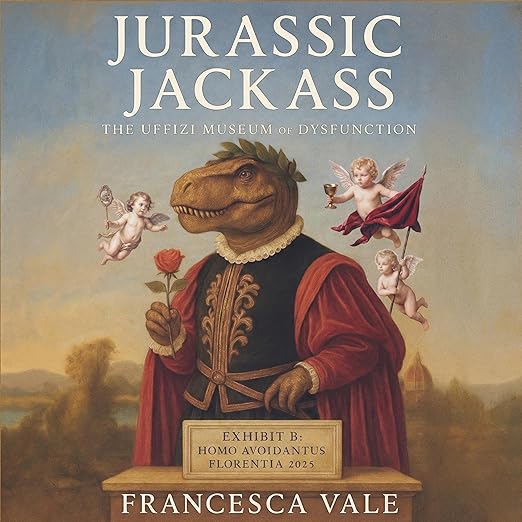
The full title, Jurassic Jackass: The Uffizi Museum of Dysfunction, tells you most of what you need to know about the register before you press play. Vale, a real-estate writer and brand strategist by trade, applies that structural, categorizing instinct to the wreckage of a relationship with a charmingly avoidant Italian man whose emotional architecture, per her own framing, proves as unstable as an actual Renaissance ruin.
Part Essay, Part Confession, No Reviews Yet
The museum-exhibit conceit is the book's real achievement. Rather than a straight chronological breakup narrative, each chapter functions as part essay and part confession, curated the way an actual museum wall label curates an object: here is the artifact, here is the context, here is what it means now that enough time has passed to look at it clearly.
Vale narrates her own material, and self-narration tends to work best exactly where this book lives, personal essay and confession rather than plotted fiction, since the author already knows precisely which words carry the most weight and where the ironic distance needs to land. No outside reviews exist yet to confirm how the performance itself comes across, so this assessment rests on the strength and specificity of the writing itself rather than independent listener confirmation.
The Real Uffizi Behind the Central Metaphor
Chapter titles carry real wit on their own: 'The Archaeologist and the Ashes' for the book's final excavation of lessons learned is a good example of how consistently the museum framing gets applied rather than abandoned once the initial premise has made its point.
The real-estate writing background is worth dwelling on a moment longer than a passing credential, since that specific skill, making an ordinary, flawed thing sound aspirational without technically lying about its condition, maps unusually well onto memoir writing about a relationship a listener already knows failed. Vale seems aware of the parallel herself; the museum conceit essentially applies a real-estate listing's polish to heartbreak instead of square footage.
The Uffizi itself, Florence's real Renaissance treasure house of Botticelli and da Vinci, is not a random reference point; it grounds the book's central metaphor in an actual place tied directly to the relationship's Italian setting, rather than reaching for a generic museum stand-in. That specificity extends even to the title's chosen landmark, evidence of how carefully the whole conceit was built rather than assembled loosely around a vague art-history theme.
A Museum Audio-Guide Structure Built for an Audiobook
The specificity is what sells this over a more generic breakup memoir. An IKEA assembly metaphor for a relationship missing its own instructions, a Renaissance ruin standing in for a man's emotional unavailability, an actual excavation metaphor for looking back at what went wrong: these are not vague, interchangeable comparisons a dozen other memoirs could use just as easily.
Something genuinely clever emerges, too, from choosing a museum-audio-guide structure specifically for an audiobook rather than a print memoir. A printed museum-style memoir asks a reader to imagine walking through the exhibits; this one, narrated by Vale herself, gets to actually sound like the docent voice guiding a visitor from one heartbreak artifact to the next, a rare case of a book's central structural conceit mapping directly onto the format delivering it.
Brutal Honesty and Unexpected Tenderness at Once
Breakup memoirs live and die on specificity, and the genre has no shortage of entries leaning on generic stages of grief or interchangeable red flags. What separates the ones that last from the ones that fade is usually a controlling idea distinctive enough to make the particular heartbreak feel singular rather than interchangeable with anyone else's, and the Uffizi framing gives Vale exactly that kind of hook.
Vale's professional background as a brand strategist shows up productively in how tightly organized the whole conceit stays. Someone whose day job involves structuring narratives around a product or an identity brings real, transferable skill to structuring a memoir around a controlling metaphor without letting it collapse under its own cleverness.
The synopsis promises both brutal honesty and unexpected tenderness, and that combination, rather than pure comic distance from the pain or pure raw grief without any humor at all, is the harder, more interesting register to sustain across eight full hours. Whether Vale sustains it that consistently the whole way through is worth confirming with a sample chapter, but the ambition itself is genuinely well-aimed.
No Ratings Yet, Just the Chapter Titles
No ratings or written reviews are attached to this listing yet, which means everything here rests on the strength of the synopsis and the specificity of its own chapter titles rather than on outside listener confirmation. That is a real gap for anyone who relies heavily on reviews before committing to a purchase.
Self-narrated memoir performance is always something of a gamble without outside confirmation. Vale's day job is writing and brand strategy, not voice performance, and while authors narrating their own material often bring genuine intimacy a professional narrator cannot fully replicate, the reverse risk, uneven pacing or delivery, is real too without a sample to check first.
The conceptual, non-chronological structure means listeners wanting a straightforward beginning-to-end relationship timeline should adjust expectations; this book moves by theme and metaphor rather than strictly by date.
A Reasonable Pick for Shorter Individual Sessions
Readers who enjoy witty, structurally inventive personal essay memoirs, in the reflective-humor register of a Samantha Irby collection, and anyone who wants their heartbreak literature to come with genuine craft and a controlling idea rather than a straight chronological account, are the right audience here.
Skip it if you want a conventional, chronological memoir, or if you specifically need outside reviewer confirmation before trying a title that currently has no ratings or written reviews attached at all. This one genuinely asks for a bit of trust from the listener going in blind.
The chapter-as-exhibit structure has a practical audio benefit worth noting too: each one functions as a nearly self-contained unit, which makes this a reasonable pick for listeners who prefer shorter individual sessions over one long unbroken sitting, checking out one exhibit at a time the way an actual museum visitor might pace a real gallery walk.
- Narrator: Francesca Vale self-narrates with no outside reviews yet to confirm delivery, though her own material's specificity suggests real command of tone.
- Subjects: heartbreak reframed as museum exhibit, an avoidant partner's emotional unavailability, brutal honesty paired with real tenderness
- Tone: Witty and structurally inventive, sharp rather than sentimental
- Bottom line: A genuinely distinctive breakup memoir for listeners who want craft and metaphor over a straightforward chronological account, currently untested by outside reviews.
Frequently Asked Questions
Does this audiobook have any listener reviews or ratings yet?
No ratings or written reviews are attached to this listing yet, so the assessment here rests on the synopsis and its chapter titles rather than outside listener confirmation.
What does the museum-exhibit structure of this audiobook actually mean?
Instead of a straight chronological breakup story, each chapter functions as a curated exhibit, part essay and part confession, examining one specific piece of the relationship the way a museum label frames an object.