In Brief
- Narrator: Paul Trammell narrates his own solo sailing memoir with the conversational directness of someone recounting a voyage to a friend, honest about both triumphs and mistakes.
- Subjects: Self-reliance at sea, the pull of uninhabited places, honest self-appraisal in difficult conditions
- Tone: Open-water and unhurried, with genuine moments of tension and beauty
- Bottom line: Journey to the Ragged Islands works equally well as vicarious adventure and practical education for anyone with Bahamas passage-planning anywhere on their horizon.
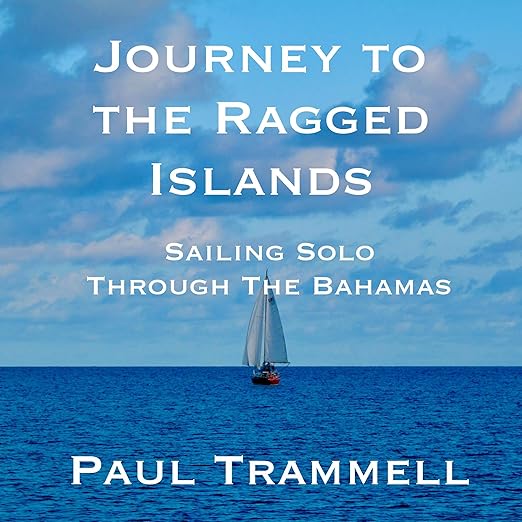
Solo sailing memoir at its best earns its authority through honesty rather than heroism, and Journey to the Ragged Islands delivers exactly that. Paul Trammell narrates his own firsthand account of sailing a 30-foot Dufour Arpege from Jacksonville, Florida through the central and southern Bahamas in this audiobook, and the thing that distinguishes it from most adventure writing in the genre is the plainness of his self-accounting. He includes both successes and mistakes, as the text states without elaboration, and that evenhandedness is what makes the memoir believable. The Ragged Islands of the title are not a metaphor; they are a specific, remote Bahamian archipelago that Trammell actually reaches after encounters with foul weather, sharks, and at least one near-death experience he describes without theatrical inflation.
Single-handed passage makes particular demands on the kind of story you can tell. There is no crew to offer perspective or dialogue, no one to disagree with your judgment or celebrate your decisions in real time. What Trammell does instead is write with unusual internal honesty about what it feels like to be alone on the water with a set of goals and a vessel that is capable of either delivering you or killing you depending on conditions and seamanship. The GPS coordinates and anchorage descriptions woven throughout give the memoir a dual-use quality that practical sailors will appreciate immediately. One reviewer confirms buying the book specifically for passage research before their own Bahamas trip, and the blend of narrative and practical information is unusual enough in the genre to be a genuine differentiating feature.
The geography covered is specific and extensive. Eleuthera, Cat Island, Long Island, the Jumentos Cays, the Exumas, the Berry Islands, and the Ragged Islands themselves are all visited and described in detail. For listeners who know these waters, the recognition will add considerable pleasure. For listeners who do not, the descriptions build a vivid geography of uninhabited cays, coral reefs, and the particular quality of Bahamian blue that appears in the text again and again as a counterpoint to the physical difficulty of getting there. Trammell also encounters a hermit on one of the remote islands, an old girlfriend, whales, and eels, and writes about all of it with the same unadorned attention he gives to squall avoidance and anchorage selection.
Trammell Reads Without Theatrical Artifice
Trammell's self-narration is the right choice for this audiobook. He reads without theatrical artifice, in the same register he probably uses to describe a course correction or brief a fellow sailor about conditions ahead. His voice carries the credibility of someone who was actually in the cockpit at three in the morning when the weather changed, and that quality of presence is difficult for a third-party narrator to approximate convincingly with a sailing memoir. One reviewer describes him as educational, encouraging, philosophical, and exciting, which captures the tonal range accurately. He is not merely reporting events; he is making an argument for a way of engaging with the world, and you hear that conviction in his reading.
Trammell is part of a longer tradition of solo sailing literature, and one reviewer invokes Moitessier and Knox-Johnston as the far horizon of that tradition. Trammell does not claim that territory, but the structural honesty of his writing, the willingness to document what went wrong alongside what went well, places him in recognizable company with the mode of seamanlike memoir those names represent.
Bought for Passage Research Before a Bahamas Trip
This is personal travel writing rather than crafted literary memoir, and listeners who come expecting polished prose architecture will find something rougher and more functional. The sailing technique discussions, while not dominant, require some baseline familiarity with passage-making terminology to fully appreciate. Those with no sailing background will still follow the narrative without difficulty, but some of the practical texture will be opaque. The book is also part of an ongoing body of work by Trammell, who has written multiple solo sailing narratives including Becoming a Sailor and Sailing to Newfoundland, and while this standalone volume has a complete arc from departure to return, readers who find his approach appealing have additional material available.
Searching for Uninhabited Islands as a Philosophy
This audiobook is a strong match for sailors with Bahamas plans, active or aspirational. It works equally well as practical research and as the kind of companionable armchair voyage one reviewer describes as a great way to go sailing in the Bahamas after a long day of work. Non-sailing listeners with an interest in solo adventure, uninhabited islands, and honest self-reckoning in difficult conditions will find enough here to justify the eight-and-a-half-hour runtime. Those expecting polished literary prose should look elsewhere. Those who want an honest voice from the cockpit of a small boat somewhere in the southern Bahamas, with all the practical and philosophical dimensions that come with extended offshore solo sailing, will find exactly that here.
There is a philosophy embedded in this kind of voyage that Trammell does not announce but does not hide either. Searching for uninhabited islands as a goal is itself a statement about what you want from the world, and the GPS coordinates and anchorage notes exist alongside reflections on what solitude at sea actually feels like from inside a small boat rather than from the shore. The book is not attempting to be more than it is, which is its actual virtue: accurate account from a single competent sailor who went somewhere genuinely remote and came back to describe it honestly.