Quick Take
- Narration: Munya Andrews narrating her own work is non-negotiable, she is an Aboriginal elder transmitting her culture’s knowledge in her own voice, and that specificity is the entire point of the audiobook.
- Themes: Indigenous cosmology, purpose and belonging, the relationship between self and country
- Mood: Contemplative, warm, and gently orienting
- Verdict: One of the few audiobooks where the listening format is genuinely superior to reading, Andrews’s oral guidance through Dreamtime concepts is exactly what audio was designed for.
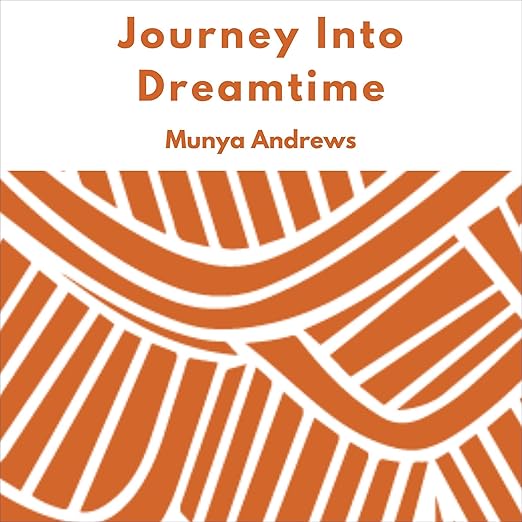
I put this one on early on a Saturday morning, before the day started demanding things of me, and I didn’t move much for three hours. That’s not a common experience with nonfiction. But Journey Into Dreamtime is not quite nonfiction in the way that history books are nonfiction. It’s closer to what you might call guided transmission, Aunty Munya Andrews, Aboriginal elder, inviting you into a way of understanding the world that has been sustained for over 65,000 years. The audiobook format here is not a convenience. It’s the point.
Andrews has a background as a barrister, a teacher, and an author, but the voice you hear in this audiobook is the elder voice, patient, specific, generous. She explains the Rainbow Serpent not as a mythological creature to be catalogued but as a living concept: a presence in water, in land, in the mechanism of traditional healing. She explains song lines not as poetic metaphor but as actual navigational and social infrastructure, how stories are woven into the land to guide people across vast distances. She explains dreaming not as sleep-vision but as the organizing principle that connects each person to a specific animal, place, or natural force in a web of belonging and responsibility.
Why Audio Is the Native Format for This Material
Dreamtime knowledge has always been oral. It was never meant to exist primarily on a page. The song lines themselves are the prototype of an audiobook, knowledge encoded in sound and movement, transmitted from elder to younger, inseparable from the voice that carries it. When Andrews speaks the Rainbow Serpent’s name in this audiobook, it arrives differently than it does on a page. There is authority in her pronunciation, a familiarity with the concept that no typeset rendering can replicate. This is one of the clearest examples I’ve encountered of oral tradition for which audio is the native format.
At three hours and thirteen minutes, the runtime is short by nonfiction standards. This is by design. Andrews moves through the major concepts, the Rainbow Serpent, Baiame the creator, sacred sites and their energetic function, the practical meaning of one’s dreaming, dreaming eyes and dreaming ears as modes of perception, without exhausting the topic. The book is an invitation, not a compendium. She is not trying to document Aboriginal knowledge for academic purposes. She is trying to give listeners enough of a framework to encounter their own relationship to the concepts.
Concepts That Travel
One of the book’s most quietly powerful moves is its argument that the Dreamtime concepts it explores are not exclusively Aboriginal, they are human. The question of how to discover your purpose in life, how to walk in the footsteps of ancestors, what it means to truly belong and be family to everyone and everything: these are questions that any listener carries. Andrews doesn’t make this argument by diluting the specificity of Aboriginal culture; she makes it by going deep enough into the specifics that their universality becomes visible from the inside rather than being asserted from the outside.
The sections on sorry rocks, on what it means to have kangaroo or possum dreaming, on the relationship between sacred sites and individual empowerment: these are specific, culturally rooted, and not simplified. But Andrews explains them in English with care for a listener who is coming from outside the tradition, and the combination of cultural precision and accessible language is what distinguishes this book from both academic ethnography and new-age appropriation.
What the Reviews Say Without Saying It
The reviews for this book are notably brief, “such a nice book full of wisdom and understanding,” “she’s a great teacher,” “very interesting”, but their consistency at 4.5 across 132 ratings suggests that what listeners encountered was exactly what they came for. The brevity of the reviews reflects something true about the experience: this book doesn’t give you a lot of argumentative content to describe or debate. It gives you something quieter that reviewers reach for simpler language to name. That’s often the sign of something that worked.
For Open Listeners and Those Who Want an Academic Catalogue
Listen to this if you want genuine engagement with Aboriginal cosmology, guided by an Aboriginal elder in her own voice. Listen to this if you’re planning to spend time in Australia and want to understand the country through a framework that predates European contact by tens of thousands of years. Listen to this if you find that audio learning opens things for you that reading doesn’t.
Skip this if you want a comprehensive academic survey of Aboriginal mythology across Australia’s many distinct Indigenous nations. Andrews is an elder and teacher, not an ethnographer cataloguing every tradition. What she offers is deep and particular; what it doesn’t offer is exhaustive breadth. But for what it is, Journey Into Dreamtime is one of the most genuinely irreplaceable titles I’ve encountered in this format.
Frequently Asked Questions
Is this a spiritual or religious book, and does it require any prior belief or practice to engage with?
Andrews presents Dreamtime concepts through Indigenous Australian cosmology, which is spiritual in the sense that it places humans in a relational web with country, ancestors, and natural forces. She does not require listeners to adopt any particular belief. The book is structured as an exploration and an invitation, and it travels well across different spiritual backgrounds, including none. Reviewers with no prior connection to Aboriginal culture consistently describe feeling welcomed rather than excluded by the material.
How does this audiobook differ from reading Andrews’s work in print?
The oral quality is the defining difference. Dreamtime knowledge has always been transmitted through voice, the song lines themselves are the precedent. Andrews narrating her own work means you’re hearing an Aboriginal elder transmit her culture’s knowledge directly, which is the mode that knowledge was designed for. The print edition carries the same content, but the audio adds an irreducible layer of authority and presence.
Does the book explain specific Dreamtime stories, or is it more focused on concepts?
It’s primarily conceptual, Andrews explains what dreaming means, what the Rainbow Serpent represents, how sacred sites function, what song lines do, rather than narrating Dreamtime stories in sequential form. There are illustrative examples and vignettes throughout, but the organizing purpose is to give listeners a framework for understanding the tradition rather than a collection of individual myths.
Would this work well as a companion listen alongside a visit to Australia?
Yes, and several reviewers suggest exactly this use. Having Andrews’s framework in mind while visiting sacred sites, engaging with Aboriginal art, or simply moving through Australian landscapes gives those experiences a different quality of attention. The concept of song lines alone, knowledge embedded in landscape, changes how you read the country once you understand it.