Quick Take
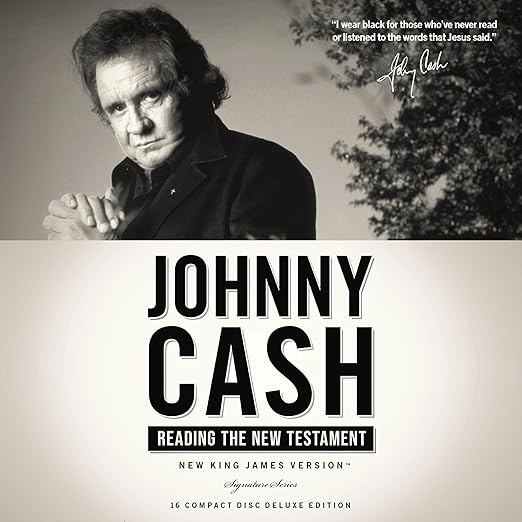
- Narration: Johnny Cash reads the New King James Version with reverence and gravitas; there is no background music, which proves to be exactly the right choice.
- Themes: scripture as living word, faith and mortality, the relationship between an artist’s voice and sacred text
- Mood: Solemn, unhurried, and quietly profound
- Verdict: A singular listening experience that transcends the category of audio Bible; Cash’s voice carries the text with a weight that most professional narrators cannot approximate.
I want to be careful about how I frame this one, because it sits in a category that usually calls for different criteria than the ones I apply to narrative audiobooks. This is a recorded reading of the New Testament, not a memoir or a thriller or a work of criticism. And yet it is also something more than a functional audio Bible, because the voice doing the reading is Johnny Cash, and that fact changes the nature of the listening experience in ways that are difficult to fully account for in standard review terms.
I came to it late on a winter evening, not looking for anything in particular, and found something that stayed with me for days afterward.
Our Take on Johnny Cash Reading the Complete New Testament
Cash approached this project, according to the synopsis, with fear, respect, awe, and reverence for the subject matter. Those four words are not marketing language. They describe a quality that is audible in the recording. Cash said he also did it with great joy because he loved the Word, and that is audible too. The combination of gravity and warmth in his delivery is something most narrators spend entire careers trying to develop and never quite achieve. Cash had it naturally, rooted in a life of faith that was complicated enough to make the text feel earned rather than recited.
The New King James Version is a translation that balances contemporary accessibility with the cadence of traditional scripture, and it suits Cash’s voice. He reads without background music, which reviewers consistently identify as one of the recording’s great virtues. A 91-year-old listener in one review specifically noted that this was the only audio Bible she had encountered without background music, and that the clarity of Cash’s unaccompanied voice made it both clear and enjoyable. That observation matters. Background music in sacred text recordings often functions as emotional instruction, telling the listener how to feel. Its absence here leaves room for the listener’s own response.
Why This Recording Goes Beyond the Audio Bible Category
There is a cultural dimension to this recording that is worth naming. Johnny Cash occupied a specific place in American spiritual life that was not quite church and not quite secular, a space where faith and suffering and music and mortality coexisted without resolution. That position gives his reading of the Gospels, the Epistles, and Revelation a texture that a studio narrator, however competent, would not bring. When Cash reads the Beatitudes or the passages from Revelation, you are aware that these are words being read by a man who has lived through things they describe. That awareness enriches the text.
The project had been requested by Cash’s mother for twenty years before he undertook it. He recorded it knowing it would outlast him. That context is present in the recording in ways that are not theatrical or performed but simply there.
What to Watch For in This Recording
At eighteen hours and forty-two minutes, this is a substantial commitment. The New Testament read in its entirety is not something most people sit through in a single stretch, and the recording is designed for sustained, intermittent listening rather than consumption in the manner of a narrative audiobook. The 16-CD structure mentioned in the synopsis maps to a format designed for incremental engagement, and audio listeners may want to approach it the same way, returning to specific books or passages rather than trying to process the whole in sequence.
The recording also requires clarity about what it is and is not. It is not annotated, not discussed, not explained. Cash reads, and then the next book begins. For listeners who want commentary or study notes alongside the text, a different format will serve better.
Who Should Listen to Johnny Cash Reading the Complete New Testament
This is for listeners who want to engage with the New Testament text as an act of listening rather than study, and who respond to the idea of a specific voice carrying that text. It works for personal devotion, for listeners who struggle with reading due to vision or other challenges, and for anyone curious what it sounds like when a major American artist reads the text he spent his life believing. Those who want scripture in a contemporary translation with added commentary should look to other formats. Those who want the words themselves, delivered without intermediary, will not find a better version than this one.
Frequently Asked Questions
Is there any background music or sound design in this recording, or is it just Cash’s voice?
It is purely Cash’s voice with no background music. Multiple reviewers specifically praise this choice, noting it makes the reading clearer and more emotionally direct than audio Bibles that use musical accompaniment.
Which translation of the New Testament does Johnny Cash read?
Cash reads the New King James Version, a translation that maintains the rhythmic cadence of traditional scripture while updating archaic language for contemporary listeners.
Is the recording suitable for listeners who are not practicing Christians?
Yes. The recording functions as both sacred text and as a document of an artist’s faith, and listeners curious about either dimension will find value here. Cash’s voice and the cultural weight he carries are accessible regardless of the listener’s own religious position.
How does this compare to other audio Bible recordings in terms of production quality?
The production is clean and the audio quality is solid given that it was released in 2006. It is not a studio production with modern processing, but Cash’s voice is captured clearly and the absence of background audio means there is nothing to compete with the reading itself.