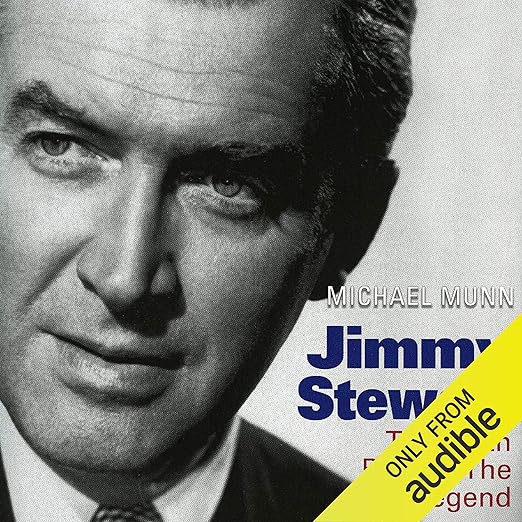
Jimmy Stewart is one of those figures whose screen persona is so thoroughly absorbed into American cultural memory that writing about the real man almost feels like a category error. The earnest drawl, the lanky grace, the moral decency that George Bailey and Jefferson Smith made synonymous with a certain vision of American goodness. Michael Munn's biography sets out to complicate all of that, and in substantial ways it succeeds. I finished it on a Sunday evening with the distinct feeling that I understood something truer about Stewart and something more uncomfortable about the period he inhabited.
The book draws on Munn's claimed personal interviews with Stewart and his friendship with Stewart's wife, Gloria. It is worth noting that Munn's methodology has attracted criticism, particularly regarding his habit of direct quotation from private conversations and some factual errors identified by reviewers familiar with the period. I take those concerns seriously, and the more sensational revelations should be held with corresponding skepticism while recognizing that the broad portrait of Stewart's contradictions is corroborated by other sources.
First, the Big Picture
The biography's most valuable contribution is its treatment of Stewart's World War II service, which is covered comprehensively and with genuine respect. Stewart flew real combat missions, rose to the rank of colonel, and returned from the war marked in ways that his postwar films, particularly Rear Window and Vertigo, register if you know where to look. Munn draws the connection between Stewart's wartime experience and the darkness that entered his screen performances after 1945 with more precision than most accounts manage. The sections on his working relationships with Frank Capra and Alfred Hitchcock are particularly well rendered. One reviewer who had projected an idealized image onto Stewart notes with some sadness that the biography revealed him to be fully human, complete with faults and a notoriously volatile temper that surprised many readers. That quality of surprised recognition is the biography's primary gift.
Mark Whitten's narration is steady and professional throughout, and the audiobook runs to just over eleven hours, which is appropriate for the scope of Stewart's career. The audio format suits this kind of celebrity biography because the anecdotal structure, moving between film sets, military service, personal relationships, and political entanglements, flows more naturally when heard than when read on the page. Whitten does not attempt to imitate Stewart's famous vocal style, which is the right call. Impersonation would undercut the seriousness of what Munn is attempting, and the steady neutral register keeps the biographical distance appropriate for material this contested.
What to Watch For in Jimmy Stewart
The FBI material is the most provocative section of the book, and the most contested. Munn claims Stewart worked for J. Edgar Hoover and was manipulated into participating in the Hollywood Red Scare investigations. Stewart's right-wing political convictions were genuine and well documented by other sources, so the broad claim is not implausible, but the specific details about undercover work should be held lightly. One critical reviewer notes that the book actually glosses over some of Stewart's most important films while spending considerable time on his private life. Listeners hoping for comprehensive analysis of It's a Wonderful Life, Rear Window, or the westerns may find the filmography coverage thinner than expected. The revelation about Stewart's romantic history before his marriage to Gloria is handled with more tact than the synopsis's framing suggests.
Best Suited For
Film history enthusiasts who want a biography that takes the life seriously alongside the work will find value here. Those who prefer hagiography or want the George Bailey version of Jimmy Stewart intact should look elsewhere. Listeners with a particular interest in Hollywood's relationship with American politics in the 1940s and 50s will find the book's treatment of that period relevant. Anyone who has found the darkness in Stewart's postwar Hitchcock performances puzzling will come away with useful context, even allowing for the methodological caveats that responsible reading of Munn requires.
Is Michael Munn's biography of Jimmy Stewart considered reliable by historians?
Munn's methodology has attracted criticism, particularly regarding direct quotations from private conversations and some factual errors noted by reviewers. The broad portrait of Stewart's contradictions is consistent with other sources, but specific sensational claims should be verified against other biographies.
Is this audiobook appropriate for listeners who are not already familiar with classic Hollywood?
Basic familiarity with Stewart's films and postwar Hollywood will significantly enhance the experience. The biography assumes some contextual knowledge about the studio system and the political climate of the 1940s and 50s.