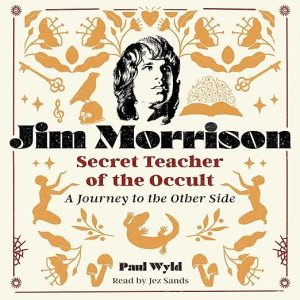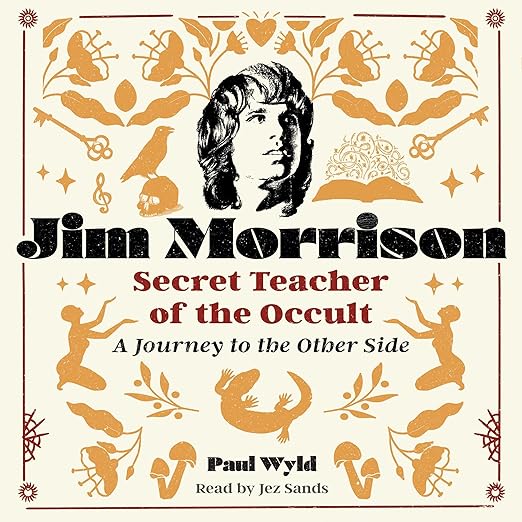
- Read by: Jez Sands reads Paul Wyld's dense argument with measured authority, calibrated to the material's scholarly ambition without tipping into the portentousness the subject might invite.
- At its heart: Rock stardom as shamanic practice, occult transmission through art, counterculture spirituality
- Vibe: Dense and atmospheric, intellectually demanding
- Short version: Wyld's argument is provocative and well-sourced enough to reward serious listeners, though those expecting conventional biography will find this a very different kind of book.
Jim Morrison's relationship to mysticism has been debated since The Doors first played the Whisky a Go Go, but Paul Wyld's Jim Morrison, Secret Teacher of the Occult takes that relationship further than most accounts have been willing to go. This audiobook, narrated by Jez Sands, frames Morrison not as a rock singer with occult pretensions but as a genuine shamanic initiate transmitting esoteric knowledge through the medium of performance and recorded sound. It is a thesis that will attract skeptics and true believers in roughly equal measure, and Wyld has clearly anticipated both readerships in the structure of his argument.
The foundation rests on specific textual analysis: Morrison's documented reading list, which included Kurt Seligmann's The Mirror of Magic, Colin Wilson's The Outsider, and the writings of Nietzsche and Kerouac, along with his intimate writings, his poetry, and the testimony of people who actually knew him, including Doors keyboard player Ray Manzarek and photographer Paul Ferrara. That evidential grounding distinguishes this from speculative fan biography. Wyld does not ask you to accept the shamanic thesis on faith; he builds it from the materials Morrison himself left behind, and the construction is careful enough to be taken seriously.
A Golden Thread Back to Thoth-Hermes
Wyld's central claim, that Morrison was not a superficial dabbler but an actual teacher transmitting knowledge through what the author calls a golden thread stretching back to Egypt and Thoth-Hermes, is bold enough to require the sustained argument the book provides. Reviewers have praised the work as the definitive Morrison biography for serious students of the subject, and one reviewer with a specific geographic connection to Morrison's high school years in Alexandria noted that the book's research into Morrison's early literary influences, including the encouragement he received from specific teachers in literature, is particularly strong.
The Doors were named for Aldous Huxley's The Doors of Perception, which is itself drawn from William Blake's Marriage of Heaven and Hell, and Wyld traces those reference chains with patient literary scholarship. The chain does not stop there. Morrison's interest in Seligmann's Mirror of Magic connects to a longer hermetic tradition, and Wyld argues that Morrison understood himself to be working within that tradition consciously rather than borrowing its imagery for aesthetic effect. That distinction between decoration and initiation is at the heart of everything the book argues.
The treatment of praxis is where the book's argument becomes most specific and most interesting. Wyld examines how Morrison's concert performances were structured around the kind of collective psychic transformation that traditional shamanic practice achieves through ritual, with the audience placed in the position of initiates rather than spectators. The Doors' extended improvised sections, the confrontational stage behavior, the deliberate construction of altered states through volume and repetition, are analyzed as applications of occult technique rather than as rock and roll excess. Whether you find this persuasive depends significantly on what you bring to the book, but the argument is made with precision rather than enthusiasm alone.
Sands Commits Instead of Keeping Ironic Distance
Jez Sands is well-suited to this material. The tone Wyld's prose requires is measured and deliberate, with occasional passages of real intensity when the argument reaches its central claims about Morrison's place in Western esoteric tradition. Sands holds that register consistently across six hours without allowing the delivery to become either too dry or too reverential. Books like this live and die on whether the narration commits to the argument or holds it at ironic distance, and Sands commits. The voice respects the scholarship without making the listener feel they are being lectured.
At just under six and a half hours, the audiobook is a compact listen relative to its ambition. The structure moves efficiently from influence to influence, tracing the esoteric threads across Morrison's reading and output with the discipline of a scholar who has done genuine archival work. Listeners who have read any of Morrison's primary sources, the poetry collections, the intimate notebooks that have been published in various forms, will find those passages particularly resonant when encountered in this interpretive frame.
Built for Consecutive Listening, Start to Finish
The book makes extensive reference to specific texts and doctrinal systems, and listeners without prior acquaintance with the Western esoteric tradition may find some of the framework requires pausing and looking things up. This is not a criticism of the writing; it is the nature of the argument. Wyld writes for readers who will follow up on his references rather than those seeking a guided tour. The sections on Morrison's poetry and the analysis of specific Doors lyrics are the most accessible entry points for listeners coming from a music rather than an esoteric studies background.
The book also engages, in its later chapters, with the question of how Morrison's shamanic project relates to the broader spiritual awakening of the 1960s counterculture. That contextualization is useful for understanding why the argument matters beyond Morrison biography, but it requires the listener to have followed the earlier chapters closely. The audiobook rewards consecutive listening rather than the kind of dipping-in that works for more episodic non-fiction.
Ambitious Music Criticism in the Esoteric Tradition
Serious Morrison scholars and students of rock music's relationship to counterculture spirituality will find this essential. Listeners interested in the Western esoteric tradition and its unexpected appearances in twentieth-century popular culture will get significant value. Those looking for conventional rock biography with anecdotes about studio sessions and tour dates will find this a different register entirely. The book is best suited to active listening rather than background play, and to listeners willing to sit with a sustained intellectual argument rather than a narrative. Wyld has written one of the most ambitious pieces of music criticism in the esoteric tradition, and Sands delivers it with the attention it deserves.
Is this audiobook a conventional Jim Morrison biography?
No. It is a scholarly argument about Morrison's relationship to the Western esoteric tradition, drawing on his documented reading, his lyrics, and the testimony of people who knew him. Readers expecting conventional biographical narrative should approach it as critical analysis rather than life story.
How well-researched is the audiobook's argument about Morrison and the occult?
Wyld draws on primary sources including Morrison's personal writings, his poetry, and accounts from Doors band members including Ray Manzarek. The bibliography includes specific texts Morrison is documented to have read, giving the argument a firmer evidential basis than speculative accounts of this kind often achieve.
Does Jez Sands's narration suit the scholarly tone of the material?
Yes. Sands maintains a measured, committed delivery that respects the seriousness of the argument without veering into academic dryness or unwarranted mysticism. The narration is well-matched to the book's ambition throughout its six-hour runtime.
Do I need prior knowledge of occult traditions to get value from this audiobook?
Some familiarity with the Western esoteric tradition will enrich the experience significantly, but Wyld explains the key frameworks as they appear. Listeners who know Morrison primarily through his music will find enough context to follow the argument, though the denser doctrinal sections may warrant re-listening.