Quick Take
- Voice: Danny Campbell brings the sustained authority and tonal control he has shown on other long-form biographies to nearly fourteen hours of frontier history.
- Big ideas: Fur trade era, westward exploration, treaty diplomacy, Native displacement
- Atmosphere: Sweeping and unhurried, honest rather than mythologizing
- Worth it?: A thorough, honestly told frontier biography for patient listeners who want depth over a single dramatic set piece.
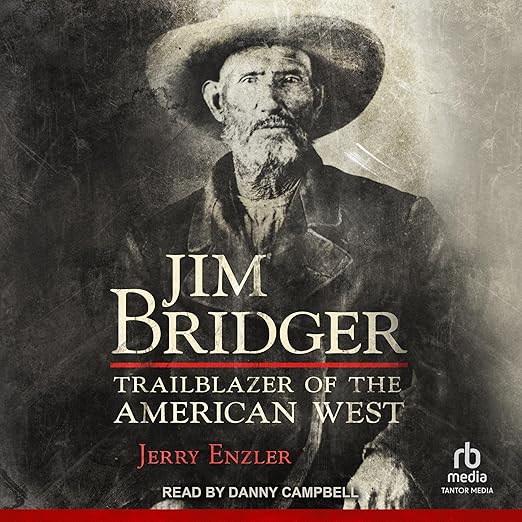
In 1822, an eighteen-year-old orphan named Jim Bridger left St. Louis with Mike Fink and roughly a hundred other young men to trap beaver up the Missouri River, and by twenty he had 'discovered' the Great Salt Lake, a claim historians still argue about but that stuck to his name regardless. Jerry Enzler's biography, narrated by Danny Campbell across nearly fourteen hours, is the first full-scale account of Bridger's life in six decades, and the audiobook format suits this kind of sprawling frontier narrative unusually well: long treks, long trapping seasons, long treaty negotiations, all rendered at a pace that mirrors how slowly and completely the American West actually got mapped by people like Bridger.
Unable to Read, Yet Trusted With the Treaty
What Enzler's book does especially well is resist flattening Bridger into a single archetype. He was a fur trapper in the Blackfeet-contested territory of the northern Rockies, but he was also, later, a trusted guide for Smithsonian scientists, army topographical engineers, and expedition leaders who needed someone who actually knew the terrain rather than a map of it. The detail that lands hardest, repeated by more than one reviewer, is that Bridger could neither read nor write, and yet he was trusted enough to help map tribal boundaries for the Great Indian Treaty of 1851, one of the most consequential documents in the era's relations between the U.S. government and Plains nations. Later still, he built a fort along the Oregon Trail that became a crucial waypoint for westward migration, and he blazed an alternate route for Montana-bound gold miners specifically to avert war with Red Cloud's Lakota coalition, a decision that reads, in Enzler's telling, as a rare moment of a frontier figure actively trying to prevent bloodshed rather than provoke it.
Enzler's specific claim to originality, sources uncovered in the six decades since the last documented Bridger biography, is not a small one; it means this version of the story incorporates archival material that simply was not available to earlier biographers working with a much thinner documentary record. That matters because Bridger himself left behind no written account of his own life, given his illiteracy, so every biography of him is necessarily built from other people's letters, expedition reports, and treaty records rather than a subject's own testimony. A wider net of primary sources translates directly into a more textured account of exactly the kind of granular detail, specific trapping-brigade routes through Blackfeet territory, precise treaty-negotiation particulars, that separates a genuinely researched biography from a recycled legend.
Mike Fink, the semi-legendary keelboatman who led that first 1822 expedition, is himself one of the era's larger-than-life characters, and Enzler's decision to begin Bridger's story inside Fink's expedition rather than with Bridger in isolation immediately locates him within a real, specific historical moment, western fur-trade expansion at its earliest organized stage, rather than treating him as a mythic figure who simply appeared fully formed.
Campbell's Range, Proven on Call Sign Chaos and Evel
Danny Campbell has narrated other long-form biography before, including Jim Mattis's Call Sign Chaos and Leigh Montville's Evel, and both prior performances suggest the specific skill this book needs: sustained authority and momentum across a marathon runtime without the energy flattening into monotone somewhere around hour eight. Evel in particular required Campbell to manage real tonal swings, exhilarating triumph chapters against darker decline chapters, and while Jim Bridger's arc is not showbiz-shaped the way Evel Knievel's was, it does move through comparably distinct phases, brutal early trapping years, midlife expertise as a sought-after guide, later diplomatic efforts to prevent frontier war, that reward a narrator capable of shifting register without losing the narrative thread. Fourteen hours is a genuine commitment, and Campbell's demonstrated stamina on other long biographical runtimes is a real asset here.
The book also builds real structural pleasure toward Bridger's late-career diplomatic turn, using decades of accumulated terrain knowledge and cross-tribal relationships to make his peace-preserving choices feel earned rather than sudden. Campbell's narration tracks that slow accumulation well, treating the early trapping years with the same unhurried attention as the higher-stakes treaty and gold-rush material later on, rather than rushing the setup to reach a more dramatic payoff.
Longevity and Adaptability Over Any Single Feat
Reviewer SharonKaz flags something worth knowing going in: alongside Bridger's own adventures, the book includes detailed description of how Native American nations were displaced from their land and way of life during exactly the decades Bridger was active, material she calls a good supplement to standard high school history precisely because it does not soften that displacement into background scenery. Enzler is telling a biography, not primarily a history of federal Indian policy, but he does not let Bridger's story exist in isolation from what was actually happening to the Blackfeet, Crow, and Lakota nations whose territory he trapped, guided through, and eventually helped draw treaty lines across. Listeners expecting a purely celebratory mountain-man adventure narrative should know this book earns its promise to finally give this outsize character his due honestly, including the parts of that history that are genuinely uncomfortable.
The comparison points the synopsis draws, John C. Fremont, Kit Carson, Jedediah Smith, are useful for calibrating expectations, but Bridger's specific niche, per Enzler's argument, is longevity and adaptability rather than any single legendary feat. Fremont and Carson both became famous largely through specific, publicized expeditions; Bridger's career instead spans essentially the entire fur-trade era into the beginning of organized westward settlement, which is part of why a single-volume biography took this long to attempt properly. Reviewer bg.basst.ers' comparison to a Ken Burns documentary is apt for exactly this reason: the pacing favors accumulated detail and connected consequence over any single dramatic set piece, a genuinely different reading experience than a more conventional frontier-adventure biography built around one legendary showdown.
Twelve Years Spent Retracing This Exact History
This audiobook rewards listeners with real patience for western American history done thoroughly, especially anyone who has read adjacent figures, Carson, Fremont, Smith, and wants the person who arguably outlasted and outadapted all of them getting comparable depth of treatment. CJ Newell's review, describing twelve years of full-time travel partly inspired by wanting to physically retrace this history, including experiencing South Pass firsthand, speaks to how vividly Enzler renders specific western landscapes; listeners who enjoy pairing history with geography will find plenty to chase here even without literally following Bridger's routes themselves.
Skip this one if you are looking for a tightly plotted, single-episode adventure narrative rather than a comprehensive career-spanning biography, or if extended, honest treatment of Native American displacement alongside the frontiersman narrative is not what you are in the mood for right now. Readers who prefer their mountain-man history mythologized rather than complicated, per SharonKaz's more clear-eyed take, may also find Enzler's approach less romantic than some competing frontier biographies, though that same honesty is exactly what makes this the more durable, defensible account of the two options.
A Few Questions About Jim Bridger
How does this audiobook compare to biographies of Kit Carson or John C. Fremont?
Enzler argues Bridger's distinguishing trait is longevity and adaptability across the entire fur-trade era, rather than a single famous expedition the way Fremont and Carson are often remembered.
Is Danny Campbell's narration suited to a fourteen-hour audiobook, or does the pacing drag?
His demonstrated stamina on other long-form biographies, including a seventeen-plus-hour title, suggests he sustains momentum well across marathon runtimes like this one.