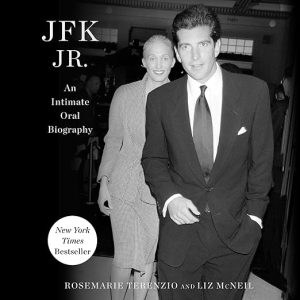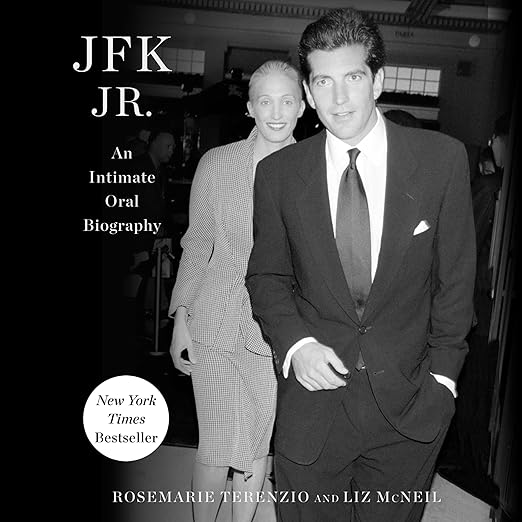
RoseMarie Terenzio occupies a specific position in the literature on JFK Jr. that no other writer can claim: she was his personal assistant for years, close enough to know him without the idealization that distance encourages and without the detachment that journalistic distance imposes. JFK Jr., this audiobook narrated by Michael David Axtell and running nearly fifteen hours, is billed as the first oral biography of John F. Kennedy Jr. That designation is its key structural choice. Rather than Terenzio narrating a linear life, the book assembles testimony from friends, lovers, classmates, teachers, and colleagues - building a portrait the way a mosaic builds an image, through accumulation rather than declaration. The Washington Post called it "the fullest portrait of Kennedy ever written," which is a claim the format earns.
JFK Jr. was one of the most photographed and scrutinized private citizens in American history, which creates a particular challenge for any biography: the public mythology is so dense that the actual person is difficult to see through it. The oral format is Terenzio's answer to that problem. When thirty-plus people who actually knew John Kennedy Jr. tell you what he was like in a specific moment - how he handled embarrassment, what made him genuinely angry, how he moved through a room - the accumulated specificity begins to displace the myth in ways that no single narrative voice can achieve. Multiple reviewers describe the experience of listening as "being in a room" with his friends and loved ones, which is exactly the feeling the format is designed to produce.
Voices That Complicate as Well as Celebrate
The decision to structure this as a pure oral biography rather than a hybrid narrative-interview form creates real stakes for the project. If the voices are not varied and specific enough, the format collapses into a procession of praising anecdotes. Terenzio avoids that by including voices that complicate as well as celebrate - people who saw him at his most frustrated, at his most uncertain, at his most characteristically human. The portrait that emerges is of a man who was funny, genuinely kind, and burdened in ways that he managed with more grace than most people would have in comparable circumstances. That "complicated psyche" the synopsis promises is rendered through other people's observations rather than through the biographer's analysis, which creates a different kind of intimacy.
The George magazine chapter - his foray into political journalism - is where the book is most interesting for readers who want to understand what Kennedy was building rather than simply who he was. The magazine represented a genuine creative and professional project, and the accounts from colleagues there give a picture of his ambitions that the celebrity mythology tends to obscure. He was not simply coasting on his name; he was attempting something. The "what-ifs" the synopsis references are most alive in these sections, where the distance between what he was pursuing and what he never got to complete feels most acute.
Axtell Keeps Dozens of Voices Distinct
Michael David Axtell's narration is doing something technically specific in this audiobook: he is reading testimony from dozens of named individuals, all speaking in first person, without allowing any voice to subsume the others. The 14 hours and 54 minutes of runtime would be exhausting if the narration flattened the oral voices into a single register, but Axtell maintains enough differentiation to keep the speaker transitions clear while preserving the sense that the testimonies are being heard rather than merely read. Reviewers who describe the experience as "sitting in a room" are responding to this specific quality of Axtell's approach - the narration that makes you feel like a witness rather than a reader.
The audio format also suits the oral biography's structural logic particularly well. An oral biography is, literally, spoken testimony - it has an intrinsic relationship to voice and listening that the page-reading experience somewhat contradicts. In audio, the material is arriving in the medium it was gathered in, and that alignment creates an unusual sense of authenticity. The book was always meant to be heard, in some sense, and Axtell's narration honors that.
A Gift or an Impossible Weight to Carry
The structure of the oral biography means that certain themes accumulate gradually rather than being announced. The question of what Kennedy owed to his father's legacy, and how he carried that obligation, is not addressed in a single chapter but threaded through dozens of individual accounts. Listeners who attend to how different speakers frame that inheritance - some seeing it as a gift, others as an impossible weight - will find the book developing a more complex argument than any single speaker makes explicitly.
The inevitable ending - the plane crash in July 1999 that killed Kennedy, his wife Carolyn Bessette-Kennedy, and her sister - is handled with the same oral format that carries the rest of the book. Multiple reviewers note the particular weight this creates: when you have spent fourteen hours in the company of people who loved him, the ending is not historical information but personal loss. That accumulated investment is the oral biography's greatest achievement, and it is the reason the audio format is the right way to experience this particular book.
Who He Actually Was, Through Others' Testimony
Readers with any interest in Kennedy family history, American political mythology, or the specific experience of public life in the late twentieth century will find this rewarding. The oral format means it is not a conventional political biography, and listeners who want policy analysis or a comprehensive account of his political potential should look elsewhere. Those who want to know who JFK Jr. actually was as a human being, through the testimony of people who knew him well, will find nothing comparable in the existing literature. The nearly fifteen-hour commitment is justified by the scope and specificity of what Terenzio has assembled.
Before You Press Play
- Narration: Michael David Axtell navigates the unusual structure of an oral biography - dozens of named speakers with distinct voices and relationships to the subject - with a consistency that makes the chorus of perspectives feel unified rather than fragmented.
- Themes: Legacy and expectation, public myth versus private life, grief and American idealism
- Mood: Intimate and elegiac
- Verdict: RoseMarie Terenzio's oral biography of JFK Jr. assembles a portrait that the standard narrative biography cannot achieve, and Axtell's 14-hour narration makes the chorus of voices feel like a room you've been invited into.