Before You Press Play
- Narration: Jacques Roy handles the ancient proper nouns and historical texture with confident authority, keeping the narrative momentum without losing scholarly precision.
- Themes: Jewish resistance and identity, imperial overreach, the roots of Christianity and modern Judaism
- Mood: Propulsive and densely informative, like a documentary narrated by someone who understands that history is made by specific people in specific rooms
- Verdict: Barry Strauss brings real narrative drive and recent archaeological scholarship to two centuries of Jewish-Roman conflict in an audiobook that earns its place on any serious ancient history shelf.
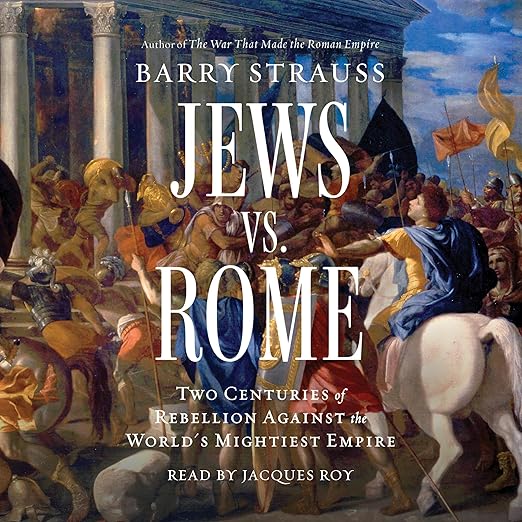
Barry Strauss's Jews vs. Rome audiobook opens on a period of history whose consequences are still visible in the present: the two hundred years between 63 BCE and 136 CE during which the Jewish people launched several major revolts against the Roman Empire, lost Jerusalem, lost the Temple, scattered across the ancient world, and - in ways that most histories have underemphasized - helped give rise to Christianity as a distinct religious movement. Strauss is a leading scholar of ancient military history, and he brings to this subject the same qualities that distinguished his earlier work: narrative drive, careful use of primary and recent archaeological sources, and a genuine eye for the specific figures who made the larger events happen.
The book covers three major uprisings: the Great Revolt of 66-70 CE, which culminated in the destruction of Jerusalem and the Temple and the Siege of Masada; the Diaspora Revolt, sparked by heavy taxes across the Empire; and the Bar Kokhba Revolt of 132-136 CE. This is not unfamiliar terrain for readers of ancient history, but Strauss earns the claim of newness through recent archaeological discoveries and scholarship that have genuinely shifted our understanding of the period. The picture of Masada's final days, for instance, has been revised by archaeological work that complicates the narrative of mass suicide that the ancient sources, particularly Josephus, established.
Berenice, Titus's Lover, Gets Her Due
What distinguishes Strauss from other treatments of this material is his equal attention to the political context of the revolts and the personal stories of the figures who led and suffered through them. Simon Bar Kokhba, the leader of the final revolt, receives a reconstruction that goes beyond the legendary figure of rabbinical tradition. But the more surprising choice, and one of the book's most effective sections, is the treatment of Berenice: a Jewish princess who played a significant role in the politics of the Great Revolt and was the love of Titus, Rome's future emperor - the same man who destroyed Jerusalem and the Temple. This is a story that sounds invented but is documented, and Strauss handles it with the care it deserves.
The internal conflicts among Jews - between zealots and moderates, between those who accepted certain terms of Roman rule and those who would not - are given full weight. One of the book's most important contributions is its treatment of the Jewish people not as a monolithic bloc facing Rome but as a community divided over strategy, theology, and political survival in ways that parallel internal divisions in any nation facing an overwhelming external power. This complexity is what makes the history feel contemporary without the book needing to make that comparison explicit.
Roy Keeps Pace Through Eleven Dense Hours
Jacques Roy narrates with the confidence that military and ancient history requires. The proper nouns of the ancient world - Roman general names, Jewish place names, Greek terms that survived into the historical record - are handled without the stumbling or over-caution that can derail a narrator working outside familiar territory. Roy keeps the narrative moving, which is important because Strauss has packed considerable historical density into eleven hours and forty-four minutes, and a narrator who let the pace drag would make the content feel heavier than it is.
Reviewers consistently describe the book as "hard to put down" - a quality that is particularly notable for military history, which can easily become a sequence of maneuver-and-result without the emotional texture that makes battles feel like things that happened to human beings. Strauss's approach, which a reviewer describes as "vivid" in its reconstruction of specific scenes, and Roy's narration of those scenes with appropriate energy, work together to produce a listening experience that sustains attention across the full runtime.
Written by the Losing Side's Own Historian
The book's primary ancient source for much of this period is Josephus - a Jewish historian who initially commanded forces against Rome, surrendered, and ultimately wrote his histories under Roman patronage. Strauss uses Josephus extensively while also flagging the interpretive problems his position creates. A reviewer who is a humanities professor notes this explicitly: Strauss "relies heavily on Josephus' histories" while working to distinguish what is reliable from what reflects Josephus's complicated obligations to his Roman patrons. Listeners should understand that we are working from the "loser's perspective," as one reviewer characterizes it, and that the historical reconstruction involves judgment calls about source credibility.
The book is also clear that the revolts' consequences extended far beyond the ancient Near East. The destruction of the Temple in 70 CE reshaped Judaism permanently, accelerating the development of the rabbinic tradition as the center of Jewish life in the absence of the priestly Temple structure. The simultaneous development of early Christianity out of the same matrix is addressed as a parallel consequence rather than a separate history, which gives the book an intellectual ambition beyond military history.
General Readers of Rome, Judea, and Christian Origins
This audiobook rewards listeners with an interest in Roman history, Jewish history, or the origins of Christianity who want a narrative treatment that incorporates recent scholarship without requiring prior expertise. Strauss writes for an engaged general audience rather than specialists, which means the book is accessible without being simplified. Skip if you want pure military operational history or a theological treatment of the period - Strauss is a historian of ancient warfare and politics, and his interest is in the intersection of military events, political decision-making, and cultural consequence rather than liturgical or doctrinal development. For the listener who wants to understand how two centuries of conflict between Rome and Judea reshaped the ancient world, the book is among the more accomplished recent entries in this territory.
Frequently Asked Questions
Does this audiobook require prior knowledge of Roman or Jewish history to follow?
No. Strauss provides enough context for each period and figure that listeners without a background in ancient history can follow the narrative. The book is written for an engaged general audience, and Roy's narration keeps the historical material accessible.
How does this audiobook handle the reliance on Josephus as a primary source, given his complicated position as a surrendered Jewish general writing under Roman patronage?
Strauss addresses the problem of Josephus directly, using his histories while flagging where his obligations to Roman patrons may have shaped his account. The book's use of recent archaeological evidence alongside Josephus provides a way to check and calibrate the ancient source.
Does the audiobook cover only the military history of the revolts, or does it address the broader religious and cultural consequences?
Strauss covers both. The military narrative of the three revolts is the spine of the book, but the consequences - the transformation of Judaism after the Temple's destruction, the rise of early Christianity from the same matrix, the legacy of figures like Bar Kokhba in Jewish tradition - receive sustained attention throughout.
How long is the audiobook and is the runtime justified by the scope of content covered?
The audiobook runs eleven hours and forty-four minutes, covering approximately two centuries of history across three major revolts and multiple political and religious consequences. Reviewers describe the pacing as 'hard to put down,' suggesting the runtime is well-used rather than padded.