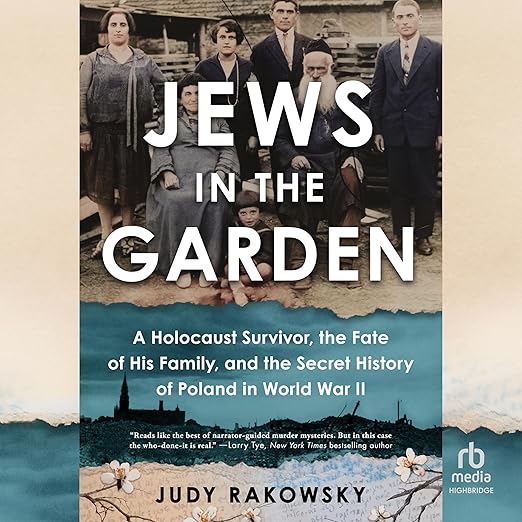
Heavy footfalls thud on a rainy road in 1944, and that single image opens Judy Rakowsky's audiobook Jews in the Garden with the same unease it must have carried in real life. Gunmen are closing in on a hilltop farm in Poland, hunting rumors of a hidden Jewish family, and by morning only one member of that family, sixteen-year-old Hena Rozenek, will still be alive. Rakowsky, an investigative journalist, builds outward from that scene into a decades-spanning inquiry that starts four decades later when her cousin Sam Rakowski Ron, a Holocaust survivor living in the United States, finally agrees to talk about the neighbors he lost and the truths Poland has spent generations avoiding. What begins as a family conversation becomes a reporter's pursuit of records, denials, and a government still guarding its own version of events.
A Delivery That Slows Into Genuine Hesitation
Rakowsky narrates her own book, and that choice turns out to matter more than it might for a typical memoir. She is not simply reading her reporting aloud; she is the cousin who received these confessions in real time, and her voice carries both a journalist's discipline and an unmistakable weight when the story turns to her own family. That combination is difficult for a professional narrator to fake convincingly, however skilled. When she describes standing in the actual garden where the Rozeneks once hid, the delivery slows in a way that reads as genuine hesitation rather than performed emotion, and that distinction matters in a genre where sincerity is the entire currency.
One listener, Pat Kramer, wrote that the book 'reveals the truths behind what was really going on during the Holocaust in Poland and how many people gave their lives to protect others, knowing full well the consequences.' That is a fair summary of the book's central achievement: it complicates the tidy national narrative Poland has told about its wartime conduct without erasing the real courage of Poles who did protect their neighbors at mortal risk.
Working a story this close to home creates an obvious tension: how does a journalist maintain rigor when the source is family? Rakowsky addresses that directly rather than pretending the conflict does not exist. Listeners can hear her own hesitation about how hard to push an elderly cousin for details he may not want to relive, and that self-awareness keeps the book from reading as either cold reportage or uncritical family tribute.
This Audiobook's Real Engine Is Forty Years of Silence
The propulsive force of this audiobook is not the 1944 night itself but the forty-year silence that follows it. Sam Rakowski Ron survived, rebuilt a life in America, and said nothing for decades before deciding, late in life, that his cousin the journalist should hear what he actually witnessed. Rakowsky follows that testimony into archives, into the village itself, and into direct conflict with an official Polish narrative that credits Poles as the most protective population toward Jews of any nation during the war. She does not deny the real cases of Polish rescue, several appear in the book, but she refuses to let a comfortable national story stand in for the specific, documented deaths of the Rozenek family.
Reviewer Judi Harrington called the book 'a masterful blend of investigative reporting and personal storytelling,' and that blend is really the whole method here. A purely academic history of Polish complicity in wartime violence against Jews would carry real value, but it would not carry a granddaughter's disbelief or a survivor's carefully rationed memory. Rakowsky keeps both registers running at once, moving between courthouse records and kitchen-table conversations without letting either flatten the other.
Much of the investigation's tension comes from an adversary that never appears in a single dramatic confrontation: present-day institutional resistance to exactly this kind of inquiry. Rakowsky describes navigating archives and local bureaucracy that seem determined to keep certain records difficult to reach, and that pattern of obstruction becomes its own kind of evidence, suggesting discomfort with the specific story she is trying to tell rather than simple wartime chaos explaining the gaps.
No Index to Catch You When Names Multiply
Terry Whitley, one of the audiobook's listeners, rated it four stars and flagged something worth knowing going in: the sheer number of Polish names, villages, and family branches introduced across the investigation. Audio strips away the index and family tree a print edition might offer, so a listener has to hold multiple related Rozenek, Rakowski, and neighboring family names in mind without a page to flip back to. This is not a flaw in the reporting, dense casts of real people are unavoidable in investigative history this granular, but it does mean the book rewards focused listening over background half-attention.
The subject matter itself is the second thing to know. This is not a gentle historical overview; it deals directly with mob violence against a hiding family, community complicity, and the decades-long suppression of an inconvenient history. The synopsis itself does not soften the fate awaiting most of the Rozenek family, and the audiobook follows that lead. Anyone approaching this expecting a redemptive or triumphant WWII story should recalibrate before pressing play. The pacing also shifts between eras without much warning, moving from 1944 to the 1980s to the present investigation within a single chapter at times, which asks a listener to track three timelines at once rather than following one linear thread.
No Clear Villains, and Sam Defends His Countrymen
Readers drawn to Anne Applebaum's Eastern European histories or to Daniel Mendelsohn's The Lost, another family investigation into Holocaust-era disappearance, will recognize the method here even though Rakowsky's prose voice is distinctly her own. Journalists and true crime listeners who appreciate a paper trail followed to its uncomfortable end will also find plenty to hold onto, since the book functions as much as an investigation procedural as a memorial. Listeners with their own family ties to Poland or to Holocaust survivor communities may find the book especially resonant, since Rakowsky's own position as an outsider-by-generation but insider-by-blood mirrors a common experience among descendants piecing together fragmentary inherited history.
Those who prefer history with clear villains and clean moral lines may find the book's central tension harder to sit with: Sam himself defends his countrymen even as he suspects a painful truth about what some of them did, and Rakowsky refuses to resolve that tension into a simple verdict. Listeners wanting a tidy conclusion should know upfront that this book's honesty is exactly what keeps it from offering one.
Does Judy Rakowsky narrating her own audiobook change how Jews in the Garden lands compared to a professional narrator?
Yes. Because she is both the reporter and the family member receiving this testimony, her narration carries a personal weight during the most emotional passages that a hired narrator could only approximate secondhand.
How difficult is it to keep track of the Polish names and villages in this audiobook without a printed reference?
One listener specifically flagged the density of Polish names, villages, and family branches as demanding, since audio offers no index or family tree to check back against.