Quick Take
- Narration: David Fitzgerald narrating his own work gives the material a conversational authority, he knows where the argument is going and paces it accordingly.
- Themes: Historicity of Jesus, the development of Christian orthodoxy, mythology and its reception
- Mood: Intellectually engaged and occasionally playful, the H.G. Wells time-travel conceit lightens a dense subject
- Verdict: A satisfying conclusion to a long-running argument for mythicist skeptics, less accessible as a standalone but rewarding for those who have followed the series.
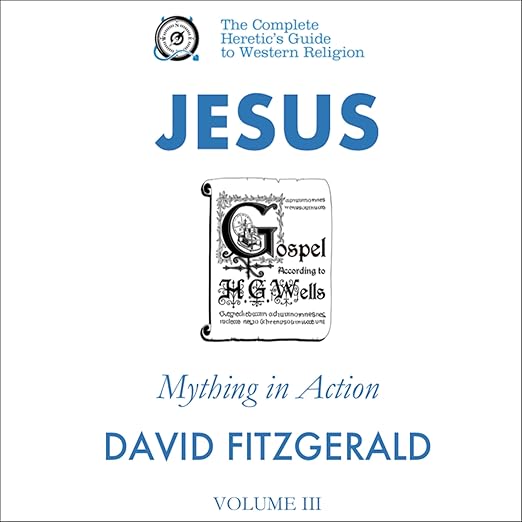
I have a complicated relationship with books that use fiction as a Trojan horse for intellectual argument. When it works, the combination produces something genuinely illuminating, the argument becomes embodied, experienced rather than simply followed. When it does not work, you end up with a premise that keeps interrupting the intellectual content you actually came for. David Fitzgerald’s decision to frame the final volume of his Jesus Mything in Action series as a time-travel narrative, “The Gospel According to H.G. Wells”, sits interestingly between those two outcomes, and I think it is worth being precise about which parts work and which parts strain.
This is volume three of the series, and chapters 19 through 25 of a larger argument that began with Fitzgerald’s 2010 book Nailed: Ten Christian Myths That Show Jesus Never Existed at All. The overarching project is presenting what Fitzgerald calls Jesus myth theory, the position that Jesus of Nazareth was not a historical figure but a mythological construction, and critically examining both the evidence for that position and the scholarly reception it has received. Volume III is specifically about the development and spread of early Christianity, framed through the time-travel conceit.
Our Take on Jesus: Mything in Action, Vol. III
The intellectual content is the strongest element of the book. Fitzgerald traces the growth of Christian orthodoxy through its competition with other sects, the political and cultural conditions that allowed one version of Christianity to dominate, and the mechanisms by which what became Catholicism won the battle for minds across the first several centuries. One reviewer described this as showing “the development of Christianity in the context of other historical events,” and that contextual embedding is what gives the argument its coherence. You cannot understand why orthodoxy won without understanding the environment in which it competed.
The time-travel framing works well in specific places, particularly when Fitzgerald uses it to make visible how strange and contingent the early development of Christianity was, how different the landscape of religious options looked from the inside. It works less well when the fictional mechanism requires the argument to pause and re-establish its conceit. Fitzgerald is sufficiently self-aware about this that he does not let the framing overwhelm the substance, but listeners who prefer their intellectual argument undressed will find the H.G. Wells scaffolding occasionally more obstacle than assistance.
Why Listen to Jesus: Mything in Action, Vol. III
Fitzgerald narrating his own work is the right call for this material. He is not a professional narrator, and that is audible, but what he brings is something more valuable in this specific context: the authority of someone who has spent years thinking about the argument he is making. He knows which points are load-bearing and which are supporting detail, and that knowledge shapes his pacing. The three-and-a-half-hour runtime is appropriate, he has learned what the series has established and does not re-explain what earlier volumes covered.
The self-narration also means the conversational quality of the prose translates directly. Fitzgerald writes as someone talking to you about something that has genuinely engaged him, and that quality of enthusiasm is present throughout the audio. For a subject that can be presented drily, the enthusiasm matters.
What to Watch For in Jesus: Mything in Action, Vol. III
This is emphatically not a standalone work. It is chapters 19 through 25 of a multi-volume argument, and it assumes familiarity with the earlier volumes. Listeners who have not worked through the previous entries will be missing the cumulative case that Volume III is completing, and the time-travel framing will feel like a stylistic choice detached from the intellectual architecture it is meant to cap. Starting here makes approximately as much sense as reading the final chapters of a long academic book without the preceding argument.
The book is also explicitly situated within a particular position on the historicity debate. Fitzgerald acknowledges that his work summarizes more scholarly mythicist studies, as one reviewer notes, but presents them accessibly. Listeners expecting balanced engagement with historicist scholars will find this a partisan document rather than a neutral survey, which is not a flaw so much as a transparency issue worth clarifying upfront.
Who Should Listen to Jesus: Mything in Action, Vol. III
Listeners who have followed Fitzgerald through the previous entries in this series, or who have already engaged seriously with Jesus myth theory through other sources, will find this a satisfying and thought-provoking conclusion. At under four hours it is one of the shorter entries in the series, and the H.G. Wells conceit gives it a different texture from the earlier volumes.
Listeners new to the subject should start with Nailed or the first volumes of Jesus: Mything in Action rather than arriving here. The argument requires its foundation, and Volume III is a conclusion, not an introduction.
Frequently Asked Questions
Can Jesus: Mything in Action, Vol. III be listened to without the earlier volumes?
Not meaningfully, no. This is chapters 19-25 of a multi-volume argument, and it assumes familiarity with everything Fitzgerald established earlier in the series. The time-travel framing is also harder to appreciate without understanding how it differs from the approach of the previous volumes.
How does the H.G. Wells time-travel conceit actually work in the book?
Fitzgerald uses the time-travel framework to walk listeners through the development of early Christianity chronologically, visiting key moments in the growth and diversification of the early church, the competition between sects, and the eventual establishment of orthodoxy. It works as a way to make historical contingency vivid, though reviewers note it occasionally slows the intellectual argument.
Is this series accessible to listeners who are not already skeptical of the historicity of Jesus?
Fitzgerald presents the mythicist position in accessible rather than academic language, but the work is explicitly partisan, it argues for a specific conclusion rather than surveying the debate neutrally. Open-minded agnostics on the question will find it substantive; committed historicists will find it incomplete in its engagement with the other side.
Does Fitzgerald’s self-narration hurt the listening experience?
It is not professional narration, but the trade-off is genuine authority. He knows his argument well and paces accordingly, and the conversational enthusiasm translates through audio in a way that compensates for the technical limitations. Listeners who prioritize narration quality may find it occasionally rough; listeners who prioritize content authenticity will appreciate it.