Quick Take
- Narration: Fitzgerald self-narrates with the energy of a passionate lecturer – engaged, occasionally rapid-fire, and clearly invested in the material without tipping into polemic.
- Themes: Jesus mythicism, the reliability of biblical sources, the Gospel of Mark as allegory
- Mood: Dense and intellectually driven, with a dry wit that keeps the pace from becoming punishing
- Verdict: The most accessible entry point yet into serious mythicist scholarship – David Fitzgerald writes with clarity and a sense of humor that most academic treatments lack.
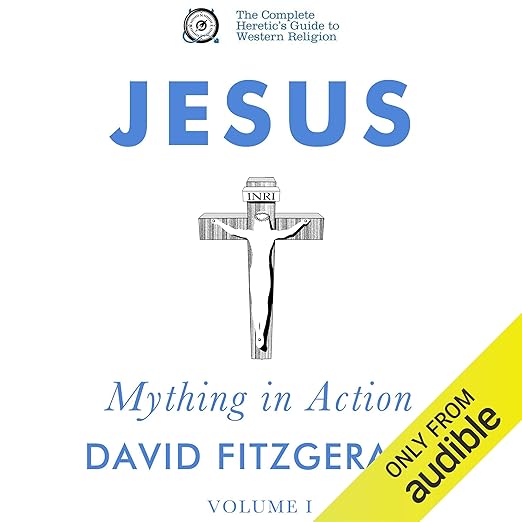
I have been tracking the mythicist conversation in biblical scholarship for about a decade now, mostly from a literary angle – the question of how a figure becomes mythologically overdetermined over time interests me as much as the historical claims themselves. So I came to Jesus: Mything in Action, Vol. I with some prior exposure to the arguments. What surprised me was how much fresh organizational clarity Fitzgerald brings to a debate that can easily become overwhelming in its source material. I listened to the first half on a Sunday afternoon, unable to stop.
This is the follow-up to Fitzgerald’s 2010 book Nailed: Ten Christian Myths That Show Jesus Never Existed At All, and it arrives seven years later with more depth, more nuance, and a more sophisticated engagement with the resistance the mythicist position receives from mainstream biblical scholars. Fitzgerald narrates his own work, which suits the material – this is a book with a specific argumentative voice, and you can hear him thinking through the implications of his evidence as he presents it.
Our Take on Jesus: Mything in Action, Vol. I
What distinguishes this volume from other popular treatments of the mythicist position is Fitzgerald’s willingness to take the opposition seriously. Rather than dismissing the scholarly consensus that a historical Jesus probably existed, he examines why that consensus holds and what the quality of the underlying evidence actually is. One reviewer notes that Paul – writing before the Gospels – has strikingly little to say about the details of Jesus’s Galilean ministry or Jerusalem activities, knowing mainly that Jesus was crucified and resurrected without mentioning Pilate, Jerusalem, or Judas. This is a genuinely startling point once laid out clearly, and Fitzgerald earns his time with it.
The second major focus of this volume is the Gospel of Mark, which Fitzgerald examines as an allegorical text rather than a biographical one. His analysis of Mark as the oldest narrative source for Jesus draws on a range of scholarship and makes a compelling case that what we understand as the biographical foundation of Christianity is something considerably more literary and constructed than most readers assume. For those who have read Richard Carrier’s On the Historicity of Jesus or Bart Ehrman’s more skeptical treatments of the Gospel record, Fitzgerald offers a useful complement – his writing is faster and more conversational than Carrier’s, and he covers some overlapping ground with more accessible framing.
Why Listen to Jesus: Mything in Action, Vol. I
At nine hours and nineteen minutes, this is a substantial intellectual commitment, and it will reward listeners who are willing to engage actively. Fitzgerald writes with a dry wit that prevents the density from becoming monotonous – there are genuine jokes worked into the argument, and they land without undercutting the seriousness of the scholarship. One reviewer describes the book as impossible to stop reading, diving in during every spare moment and immediately ordering the next volumes. That enthusiasm is credible; Fitzgerald has a gift for the kind of intellectual momentum that makes you feel like you are thinking through something real rather than simply being told conclusions.
What to Watch For in Jesus: Mything in Action, Vol. I
This is Volume I of a three-part series, and it should be evaluated as such. The book covers chapters one through twelve and focuses on: what mythicism is and what scholars say about it, and the allegorical reading of Mark. The full argument requires all three volumes to complete. Listeners who come in expecting a fully closed case will find this a foundation rather than a verdict – which is the appropriate structure for this kind of scholarship, but worth knowing before you begin.
It is also worth noting that this book will frustrate readers committed to the historical Jesus consensus, not because Fitzgerald is unfair in his characterization of the opposing position, but because he is genuinely effective at identifying its weaknesses. This is rigorous work, not polemic, and it has the argumentative density to match.
Who Should Listen to Jesus: Mything in Action, Vol. I
This is essential listening for anyone interested in the history of early Christianity who wants to understand what the mythicist position actually argues, as opposed to caricature versions of it. It will resonate with readers of Carrier, Ehrman, and Robert Price, and serves as an excellent introduction to the landscape of current mythicist scholarship. Those with no prior background in Gospel scholarship may find some sections slow going, but Fitzgerald’s explanatory instincts are generally strong. Those committed to orthodox Christianity as a historical matter will find this a challenging read – which is rather the point.
Frequently Asked Questions
Should I read Nailed before Jesus: Mything in Action, Vol. I?
Fitzgerald designed Vol. I to stand on its own, and it provides enough context for newcomers. Reading Nailed first enriches the experience by showing how his thinking developed, but it is not required.
How does Fitzgerald’s approach compare to Richard Carrier’s On the Historicity of Jesus?
Fitzgerald is more conversational and accessible than Carrier, covering some overlapping scholarly ground with considerably more humor and less academic apparatus. Carrier’s work is more exhaustive; Fitzgerald’s is more readable. They complement each other well.
Is the self-narration a good fit for this kind of dense scholarly material?
Generally yes. Fitzgerald’s delivery has the energy of a lecturer who knows his subject well, and that engagement helps push through the denser passages. Some listeners find his pace slightly fast in sections, which may warrant a slight playback speed reduction.
Does Volume I reach any conclusions, or does it leave everything open for the subsequent volumes?
Vol. I builds the evidentiary and conceptual foundation – what mythicism is, how scholars have received it, and why the Gospel of Mark matters to the argument. The case develops further in Volumes II and III. Listeners should approach this as the first third of a larger argument rather than a standalone verdict.