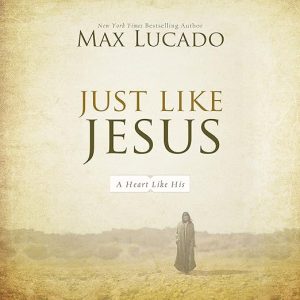
Max Lucado wrote Just Like Jesus in the same plainspoken register that made him one of the bestselling Christian authors in print, and this audiobook, listed here simply as Jesus, narrows that voice down to a single four-hour case for transformation over guilt. Lucado's premise is direct: God loves a person exactly as they are while also refusing to leave them unchanged, and narrator Ben Holland carries that dual message, warmth paired with expectation, across a runtime built for a single sitting or a short devotional series rather than a long-term listening commitment.
What We Made of It
Lucado structures the book around a direct comparison: Jesus felt no guilt, had no destructive habits, carried no fear, and showed no anxiety about death, and the argument is that God's goal for every listener is gradual movement toward that same interior peace, not perfection achieved overnight. Holland's pacing treats this as a conversation rather than a lecture, which fits Lucado's own pastoral style; he built his reputation preaching to a live congregation before most of these books existed on paper, and that congregational rhythm survives the transition to solo narration.
Lucado wrote Just Like Jesus specifically as a shorter, more focused companion to his broader body of work, rather than a comprehensive theological treatise, and that scope shows in the pacing: each chapter takes on one specific quality, guiltlessness, freedom from bad habits, fearlessness, and builds a complete, self-contained case for it before moving to the next, rather than developing one sprawling argument across the whole runtime.
The book poses its central questions directly rather than assuming easy agreement: how do we know God wants this transformation, how does the change actually occur, and why does a listener still feel like themselves despite pursuing it. Reviewer Little D specifically credits Lucado's habit of tying every explanation back to scripture for making complex theological ideas land as everyday and usable rather than abstract, and Holland's narration keeps that scripture-to-application rhythm intact rather than treating the biblical citations as separate, drier interludes.
Posing doubt in the listener's own voice before answering it is a meaningful craft decision on Lucado's part: each question sounds like something a skeptical or tired listener would actually ask, not a rhetorical setup a confident insider poses just to knock down. Holland's narration gives each question real weight rather than rushing past it toward the reassurance that follows, which keeps the doubt from feeling performative.
What Makes Jesus Worth Hearing
At four hours and twenty-nine minutes, this sits comfortably inside a single long commute or a short devotional week, which matters for a book explicitly designed for small-group study use. Reviewer Little D mentions buying it for exactly that purpose, a church small group, and audio format genuinely helps there: a shared listening assignment is easier to complete consistently across a group than asking everyone to find time with a physical book.
Reviewer C. Nicely notes the book works whether a listener has studied the Bible for years or is comparatively new to it, and Holland's narration is a meaningful part of why that range works. His delivery does not assume prior theological vocabulary, but it also does not condescend to listeners who already know the material well, threading a register that serves both ends of that spectrum inside the same four hours.
Lucado has spent decades as a pastor and one of the most widely read Christian authors in the country, and Just Like Jesus sits within a large catalog of his devotional writing built around the same plainspoken, story-driven approach to scripture. Listeners familiar with his other work, or with his long tenure preaching to a single congregation, will recognize the register immediately; newcomers get a representative, accessible introduction to why his books have found such a wide readership.
Lucado's own denomination and church background inform the book's specific theological emphases, though the writing stays broadly accessible to Christian listeners across different traditions rather than narrowly denominational in its language or assumptions. That ecumenical accessibility is likely part of why his books have found readers well beyond his own congregation.
What Might Not Land
The title listed for this audiobook, simply Jesus, does not match the title used consistently throughout its own synopsis, which refers to the book by name as Just Like Jesus repeatedly. This reads like a retitling or a shortened listing name rather than a different book entirely; the content, argument, and Lucado's authorship are all consistent with his well-known Just Like Jesus, so listeners searching under either title should find the same material.
This is explicitly devotional, faith-framed nonfiction written from within Christian belief, not a comparative-religion survey or a skeptic-friendly examination of Jesus as a historical figure. Listeners approaching it from outside an existing Christian framework should know the book assumes that framework as its starting point rather than arguing for it from first principles.
Evaluated on its own terms, the book's argument holds together internally: it starts from the premise that transformation follows from love rather than earning that love through good behavior, and stays consistent to that premise throughout rather than sliding into guilt-based motivation despite opening by explicitly rejecting guilt as the goal. Listeners who share the book's foundational Christian premises will find it argues coherently within them.
The book's short runtime also makes it a realistic candidate for repeat listening, something a denser theological work rarely invites. A listener returning to Just Like Jesus during a difficult season might reasonably revisit just the fear-focused or death-anxiety sections rather than committing to the whole four and a half hours again, treating individual chapters more like standalone devotionals than sequential arguments requiring the whole book each time.
Its brevity also makes it an easy audiobook to gift or recommend to someone newly exploring faith, without asking for a major time commitment upfront.
Who Should Listen to Jesus
Christian listeners looking for a short, scripture-grounded audiobook on personal spiritual transformation, whether for individual devotional listening or a small-group study, will find Lucado's argument clear and Holland's narration well matched to the material's pastoral tone.
It also suits listeners who prefer shorter, focused devotional audiobooks over longer theological works; at under four and a half hours, Just Like Jesus asks for a real but modest commitment compared to a multi-volume Bible study series.
Skip it if you want an academic or historical examination of Jesus as a figure, or if devotional Christian nonfiction generally is not the register you are looking for. This audiobook speaks directly to an already-believing audience rather than making a case to convince a skeptical one.
- Read by: Ben Holland's warm, conversational pacing mirrors Max Lucado's pastoral, congregation-tested voice.
- At its heart: Christian transformation, grace without complacency, scripture-grounded reflection
- Vibe: Gentle, encouraging, and directly devotional
- Short version: A clear, short case for spiritual transformation aimed squarely at an already-believing audience.
Why is this audiobook listed simply as Jesus instead of Just Like Jesus?
The synopsis and content both point to Max Lucado's Just Like Jesus; the shortened listing title appears to be this specific edition's naming choice rather than a different book.
Is this audiobook appropriate for a church small group study?
Yes, reviewer Little D specifically used it for that purpose, and its four-hour length fits comfortably into a short group study schedule.
Does this audiobook require deep prior Bible knowledge to follow?
No. Reviewer C. Nicely notes it works whether you have studied scripture for years or are newer to it, and Ben Holland's narration does not assume specialized vocabulary.
How does Max Lucado's writing style come across in audio?
Conversational and pastoral, matching the preaching rhythm he built over decades leading a congregation, which Ben Holland's narration carries faithfully.