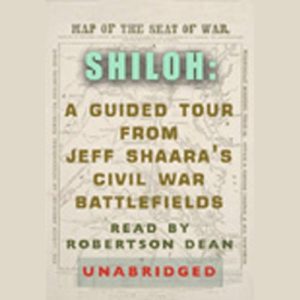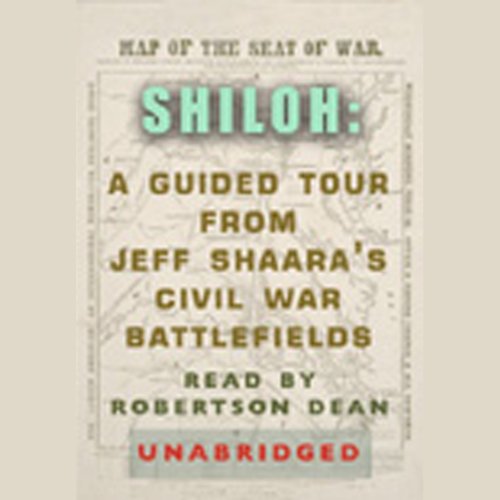
At 51 minutes, this is a compact listening experience, more extended essay than full audiobook. I listened to it during a lunch break, which felt oddly appropriate: a contained, purposeful hour spent with one of the Civil War's defining engagements, guided by a novelist who has spent his career living inside these battles imaginatively. That specific combination, fiction writer as battlefield interpreter, is what makes this worth your time.
Jeff Shaara's reputation rests on his ability to make Civil War battles feel inhabited rather than merely documented. His father, Michael Shaara, won the Pulitzer Prize for The Killer Angels, and Jeff extended that fictional legacy across multiple novels covering both the war's eastern and western theaters. Jeff Shaara's Civil War Battlefields takes a different approach: instead of novelistic immersion, it offers a guided tour framework, with Shiloh as the featured destination. The result is something that sits between travel guide, historical primer, and literary companion.
First, the Big Picture
Shiloh is the right choice for this format. It remains one of the war's most misunderstood engagements, known primarily for its staggering casualty figures (nearly 24,000 killed, wounded, or missing over two days in April 1862) but less often understood in terms of what it meant strategically for the Union's push into the Confederate heartland. Shaara brings the novelist's instinct for the human story: the commanders who underestimated each other, the terrain that shaped the fighting in ways that maps cannot fully convey, and the significance of the Peach Orchard and Hornet's Nest as places where abstracted military strategy became very immediate, very bloody reality.
Robertson Dean's narration suits the material. He has a measured quality that works for historical content, unhurried, clear, authoritative without being ponderous. At 51 minutes, there is no room for padding, and Dean moves through the material at a pace that respects the listener's time while giving the key moments enough space to land. This is not performance narration; it is guide narration, and the distinction matters.
What Makes Jeff Shaara's Civil War Battlefields Worth Hearing
The format works best as preparation rather than as a standalone listening experience. Shaara is most useful here as a context-setter: someone who can explain why Shiloh mattered in ways that make a subsequent visit to the battlefield, or a subsequent read of his own fiction set in the western theater, more meaningful. His insight that Shiloh represented a fundamental shift in how both sides understood the war's scale and duration is the kind of synthesizing observation that novelists often arrive at more cleanly than historians, who must hedge at every turn.
The publication date of 2007 and the Random House Audio imprint suggest this is part of a broader series of battlefield companion pieces, though the audiobook as presented focuses on Shiloh specifically. For listeners planning a road trip through Tennessee or those building out a Civil War reading list, it earns its place as an efficient, well-curated entry point.
A Few Reservations
Shaara's particular strength here is connecting the physical landscape to tactical decisions. He describes terrain the way a novelist would: in terms of how it felt to move through it, what it obscured, what it exposed. The Sunken Road, which Confederate troops found so defensible that Union forces nicknamed it the Hornet's Nest, becomes comprehensible as a piece of ground rather than just a name on a battle map. That translation, from cartographic abstraction to visceral geography, is where Shaara's novelist instincts add genuine value to the historical record.
Because this is so short, it necessarily omits a great deal. Listeners wanting deep analysis of Shiloh's command decisions or a full account of both days of fighting will need to look elsewhere, Bruce Catton's work remains essential for that, as does Wiley Sword's dedicated study of the battle. Think of Shaara's piece as the excellent opening chapter that sends you reaching for the longer book.
Who Should Listen to Jeff Shaara's Civil War Battlefields
Ideal for Civil War enthusiasts planning a visit to Shiloh, readers who have enjoyed Shaara's fiction and want to understand his relationship to the actual landscapes he fictionalizes, or anyone who wants a well-crafted 51-minute primer on one of the war's pivotal engagements before diving deeper.
Less useful for listeners who want comprehensive battle analysis or who are entirely new to Civil War history, the format assumes some baseline familiarity and does not attempt to provide full context for the war's arc. Also, at under an hour, this is a companion piece rather than a primary resource; pair it with something more substantial for the full picture.
- Read by: Robertson Dean brings a measured, authoritative quality suited to historical guided-tour content
- At its heart: Civil War memory, battlefield landscape as historical text, the scale of Shiloh's casualties
- Vibe: Reflective and documentary, compact in scope
- Short version: A lean, focused companion piece for anyone planning a visit to Shiloh or seeking a novelist's perspective on one of the war's most consequential battles.
Does this audiobook cover multiple Civil War battlefields or focus only on Shiloh?
Based on the available content, this edition focuses on Shiloh as its featured battlefield. The series title suggests it may be part of a broader collection covering other sites, but the 51-minute runtime and synopsis both point to Shiloh as the specific subject of this recording.
Is this appropriate as a first introduction to the Civil War for someone with no prior knowledge?
It works better as a complement to existing knowledge than as a true introduction. Shaara assumes listeners have some familiarity with the war's basic arc and can place Shiloh in context. Total newcomers may find the references to commanders and strategic stakes harder to follow without prior reading, though the narrative clarity of Shaara's novelist approach helps considerably.
How does Shaara's novelist background change the way he interprets battlefield history compared to a traditional historian?
Shaara focuses heavily on the human texture of command decisions and the way physical terrain shaped experience, the same instincts that make his fiction effective. He tends to ask 'what did it feel like to be here' more than 'what do the documents prove,' which produces more vivid and accessible history but less analytical rigor. For a battlefield guide, that trade-off works well.