Quick Take
- Narration: Xander Krivacka delivers an energetic performance that matches the book’s enthusiast-guide register, accessible and engaged without overselling.
- Themes: Shinto cosmology and its major deities, the yokai tradition of supernatural creatures, the persistence of ancient myth in contemporary Japanese culture
- Mood: Enthusiastic and welcoming, the tone of a knowledgeable guide rather than a specialist monograph
- Verdict: A genuinely accessible three-hour introduction to Japanese mythology for listeners new to the material, with enough cultural context to make the mythology meaningful rather than merely exotic.
I came to Japanese mythology sideways, through anime and manga in my twenties, and then more seriously through work on comparative religious traditions in my thirties. By the time I sat down with this audiobook, I had enough background to evaluate what it was doing rather than simply receiving it. What it is doing is something genuinely useful and not as easy as it looks: constructing a coherent, accessible three-hour introduction to a mythological tradition that is simultaneously ancient, living, and deeply foreign to most Western listeners.
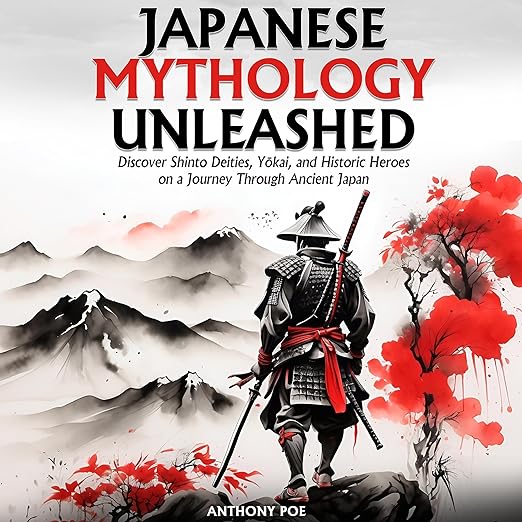
Japanese Mythology Unleashed by Anthony Poe covers the major territory of the Shinto mythological tradition, including the creation narratives from the Kojiki and Nihon Shoki, the major deities of the Shinto pantheon, the yokai tradition of supernatural creatures, and the heroic tales that have shaped Japanese cultural identity. At three hours and nineteen minutes, it cannot be encyclopedic, and it does not try to be. What it aims for is orientation, giving listeners who know little about Japanese mythology enough of a foundation to find the tradition fascinating and to pursue it further.
The Creation Narratives as Starting Point
The opening coverage of Shinto creation mythology is where this audiobook is at its strongest. The Kojiki account of the universe’s emergence, with Izanagi and Izanami creating the Japanese islands from the primordial waters, the subsequent mythology of Amaterasu, Susanoo, and the celestial realm, is handled with enough narrative clarity to be genuinely engaging. Poe makes good choices about which episodes to highlight: the cave of Ama-no-Iwato, where Amaterasu withdrew into darkness and plunged the world into shadow until the other gods devised the raucous ceremony that lured her out, is the creation mythology’s most dramatically compelling episode, and it gets appropriate attention.
The relationship between Shinto mythology and the historical Japanese state, including the way the imperial family’s lineage was traced to Amaterasu and the political function of the mythological tradition, is touched on but not extensively developed. This is understandable given the format, but it is worth noting for listeners who want to understand why Japanese mythology is not simply a collection of interesting stories but a political and religious system with active consequences through the modern period.
Yokai and the Living Tradition
The section on yokai is where the audiobook most successfully connects ancient mythology to living cultural tradition. Yokai, the supernatural creatures ranging from shape-shifting kitsune fox spirits to water creatures called kappa to ghostly yurei, are not historical curiosities in Japan. They appear in contemporary anime, manga, film, and video games in ways that are direct extensions of a tradition dating back centuries. Poe makes this continuity explicit, which is one of the book’s most valuable moves. It reframes the mythology not as a dead tradition preserved in texts but as a living symbolic vocabulary that contemporary Japanese culture continues to use and modify.
The coverage of individual yokai is necessarily selective, and listeners who want comprehensive catalogues will be better served by specialized texts. But the audiobook covers enough representative figures to give listeners a sense of the tradition’s range and character.
Xander Krivacka as Enthusiast Guide
Krivacka’s performance is well-matched to the book’s register. He narrates with the energy of someone genuinely interested in the material without pushing into the faux-breathless enthusiasm that some popular mythology narrators default to. The Japanese terminology is handled with evident care throughout, not perfectly, as pronunciation of Japanese is genuinely difficult for non-native speakers, but with consistency and attention throughout the three-plus hours.
The short runtime works in Krivacka’s favor. For longer treatments of Japanese mythology, pacing becomes more of an issue. At this length, the engaged delivery is sustainable without becoming fatiguing.
Who Should Listen and What Comes Next
This is the right audiobook for listeners who want a first orientation to Japanese mythology before engaging with either the primary texts in translation or more specialized academic treatments. It is also well-suited to anyone who has encountered yokai or Shinto concepts through anime or manga and wants to understand the mythological tradition those cultural products are drawing on.
Listeners with existing knowledge of Japanese mythology will find this covers familiar ground at an introductory level. The high rating with over 130 reviews reflects a readership that is largely coming to the material fresh and finding the orientation valuable, which is exactly what the book aims to provide.
What Makes This Different from a Reference Guide
The distinction between an introductory mythology guide and a reference compendium is significant in audio format. A reference guide listing creatures and deities alphabetically with descriptions would be nearly useless as an audiobook. Japanese Mythology Unleashed avoids this by organizing thematically and by narrative importance rather than cataloguing for completeness. The result is an audiobook that flows as a listening experience rather than functioning like a read-aloud index. This is the right approach for the format, and it is one of the reasons the book has accumulated strong ratings from listeners who came to the material fresh. The mythology feels alive in this presentation rather than filed and indexed. For listeners who already have a reference text and want something to listen to that contextualizes what they are reading, this audiobook works well as a companion in that mode too.
Frequently Asked Questions
Does the audiobook cover the Kojiki and Nihon Shoki as source texts, or does it treat mythology without historical context?
The major creation narratives come from the Kojiki and Nihon Shoki tradition, though the audiobook does not discuss the texts themselves as historical documents in depth. It uses the mythological content as the primary material, with enough contextual framing that listeners understand these are recorded traditions rather than oral folklore. For detailed engagement with the Kojiki as a document, Donald Philippi’s translation with scholarly notes is the standard reference.
How does the yokai coverage compare to dedicated yokai resources?
This audiobook provides an introduction to the yokai tradition within a broader treatment of Japanese mythology, sufficient for orientation but not as comprehensive as dedicated yokai studies. Michael Dylan Foster’s The Book of Yokai or Matt Alt and Hiroko Yoda’s work offer significantly more detail on individual creatures, historical sources, and cultural context. Japanese Mythology Unleashed is best understood as a gateway rather than a destination for yokai specifically.
Is the audiobook appropriate for younger listeners interested in Japanese mythology?
For older children and young adults, yes. The content is engaging and accessible, and the mythological material, while occasionally involving death and supernatural violence, is handled at a level appropriate for curious readers around twelve and older. The book does not carry adult content warnings, and the enthusiast-guide tone is accessible to younger audiences.
Does the audiobook discuss how Shinto mythology intersects with Buddhism, which is also central to Japanese religious culture?
The relationship between Shinto and Buddhism, which were syncretically combined in Japan for centuries before the Meiji Restoration’s forced separation, is touched on but not extensively developed. The audiobook’s primary focus is the Shinto mythological tradition. Listeners interested in the Buddhist layer of Japanese religious culture would want to supplement with dedicated resources on Japanese Buddhism.