Quick Take
- Narration: Rick Adamson delivers a measured, authoritative read that suits the scholarly material without making it feel dry, a solid match for academic nonfiction.
- Themes: Colonial origins, archaeological discovery, historical revisionism
- Mood: Meticulous and quietly revelatory
- Verdict: A rigorous, rewarding listen for anyone who wants the real Jamestown story told through evidence rather than mythology.
I came to this one expecting a dry academic lecture and finished it genuinely unsettled by how much I hadn’t known. I was listening on a weekday afternoon while reorganizing my bookshelves, one of those low-stakes domestic activities that pairs surprisingly well with nonfiction that quietly rewrites the story you thought you knew. By the time William Kelso described the recovery of Captain Bartholomew Gosnold’s presumed burial, I had set down the books entirely and was just standing there listening.
Jamestown has always occupied an ambiguous place in American origin mythology. It predates Plymouth Rock by thirteen years and was the real foothold of English settlement in North America, yet it spent decades in the shadow of the Mayflower narrative. Kelso’s book is, among other things, a correction of that particular historical distortion, and he makes the case not through polemic but through dirt. Literal dirt. Half a million artifacts cataloged from James Fort, which everyone had assumed washed away into the James River.
Our Take on Jamestown, the Buried Truth
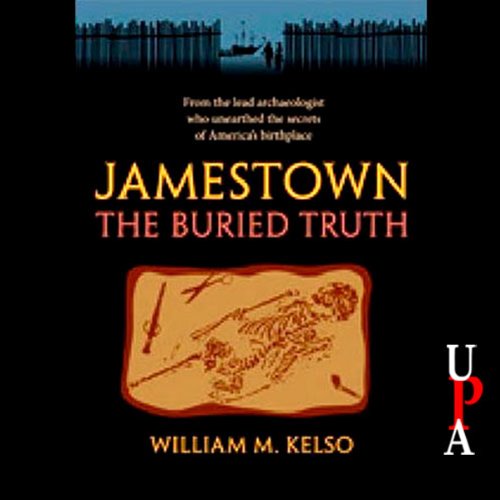
What separates this audiobook from a standard history is that William Kelso is the lead archaeologist on the dig itself. He isn’t synthesizing other people’s findings. He was there when the palisade walls emerged from the soil, when the well and warehouse foundations came into view, when the skeletal remains of a young man with a musket ball wound were carefully documented. That firsthand authority gives the narration a quality of presence that most popular history cannot replicate. Kelso knows not just what was found but what it felt like to find it.
The book directly challenges what Kelso calls the decades-old stereotype attributing Jamestown’s horrific mortality rate to settler laziness and incompetence. The archaeological record tells a far more nuanced story. The settlers were contending with brackish water, extreme drought conditions, hostile circumstances with the Virginia Indians, and a supply chain that was unreliable at best. The evidence produced a picture of resourceful people under impossible pressure, not the cartoon of idle gentlemen too proud to dig. As a narrative argument, it’s made more convincing by the specificity of the objects: the tools, the food remains, the military equipment, the glass furnace waste that suggests early manufacturing attempts.
Why Listen to Jamestown, the Buried Truth
The archaeological detective-story structure is genuinely engaging. Kelso frames discoveries around the questions they answer and the new questions they open, which gives the book momentum that a purely chronological account would lack. The chapter covering the identification of Bartholomew Gosnold, one of the most significant figures in early American settlement, is particularly compelling. The skeletal analysis, the contextual evidence, the reasoning process: it reads like careful scientific journalism at its best.
Rick Adamson’s narration is well-calibrated to the material. He doesn’t try to dramatize what doesn’t need dramatizing. The discoveries carry their own weight, and Adamson understands that. His pacing gives listeners time to absorb what’s being described, a virtue in a book that moves between narrative history, artifact analysis, and archaeological method. One reviewer noted getting bogged down in the enormous amount of information, which is a fair warning for anyone wanting a breezy listen. But for the genuinely curious, that density is the point.
What to Watch For in the Archaeological Layers
The book’s most quietly radical section concerns the relationship between the settlers and the Virginia Indians. Kelso neither romanticizes nor demonizes this relationship. The material evidence, trade goods, proximity patterns, the remains of interactions both cooperative and violent, paints something more complicated than the narratives in either direction tend to allow. For listeners accustomed to hearing Jamestown presented as a straightforward story of English triumph or English oppression, this ambiguity is genuinely instructive.
The audiobook format does sacrifice some of what makes the print version exceptional. Multiple reviewers mention the 150 color and black-and-white illustrations and maps as central to understanding what Kelso describes. Listeners who want the full picture may want to pair the audio with access to the University of Virginia Press edition. That said, Kelso’s descriptions are specific enough that the absence of visuals rarely leaves you lost, though for the architectural reconstructions and artifact comparisons, you’ll feel the gap.
Who Should Listen to Jamestown, the Buried Truth
This audiobook is for people who want American history told from the ground up, through evidence rather than received narrative. If you’ve ever stood at a historic site and wondered what’s actually underneath, Kelso provides a model for how archaeological science answers that question. History buffs, fans of true-crime-style investigative nonfiction, and anyone bothered by the Plymouth Rock mythology will find a great deal here. Students of early American colonial history will find it essential.
Skip it if you want a linear narrative driven by human drama rather than scientific process. The book’s authority comes from its methodology, and if that’s not what you’re looking for, the density that makes it valuable will feel like an obstacle. But for the right listener, Jamestown, the Buried Truth is one of those quiet revelations that permanently expands your picture of where the American story actually begins.
Frequently Asked Questions
Does the audiobook work without the maps and illustrations from the print edition?
It works, but you will notice the absence. Kelso describes artifacts and architectural features clearly enough to follow the argument, but the print edition’s 150 illustrations add significant visual context. Consider pairing the audio with a library copy if you want the complete experience.
How technical does the archaeological methodology get? Is this accessible to non-specialists?
Kelso pitches the book at an intelligent general audience rather than academic peers. He explains field methods and analysis clearly without assuming prior knowledge, though the sheer density of detail can require attentive listening. Most listeners find the detective-story framing keeps the technical sections engaging.
Does the book address the identification of Captain Bartholomew Gosnold?
Yes, and it’s one of the book’s most memorable sequences. Kelso walks through the skeletal analysis, burial context, and circumstantial evidence that led the team to their identification. The reasoning is careful and honest about its limits, exactly what you want from a scientist discussing a significant attribution.
Is this the definitive account of Jamestown archaeology, or has significant new research emerged since publication?
The book was first published in 2006, and excavation at the site has continued since. Kelso’s team has made additional discoveries in the years following. The audiobook remains the foundational account of the James Fort rediscovery, but readers seriously invested in the site’s current state should supplement it with more recent publications and the Jamestown Rediscovery project’s ongoing reports.