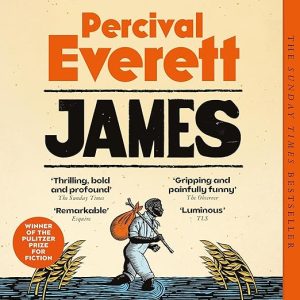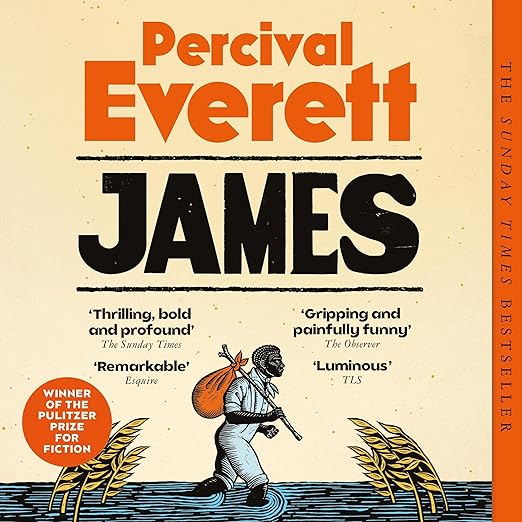
Jim overhears three words that upend his life, sold, New Orleans, tomorrow, and flees toward Jackson's Island rather than wait to be separated from his wife and daughter forever. How do you retell a story everyone already half knows, Twain's Adventures of Huckleberry Finn, from the perspective of the one character Twain never let speak for himself? Percival Everett's audiobook answers that question with a formal trick so effective it became the novel's defining feature: Jim speaks two different Englishes, one performed for white listeners and one entirely his own.
Pulitzer, Booker, and a Carnegie Medal Too
The awards attached to this novel are unusually long and every single one of them is real: winner of the National Book Award for Fiction, winner of the Pulitzer Prize for Fiction, winner of the Andrew Carnegie Medal for Excellence in Fiction, shortlisted for the Booker Prize, a finalist for the Orwell Prize for Fiction, and winner of the British Book Awards Fiction Book of the Year. That density of major-prize recognition across both American and British literary establishments in a single publishing cycle is genuinely rare.
Everett's central formal innovation is the dual-register conceit itself: Jim performs a broken, deferential dialect whenever white characters are listening, then switches, privately, to precise, educated English among people he trusts. That switch is not a gimmick, it's the book's argument made structural, dramatizing exactly how much interior life slavery required enslaved people to hide in plain sight.
Structurally, the novel runs alongside Huck's own parallel escape, faking his death to flee a violent father, so the two fugitives' journeys down the Mississippi intertwine rather than simply retracing Twain's plot from a new angle. Each bend in the river carries real risk of both salvation and disaster for both of them, and Everett keeps that dual jeopardy genuinely uncertain rather than pre-resolved by readers' familiarity with the source material.
Percival Everett arrives at this novel with a long, prolific career built on genre experimentation and sharp satire across dozens of books, most visible to mainstream audiences through Erasure, his earlier novel about a Black novelist wrestling with the publishing industry's narrow expectations, later adapted into the film American Fiction. James channels that same interest in who gets to control a narrative and how, applied here to the most canonical American road novel of them all.
The title itself does real work before the story even begins: Twain's Adventures of Huckleberry Finn only ever called this character Jim, a diminutive that reads as casually reductive once you notice it. Everett's choice to title his own novel with the full, formal name James, and to let other enslaved characters address him that way in private, is a reclamation built directly into the book's cover rather than something explained later in the text.
Guardian Names This Its Audiobook of the Week
The Guardian, which named this its Audiobook of the Week, praised the performance as 'terrific: variously wry, poignant and thoughtful' in imbuing Jim with 'the humanity and agency denied to him by Twain.' That is a precise description of what Dominic Hoffman actually accomplishes: real dry comic timing in the lighter passages without ever letting the performance undercut the character's underlying gravity.
Hoffman's job is genuinely difficult in a way most narration is not: cleanly separating two registers of the same character's speech so a listener always knows which Jim they're hearing, the one performing for safety and the one speaking freely, without ever resorting to a cartoonish voice switch that would cheapen the device.
Hoffman Stretches Well Past His Usual Catalog
Ann Patchett put the recommendation about as broadly as a blurb can: 'Who should read this book? Every single person in the country.' Reviewer Charliep's account backs that breadth up from the ground level, writing plainly that the narrative 'powerfully conveys the dehumanizing reality of slavery,' a direct reader response worth as much as any awards-committee citation for a book asking this much of its audience.
Dominic Hoffman's own catalog includes extensive work across the Who Was? educational series and other clarity-first children's and family audio, a very different register from the dual-register literary performance James demands, which makes his success here a genuine stretch beyond his most heavily logged prior work rather than a predictable extension of it.
Tagged as Comedy, It Carries Real Violence
The genre tagging on this listing undersells the book considerably: it reads as primarily comedy, but while James is genuinely funny in places, dryly, sharply, sometimes savagely, that humor sits alongside direct, unflinching material about slavery's violence and dehumanization. Listeners expecting a straightforwardly comic listen based on the category label should recalibrate before starting.
Familiarity with Twain's original enriches the experience considerably but is not required; Everett gives enough context within the text itself for James to work as a standalone novel, though readers who know exactly which moments from Huckleberry Finn are being inverted will catch a second layer the book is clearly built to reward.
At seven hours and forty-nine minutes, this is a relatively compact listen for a novel carrying this much prize weight, and the pacing reflects that: Everett moves the river journey forward with real urgency rather than lingering in extended reflection, which some listeners used to more meditative literary fiction may notice as a brisker register than expected.
Ninety-Eight Ratings Trail This Novel's Awards
Twain's original novel carries its own long, genuinely contested history, repeatedly challenged and removed from school reading lists over its use of dialect and a racial slur throughout, even as it's simultaneously taught as a landmark critique of slavery and American hypocrisy. Everett's novel doesn't resolve that tension so much as walk directly into it, reclaiming the interiority Twain's version denied its Black characters while keeping the river journey's structure fully intact.
With ninety-eight ratings at a 4.6 average, this title's review base is still noticeably smaller than its award coverage might suggest, a reminder that audiobook ratings on major literary prize winners often lag well behind print sales and critical attention, especially for a book still this recent. The existing reviews are unusually substantive and specific rather than one-line praise, though, itself a signal of genuine engagement rather than thin enthusiasm.
Brace Differently if You Want Light Comedy
Readers of serious literary fiction, whether or not they have any history with Twain, are the clear core audience, alongside anyone drawn to other recent reimaginings of canonical texts from a marginalized character's viewpoint.
Listeners who appreciated Colson Whitehead's The Underground Railroad, or who want a starting point for understanding why this specific novel swept the 2024 to 2025 prize season so thoroughly, will find both the craft and the substance justify the attention.
The novel's ending, which this review won't spoil, reframes everything that came before it in a way several reviewers describe as genuinely destabilizing on a first listen, worth revisiting once the full shape of the story is clear rather than treating the final chapters as simply wrapping up the plot.
Skip it, or at least brace differently, if you specifically want light, uncomplicated comedy based on the listing's genre tag; the humor is real but it shares space throughout with material about slavery's brutality that deserves to be approached deliberately rather than as background listening.
Common Questions
Do I need to have read Mark Twain's Adventures of Huckleberry Finn before listening to this audiobook?
No, the novel stands completely on its own, though listeners who know Twain's original will catch specific structural echoes and reversals that add another layer of appreciation.
Does Dominic Hoffman really narrate Jim in two different voices?
Yes, and it's the audiobook's defining performance choice: one register is the exaggerated dialect Jim performs for white listeners, the other is the educated, private voice he uses among people he trusts.
Is James an appropriate audiobook for readers expecting straightforward comedy given its genre listing?
Not exclusively. It is genuinely funny in places, but the genre tag undersells how much of the book confronts slavery's violence and dehumanization directly, so go in expecting both registers rather than comedy alone.
Is this audiobook worth it if I already know the plot from the award coverage?
Yes. The awards reward the execution, not just the premise, and Hoffman's performance in particular is a reason to experience the story in audio even if you already know where the plot goes.