At a Glance
- Read by: Sarah Van Sweden maintains the meditative pace the visionary sequences require; the audiobook format suits this text particularly well.
- At its heart: Feminine spiritual power, initiation and shadow work, the intersection of indigenous tradition and Western psychology, the cost of suppressing inner darkness.
- Vibe: Incantatory and immersive; demands patience and willingness to enter the text's framework rather than observe it from outside.
- Short version: Essential for readers already in the Andrews tradition; for newcomers, begin with Medicine Woman first to appreciate the depth of what follows.
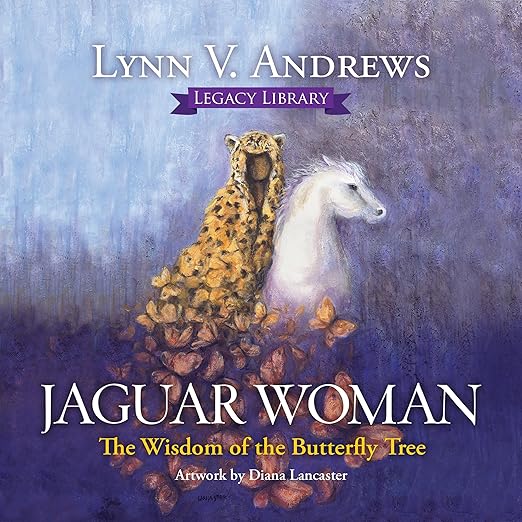
The butterfly tree looms over the Yucatan as Lynn V. Andrews approaches it, a moment in this audiobook that arrives with the specific gravity of genuine visionary experience. Jaguar Woman collects five spiritual narratives from Andrews's encounters with the Sisterhood of the Shields, a group of indigenous medicine women whose teachings she has documented across multiple books. The collection moves between personal initiation, archetypal narrative, and the stories of other women in the Sisterhood, creating a composite portrait of feminine spiritual power that resists reduction to any single tradition or framework.
An Initiate Who Nearly Unleashes Her Darkness
Andrews writes in a tradition that bridges memoir and vision, ethnographic encounter and personal transformation. Jaguar Woman does not read as conventional memoir; it reads as spiritual testimony, which is a distinct mode with its own conventions and demands. Readers who approach it expecting the analytical frameworks of Western memoir will need to adjust their expectations. Andrews is not writing about her spiritual experiences from a critical distance; she is writing from inside them, which gives the book its unusual intimacy and also its occasional opacity.
The five narratives that comprise the collection are distinct in setting and character but coherent in theme. Spirit Woman follows Andrews as she creates her own shield and learns the nature of her spiritual path. Jaguar Woman takes her to the Yucatan, where she confronts the butterfly tree and the terrifying knowledge of feminine power that it represents. The Woman of Wyrrd moves into the Dreamtime and emerges in medieval England, where Andrews becomes Catherine and encounters the Grandmother. Dark Sister shifts perspective to follow Sin Corazón, an initiate who nearly unleashes her inner darkness after her husband's abandonment. Tree of Dreams offers portraits of the elder women of the Sisterhood, their lives and losses and loves.
The range across these five pieces demonstrates Andrews's structural ambition. She is not simply narrating her own journey; she is assembling a mythology. Sin Corazón's story in particular is the collection's most dramatically compelling, precisely because it does not follow Andrews's perspective. The intimacy with which Andrews renders Sin Corazón's psychological near-collapse suggests either deep empathy or deep knowledge, probably both.
The Real Reason to Read Medicine Woman First
Readers who have noted that these books 'are spells' are responding to something genuine in Andrews's prose style. The writing is incantatory in places, designed to work on the reader through accumulation and rhythm rather than through argument. This is either exactly what you are looking for or exactly what you are not, with no intermediate position. Andrews is not writing for the skeptic; she is writing for the reader who is willing to enter the space her narratives create.
The bridging of Western psychology and indigenous spiritual traditions is a consistent feature of Andrews's work and a source of both its appeal and its controversy. She draws on Jungian frameworks alongside the specific knowledge of Agnes, Ruby, and the other women of the Sisterhood, creating a synthesis that makes the material accessible to Western readers while potentially oversimplifying the indigenous traditions it engages. Readers who approach the book as spiritual guidance rather than as anthropology will find it more rewarding than those seeking ethnographic precision.
The recommendation to read Medicine Woman first is genuine. Jaguar Woman is the second book in what was originally called the Medicine Woman Trilogy, and Andrews's relationship with Agnes and Ruby, which provides the foundation for everything that follows, is established in that volume. Readers who begin here will understand the surface of these relationships without fully grasping their depth.
Van Sweden's Measured Pace Is by Design
Sarah Van Sweden's narration suits the material's meditative quality. The audiobook format is particularly well-suited to the visionary sequences, which benefit from continuous oral delivery. Andrews's prose in the Dreamtime sequences has an incantatory rhythm that loses something when read silently on the page; heard aloud, at Van Sweden's measured pace, the accumulative effect is closer to what the writing intends. At over nine hours, this is a listening commitment, but the pace is unhurried by design rather than by accident.
Blurring Memoir, Fiction, and Vision Without Warning
The collection is not for readers seeking a straightforward narrative arc. Andrews moves between first-person memoir, third-person narrative, and visionary sequence without always signaling the transitions explicitly. Readers who need clear generic boundaries between fiction, memoir, and spiritual teaching will find Jaguar Woman consistently blurring those lines. This is the nature of the tradition Andrews is working within, but it can be disorienting for listeners expecting conventional memoir structure.
The spiritual content draws on specific indigenous traditions that Andrews has been both celebrated for transmitting and criticized for appropriating. Listeners should approach with awareness of this debate rather than ignorance of it; the books carry more value when read within that critical context.
Five Narratives Giving Listeners Natural Pause Points
Readers who are already engaged with feminine spiritual traditions, with shamanic practice or Jungian psychology or both, will find Andrews's synthesis illuminating and provocative. Listeners who have read Medicine Woman and want to continue following Andrews's journey with the Sisterhood will find this collection the natural next step, with Dark Sister particularly rewarding for its expansion of perspective beyond Andrews's own experience. Those new to this territory should begin with Medicine Woman; those returning will find Jaguar Woman deepens and complicates what came before in productive ways. Van Sweden's narration makes the audiobook a strong format choice for this title. The nine-hour runtime is well used, and the five-narrative structure gives listeners natural pause points for reflection between sessions. Listeners who are willing to meet Andrews on her own terms will find the investment substantial.
Do I need to read Medicine Woman before this audiobook?
Yes, ideally. Jaguar Woman is the second book in Andrews's Medicine Woman Trilogy, and the relationships with Agnes, Ruby, and the Sisterhood that provide its foundation are established in the first volume. You will follow the surface of this book without that context, but its emotional depth depends on it.
Is Jaguar Woman an audiobook of memoir, fiction, or spiritual teaching?
It operates across all three modes without maintaining clean distinctions between them. Andrews writes from inside her visionary experiences rather than from a critical distance, blending personal memoir with archetypal narrative and the specific spiritual teachings of the Sisterhood of the Shields.