The Short Version
- Narration: Jacqueline Kennedy's own 1964 voice is the entire point here, unpolished, candid, and unmistakably real.
- Themes: Grief and duty, an insider's view of the Kennedy White House, the making of a presidential legacy
- Mood: Intimate, historic, quietly devastating
- Verdict: A genuine primary source rather than another JFK biography, and worth hearing for that reason alone.
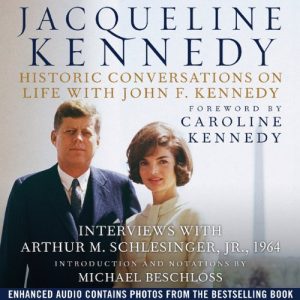
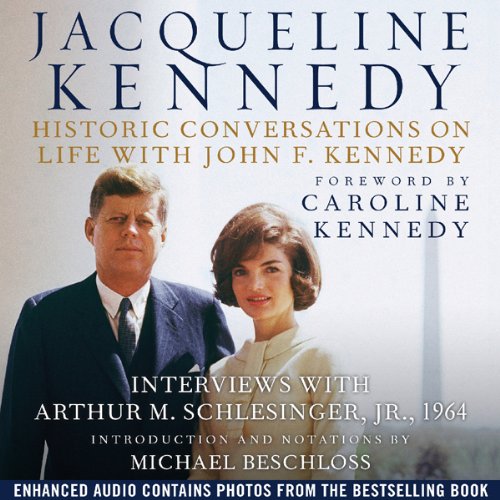
Jacqueline Kennedy's own voice carries this entire audiobook, and that single fact is the whole review in miniature: this is not a biography narrated about her, it is roughly eight and a half hours of Jacqueline Kennedy herself, recorded in 1964, sitting down with historian Arthur Schlesinger Jr. just months after her husband's assassination to preserve her own unfiltered account of their life together. The tapes were sealed by her own request and only released decades later, alongside a new foreword written and read by Caroline Kennedy and an introduction from historian Michael Beschloss, timed to the fiftieth anniversary of John F. Kennedy's inauguration.
An Unrepeatable Document From a Private Widow
The remarkable thing about this recording, based on what the synopsis and attached reviews describe, is how unguarded it apparently is for someone famously private about exactly this period of her life. Jacqueline Kennedy reportedly refused for the rest of her life to discuss these years publicly, which makes this specific 1964 recording, made once, sealed deliberately, and never repeated, an unrepeatable historical document rather than one account among many available versions of her perspective.
What comes through, per the synopsis, is not a polished public performance but candid, sometimes unscripted opinion, her actual impressions of world leaders, her relationship with Robert and Ted Kennedy, her private read on the people and decisions that shaped her husband's presidency. One listener review calls it a chance to hear her perspective 'in her own words,' a simple description but an accurate one for a recording whose entire value rests on authenticity rather than narrative polish.
A Trusted Friend Who Was Also a Historian
Arthur Schlesinger Jr., the historian who conducted these original interviews, was himself a Pulitzer Prize winning presidential historian and a genuine Kennedy administration insider, having served on the White House staff before returning to writing; his own later book on the administration, A Thousand Days, remains a standard reference on the Kennedy presidency. That dual role, trusted friend and serious historian simultaneously, is part of why Jacqueline Kennedy apparently spoke as openly as she reportedly did across these sessions, something a more distant, purely academic interviewer might not have drawn out as effectively.
It is worth sitting with the timeline here: these conversations were recorded within roughly four months of President Kennedy's assassination, while Jacqueline Kennedy was still, by any reasonable measure, in the acute stages of grief and adjusting to a completely different life as a widow and single mother at thirty-four. That proximity to the loss is part of what makes the recordings feel so historically valuable and also, per multiple listener reviews, genuinely difficult and moving to sit with as a listening experience.
One listener review describes the collection as 'moving beyond words,' which, however hyperbolic that might sound out of context, is a fair description of what makes archival recordings like this one different from even the best-written biography: the specific catch in a voice, a pause before answering a difficult question, information a transcript alone cannot fully carry. The included transcript and photographs are valuable supplements, but they are not equivalents of hearing the actual recording.
Her Actual Voice Replaces Any Narrator Performance
No traditional narrator performance exists to evaluate here, which is exactly the point. Jacqueline Kennedy is not being interpreted by an actor's craft; listeners hear her actual 1964 speaking voice, cadence, pauses, and all, which means the audiobook functions less like a produced narration and more like an archival primary source you happen to be able to listen to directly. That distinction matters enormously for anyone doing serious reading around the Kennedy presidency specifically.
The supporting material adds real value without diluting the core recording. Caroline Kennedy reads her own foreword and Michael Beschloss reads his own introduction and annotations, meaning every piece of framing material is delivered by the actual person who wrote it rather than a proxy narrator, consistent all the way through the production. A downloadable PDF of photographs and Beschloss's complete annotations rounds out a package clearly built for listeners who want serious historical context alongside the recordings themselves.
The John F. Kennedy Presidential Library holds an extensive oral history collection built from interviews with hundreds of people connected to the Kennedy administration, and these specific recordings were originally part of that same broader project before being sealed separately at Jacqueline Kennedy's request. Understood in that context, this was never meant as a standalone product but as one piece of a much larger historical preservation effort, which adds useful perspective on just how unusual its eventual public release as a standalone audiobook actually was.
Still Alive and Politically Active at the Time
Because this is a genuine 1964 recording rather than a modern studio production, listeners should expect period audio quality and Jacqueline Kennedy's own unscripted, conversational pacing rather than the polish of contemporary audiobook narration. That is a feature of the format, not a defect, but it is worth knowing before starting if you are expecting something closer to a conventional biography's smooth narrative flow.
That PDF companion is more than a nice extra, however; listeners who skip downloading it will miss visual and contextual material the production is clearly built around. Given how much the annotations apparently add historical framing to the raw interview content, treating the PDF as optional risks missing real context the audio alone does not fully supply.
Given how emotionally close to the assassination these interviews sit, and how openly Jacqueline Kennedy reportedly speaks about people who were, at the time of recording, still very much alive and politically active, this is not lighthearted listening, and listeners should approach it with the same seriousness they would bring to any firsthand historical testimony recorded in the immediate aftermath of trauma, however eloquently delivered.
Historian Michael Beschloss's specific credentials are also worth naming: he has written extensively on the American presidency across multiple administrations and is a familiar voice from television historical commentary, part of why his introduction and annotations carry real, checkable authority rather than functioning as simple marketing framing around the core recordings.
Close to Essential for Kennedy Presidency Interest
This audiobook is close to essential for anyone with serious interest in the Kennedy presidency, presidential history, or Jacqueline Kennedy specifically, precisely because it is a primary source rather than another secondhand biography. It is also a strong fit for listeners who appreciate archival journalism and oral history formats generally, beyond just Kennedy-specific interest. It is also a natural next listen for anyone who has already read a standard JFK biography and wants to hear the human texture behind the historical record in the words of someone who lived it firsthand.
Skip it if you are looking for a conventional, narratively smooth biography with modern production polish; this is a historical document first and an entertainment product second, and listeners expecting a traditional biographical narrative arc may find the interview format and 1964 recording quality require more patience than a contemporary audiobook would.