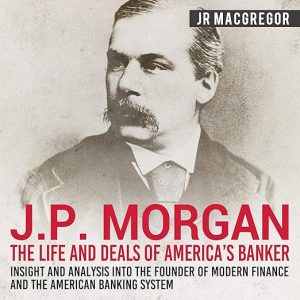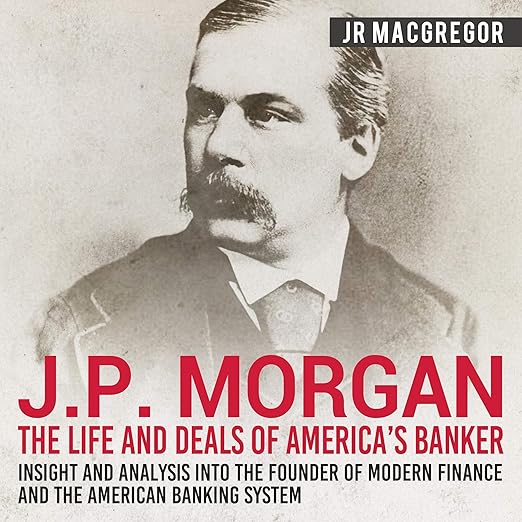
J. P. Morgan: The Life and Deals of America's Banker, part of J. R. MacGregor's Titans of Industry series, sets its ambitions clearly from the first pages. This audiobook is not Ron Chernow's Morgan: An American Financier, which runs to more than eight hundred pages and spends considerable time on family dynamics and private life. MacGregor's is a three-and-a-half-hour profile that hits the essential facts of Morgan's career, his deals, his relationships with Carnegie, Rockefeller, Edison, and Tesla, and his central role in rescuing the American economy during the Panic of 1907. Reviewer 61 and holding made the direct comparison to Chernow's approach, deliberately choosing MacGregor's brevity because it delivers the financial and public history without what that reviewer felt was the domestic overload of the longer biography. That is an honest account of what this book is for and who it serves best.
MacGregor covers the major chapters of Morgan's career in sequence. The growth of Morgan's financial influence through the industrial consolidations of the late nineteenth century, including the formation of US Steel. His role as chief financier for the titans of the Gilded Age. His funding of Edison's early electrical ventures and his recognition of Tesla's potential at a time when the commercial possibilities of alternating current were not yet obvious to the wider business world. The Panic of 1907, when Morgan essentially acted as a one-man central bank, corralling other financiers in his library to commit funds that stabilized the system before the Federal Reserve existed to play that role. Each of these episodes gets enough space to be intelligible but not so much that the book loses momentum. The pace is genuinely brisk, which is what a compact biographical profile should deliver. MacGregor also traces Morgan's influence across industries beyond Wall Street: shipping, power, steel, a reach that makes him less a banker in the narrow sense and more the organizing intelligence of an entire industrial era. The book also notes that Morgan's reputation was not bound by the shores of America, touching core industries and relationships that extended across the Atlantic financial world. Understanding that scope is important for understanding why Morgan's decisions in 1907 carried the weight they did.
Kollins Favors Clarity Over Dramatic Performance
Reviewer Inshaal Malik's comparison to Rich Dad Poor Dad signals something useful about how this audiobook is being received: it works for listeners who come to financial biography looking for lessons and orientation rather than scholarly depth. MacGregor draws attention to Morgan's personal losses, particularly the death of the woman he loved and how that grief changed him and intensified his drive, because those human details are part of understanding how an individual builds the kind of relentless professional momentum that Morgan sustained across decades. Kevin Kollins reads the material with efficient clarity. This is narration calibrated to content delivery rather than to performance, which suits the book's function perfectly. Reviewer Savvy noted the book directly addresses Morgan's faults as well as his legendary strengths, which is important for a biographical sketch of someone this mythologized in American financial history.
Three and a Half Hours Buys a Starting Point
The title's subtitle, Insight and Analysis into the Founder of Modern Finance and the American Banking System, sets expectations the book can only partially meet in three and a half hours. The analysis present is more summary than analytical depth. MacGregor makes clear interpretive claims about Morgan's legacy and character, but the space available does not allow him to develop those claims with the kind of evidence and qualification a longer book would provide. Reviewer 61 and holding described the writing as not well written but adequate for a basic overview, which is a candid and useful calibration. This is a starting point, an efficient orientation to Morgan's significance, not a definitive treatment. Listeners who finish this book and want to understand the Panic of 1907 at genuine depth, or Morgan's relationships with Carnegie and Rockefeller in their full complexity, will need to go further into the historical literature. But as an entry point, the book does its job cleanly.
Kollins Delivers a Productive, Honest Orientation
This audiobook serves listeners who want a clear, time-efficient introduction to Morgan's life and legacy without committing to a full scholarly biography. It is particularly well matched to people building a general literacy in American financial history who want to understand who Morgan was and what he did before encountering him in more detailed accounts of the Gilded Age or the Progressive Era. Listeners already familiar with the period, or those who have read Chernow or other serious Morgan biographies, will find little here that is new. Those looking for a book that grapples seriously with the anti-competitive aspects of Morgan's consolidations, his relationships with government and regulation, or the ethical dimensions of his financial power will find the treatment too brief to satisfy. For the target listener, three and a half hours with Kevin Kollins is a productive and honest orientation to one of the most consequential financiers in American history, and to the financial world he built that we are still largely living in today.
Common Questions
Does the audiobook cover J. P. Morgan's role in the Panic of 1907?
Yes, Morgan's intervention during the 1907 financial crisis is one of the central episodes the book covers. MacGregor treats it as the clearest demonstration of Morgan's singular power and influence at a moment when the American financial system had no central bank to play that stabilizing role.
Is J. P. Morgan: The Life and Deals of America's Banker audiobook suitable for listeners with no background in financial history?
Yes. The book is written for a general audience and explains the financial concepts and historical context as it goes. Listeners without specialist knowledge of the Gilded Age or American banking will find it accessible, though they may want to follow it up with more detailed resources on the period.
Does the audiobook address Morgan's personal life and character, or is it purely focused on his financial career?
MacGregor includes personal details, particularly around the loss of Morgan's first great love and how that grief shaped his professional drive. Reviewer feedback confirms the book addresses his faults alongside his strengths. The personal dimension is present but secondary to the career and deals emphasis that the title promises.