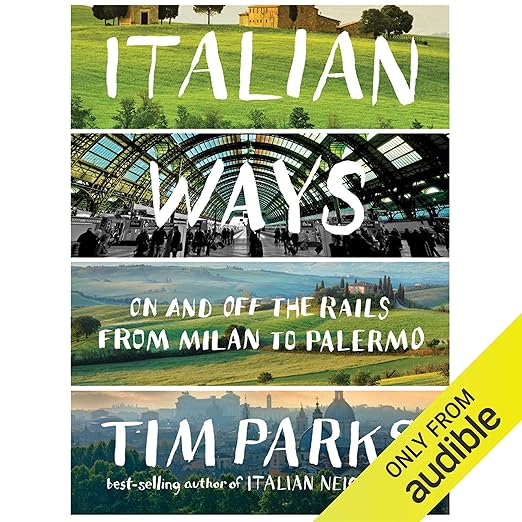
Quick Take
- Narration: Ben Bartolone suits the literary travelogue form well; his delivery has the measured quality of a writer-narrator thinking through observations rather than performing them.
- Themes: modernity and tradition in perpetual Italian negotiation, the train as social cross-section, the foreigner who has become an insider
- Mood: Wry and reflective, with affectionate exasperation throughout
- Verdict: One of the better literary travel audiobooks about Italy, most satisfying for readers who have already spent time in the country and want their observations sharpened and expanded.
I listened to Italian Ways on the train from London to Edinburgh, which felt appropriately fitting. Tim Parks argues that trains are a perfect lens for a culture: who rides them, how they are managed, what the infrastructure says about a society’s relationship to its own history, what the encounters between strangers reveal about the social contract. By the time I changed trains at York, I was reconstructing my own journey as a Parks-style field observation exercise, which is precisely the effect the book intends.
Parks is an English novelist who has lived in Italy for decades, teaches there, has married there, and has written several books about the country including the well-regarded Italian Neighbors and An Italian Education. Italian Ways returns to that project after a ten-year gap, using a different structural conceit: rather than describing Italian life from the inside out through neighborhood and family, he rides the trains from Verona to Milan, from Rome to Palermo, and down to the heel of the boot, and uses the journeys as a framework for observations about what Italy is and is not becoming.
The Structural Bet: Trains as Italy
The choice of trains as the organizing metaphor is elegant in the way that the best travel-writing conceits are elegant: it is not forced. Italy has a complex and revealing relationship with its train system, from the national pride invested in the high-speed Frecciarossa services to the resigned acceptance of delays on the regional lines, from the grandeur of Milano Centrale to the particular culture of behavior in the older inter-city carriages. Parks uses all of this, and the result is a portrait of a country in perpetual negotiation between its sense of itself as modern and its attachment to older ways of being.
One reviewer described this as a duality built into the book’s title itself: Italian Ways refers both to how the Italian railways run and how the Italian psyche operates. That double meaning is present throughout. Parks moves naturally between infrastructural observation and social analysis, between a specific encounter with a ticket collector and a broader argument about why Italians argue with such pleasure. The transitions are handled well enough that the structural seams are not visible. His encounters with conductors, priests, gypsies, immigrants, scholars, and lovers on the trains give the book its human texture, and Parks has the novelist’s eye for the detail that reveals the whole.
Parks the Insider Who Has Not Gone Native
The most distinctive quality of Parks’s Italian non-fiction is his particular position: not a tourist, not Italian, but something in between that allows him access to the inside without losing the outsider’s eye. This book is, if anything, more honest about the costs of that position than his earlier Italian work. He describes himself as increasingly grumpy, which one reviewer noted affectionately, and the observations in Italian Ways have a more critical edge than the warmer portraits in Italian Neighbors. He is still affectionate about Italy, but the affection is seasoned by decades of frustration with specific institutional failures.
The Garibaldi-to-Berlusconi historical thread is one of the book’s more intellectually ambitious sections. Parks traces how the Italian state’s development and decline is legible in the history of the train network, which is a genuinely interesting argument even for readers without deep Italian political knowledge. He does not assume familiarity, but he also does not slow down to over-explain, which is the right calibration for a book of this type. The question he poses explicitly, is Italy part of the modern world, or not, is answered with characteristic ambivalence: yes and no, sometimes simultaneously, on the same train.
Ben Bartolone and the Rhythm of Observation
Ben Bartolone’s narration suits the literary travelogue form. He reads with the measured pace of someone working through observations aloud rather than performing them for effect, which is appropriate for Parks’s essayistic style. The humor in Parks’s writing is dry and occasionally self-deprecating, and Bartolone plays it at the right temperature: warm enough to land, cool enough not to oversell.
The absence of photographs, which Parks mentions frequently having taken during his journeys, is a limitation of any edition of this book and not a narration problem. Several reviewers noted this disappointment. The descriptions are vivid enough to construct images, but the gap between described photograph and absent photograph is occasionally felt, particularly in the passages about station architecture where Parks’s observations are clearly grounded in specific visual experience.
Who Will Get Most from This Journey
Listeners who have spent time in Italy and want their experiences contextualized and deepened will find Italian Ways most rewarding. Parks is not writing for the first-time visitor and does not attempt to be a guidebook. He assumes some familiarity with the country and builds on it. Listeners interested in the literary travel writing tradition more broadly will find the book a good example of what that form can do at its most intelligent: using a specific physical journey as a scaffold for genuine cultural analysis.
Those looking for pure narrative travel entertainment, story-driven adventures with colorful characters and dramatic reversals, will find Parks more reflective and essayistic than they may want. This is a thoughtful book, not a dramatic one, and the travelogue structure is looser than a narrative might be. At nine and a half hours, it rewards the kind of listening you do on your own journeys rather than as your primary task. The ideal context is, of course, a train.
Frequently Asked Questions
Do I need prior knowledge of Italian history or culture to appreciate Italian Ways?
Prior familiarity with Italy helps but is not required for the main observations. Parks writes for a general literary audience and provides context for historical references. The book is most rewarding for readers who have spent some time in Italy, but a general cultural curiosity about European societies is sufficient to engage with the central arguments.
How does Italian Ways compare to Parks’s earlier Italian books like Italian Neighbors?
Italian Ways has a more critical edge than Italian Neighbors, which one reviewer described as Parks having become increasingly grumpy after decades in Italy. The affection for the country is still present, but the observations are sharper and the institutional frustrations more explicitly named. The train conceit is also more formal than the neighborhood-based approach of the earlier books.
The book was published in 2013. Is it still relevant as a portrait of Italy?
The book addresses structural and cultural patterns with deep roots in Italian society. The specific political references are period-specific, but Parks’s central arguments about Italy’s negotiation between modernity and tradition remain applicable. It is more a cultural analysis than a practical guidebook, which gives it longer durability than travel writing tied to current logistics.
Ben Bartolone narrates. Is he familiar with Italian pronunciation and proper nouns?
Bartolone handles Italian names and place-names with reasonable competence. Listeners with deep Italian language knowledge may notice occasional imprecision, but the narration does not create confusion or distract from the reading experience. Parks’s essayistic prose style is well served by Bartolone’s measured delivery.