Quick Take
- Narration: Scharpling narrates with the same sardonic control that defines The Best Show, self-aware, precise, and capable of unexpected vulnerability without sacrificing the comedic register.
- Themes: Mental illness and creative survival, underdog comedy culture, the cost of caring intensely about things nobody else cares about
- Mood: Dark but buoyant, raw without being indulgent
- Verdict: One of the more honest comedy memoirs in recent memory, Scharpling earns the humor by putting the darkness on the table first.
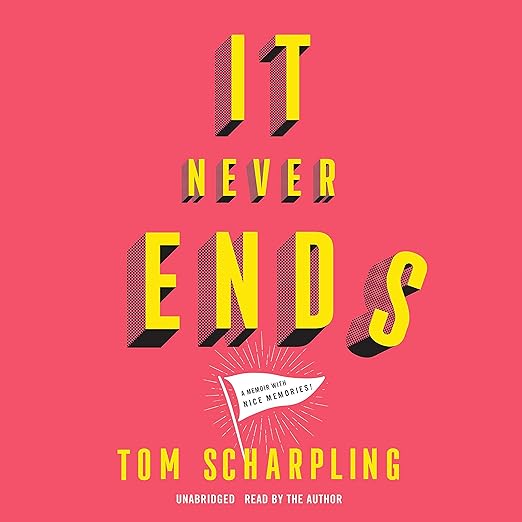
I started It Never Ends on a Tuesday night when I had been feeling the particular low-grade weight that sometimes settles in for no specific reason, and I want to be honest about that context because it matters for how I experienced this book. Tom Scharpling is describing something real and sustained about what it is like to carry mental illness through a creative career, and the fact that he does it with wit and genuine comedy timing does not soften the subject so much as hold it at an angle where it can be looked at directly.
I was not familiar with The Best Show before this book. For those similarly positioned: Scharpling has been running a radio show and podcast out of New Jersey since 2000, building one of the most devoted cult audiences in American comedy through what amounts to an extended performance piece about the fictional town of Newbridge, NJ, conducted mostly alone in the middle of the night. The memoir is as much an account of that project as it is a conventional celebrity autobiography, and that is the best thing about it.
The Comedy That Kept Him Alive
The early sections of the memoir deal with Scharpling’s adolescence and young adulthood in New Jersey with an unsparing honesty that several reviewers described as the most relatable writing they had encountered. He describes a specific kind of intense, unsocialized fandom, punk zines, obsessive basketball coverage, the particular salvation of finding music and comedy that felt like it was made for you even though it was made by strangers. This is not nostalgic material. He is describing these things as survival mechanisms, and the distinction is important.
His description of the mental health crisis that forms the book’s emotional core is handled with the kind of precision that only comes from someone who has spent years working out exactly what happened and how to talk about it. He is not performing trauma for the listener’s consumption. He is accounting for it clearly, with humor that does not trivialize and pain that does not overwhelm. One reviewer called him ‘an expert at towing the line between self-deprecating and self-aggrandizing,’ and that balance is maintained throughout the memoir at the level of sentence-by-sentence craft.
Monk, The Best Show, and the Double Life
The stretch of the memoir dealing with his career as a television writer, executive producing Monk while simultaneously running The Best Show in off-hours, is fascinating from a professional perspective. He is describing a decade-long double life, one career that was visible and paid the bills, another that was invisible to most of the industry but meant everything to him. The way he writes about this tension has something genuinely useful in it for anyone who has maintained creative work alongside the job that sustains them.
The tangents work. The extended digression about why Billy Joel deserves more contempt than he receives, the account of auditioning for the New Monkees, the Sex and the City slot machines, the elevator with Patti Smith, these are not distractions from the memoir’s emotional argument, they are the memoir’s emotional argument. The things Scharpling cares about, the obscure and unfashionable and apparently trivial things, are the exact things that kept him going.
The Audio Performance as Extension of the Radio Voice
Scharpling narrating his own memoir is not just the obvious choice, it is the only choice that makes sense for this particular book. The Best Show exists in audio, has always existed in audio, and Scharpling’s voice and timing have been developed through thousands of hours of live radio performance. He reads with the confidence of someone who knows how to hold an audience in an empty room, which is a specific skill and a rare one.
At just under nine hours it is a substantive listen that never feels like it is filling time. The memoir has a real shape to it, moving from the crisis of the early material to something that resembles not resolution exactly, but a kind of hard-won continuance that is more honest than resolution would be.
Who Should Listen and Who Should Skip
This is an essential listen for Best Show fans, obviously. But it is also worth the nine hours for anyone interested in what comedy as a lifeline actually looks like from the inside, or for listeners who are themselves navigating creative work alongside mental health struggles. The humor is real and consistent. The darkness is real and consistent. Both things coexist without either one canceling the other out, which is the book’s central achievement. Listeners who prefer their comedy memoirs lighter will find this heavier than the genre convention suggests.
Frequently Asked Questions
Do I need to be a Best Show listener to get full value from this memoir?
Prior familiarity helps with context and will deepen the experience, but Scharpling writes about The Best Show in a way that explains its importance without assuming you already know it. Non-listeners will understand what the show meant to him even without having heard it.
How explicitly does the memoir address mental illness, is it clinical or more personal and narrative?
It is personal and narrative rather than clinical. Scharpling does not frame his experience in diagnostic terminology so much as describe what he went through and how it shaped his choices. The approach is honest and specific without being didactic.
Is the comedy in It Never Ends consistent throughout, or does the darker material overwhelm it?
The comedy is consistent and genuine throughout. Scharpling has the ability to be funny about genuinely painful material without trivializing it, and the balance holds across the full nine hours. Multiple reviewers specifically noted that the humor keeps the darker material buoyant.
Does the memoir cover Scharpling’s work as a music video director alongside his comedy career?
The memoir’s focus is primarily on the crisis years, the writing career, and the development of The Best Show. His work as a music video director is not a central subject.