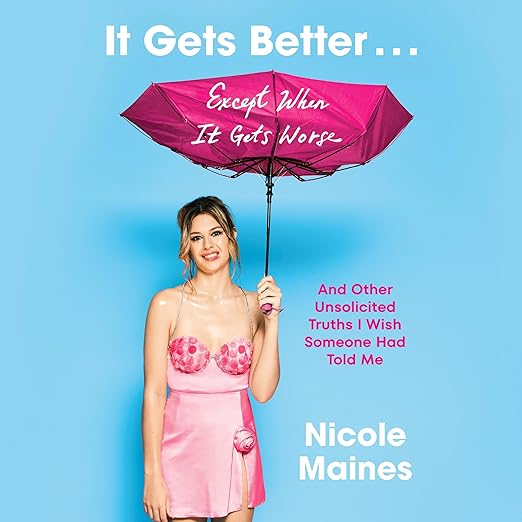
Before You Press Play
- Narrator: Author-read, with no second voice and no dramatization credited across five hours and fifty minutes.
- Subjects: growing up trans in rural Maine, a landmark court case, Hollywood and the myth of the happy ending, activism by accident
- Tone: Funny, profane and impatient, with the sadness arriving without warning
- Bottom line: A memoir that earns its joke of a title, best for listeners who want the story told rather than explained.
Happily ever after is the shape Nicole Maines builds carefully and then knocks over, and the audiobook's own description does the demolition in three lines. She came out young, her family fought and won a landmark case in Maine before she finished high school, she got to college, got the guy, had the surgery, and landed the role. Cue the sunsets, the copy says, because we have ourselves a happy ending. Ha. As if.
This Time She Refuses to Explain Anything
Becoming Nicole came first and was written by someone else. The five-star response headed Highly recommended Memoir makes the distinction that matters, describing Amy Nutt's earlier book as the story of a family educating itself and adapting, and this one as Nicole telling her own story for the first time. That shift of narrator changes what the material can do: the earlier account explains a child to the world, and this one refuses to explain anything.
Rural Maine to Hollywood is the geographic arc, and the legal fight sits in the middle of it. A family that had to educate itself and everyone around it, a court case won before a high school graduation, a state that became a precedent: these are the load-bearing events, and Maines handles them as things that happened to a kid rather than as milestones in a movement. The difference in register is the whole point of a memoir arriving after a biography.
Supergirl gave her the part of television's first live-action transgender superhero, and the book treats that achievement with the same suspicion it treats every other tidy ending. The copy names the insidious messages the memoir goes after: that any one thing can fix you, that something must be wrong with you when the fixing does not take, that reaching the goal is the end of the story rather than the start of a harder one.
A Raw and Hilarious Writer's Voice Emerges
Comedy is the default register, and the description sets it accurately by describing its own author as sometimes just someone who is existing, which is actually pretty hard. A Disney princess expertise runs through the material as a running joke that keeps turning serious. Memoirs about hard childhoods usually choose between being funny and being honest, and the achievement here is refusing the choice for most of five hours and fifty minutes.
Summing up the difference between the two books is what the entry headed Unabashedly Nicole does best. It loved the earlier account and still prefers this one, distinguishing them by summary phrase: the first book was about becoming Nicole, and this one proceeds from the position that she always was. That is a sharp piece of reader criticism, and it identifies the book's actual argument better than the jacket copy does.
Timeliness cuts both ways in a memoir, and the October 2025 four-star lands on the useful side of it, crediting Maines with a raw and hilarious writer's voice and calling the book inspirational and educational without visibly trying to be either. That last clause is the compliment worth having. Books written by activists tend to instruct; this one mostly tells you what happened and lets the instruction happen by accident.
Nobody Describes How She Sounds Delivering Her Jokes
Nobody in the written column describes the reading. Forty-two ratings and five written responses have produced praise for the wit, the rawness and the politics, and not one line about how the author sounds delivering her own jokes, which is the single thing a listener would want confirmed before choosing audio over print. Maines is a working actress, so the odds are favorable, but the page offers no evidence either way. Sample it.
Libraries come up in the February 2025 five-star, which praises the memoir and then makes a claim the listing does not corroborate: that Maines's work, and work about her, is being systematically pulled from library shelves and recommended reading lists. Treat that as one reader's account rather than as a documented fact. It does capture the atmosphere the book was published into, which is part of why the memoir refuses to end on a resolution.
Length is the honest caveat. Under six hours is short for a life this eventful, and the consequence is compression: the court case, the transition, the move into television and the aftermath of all three share a runtime that a more conventional memoir would spend on the childhood alone. The copy's phrasing around the surgery is glancing, and no content guidance appears on the record at all, which is worth knowing before handing it to a younger listener.
No Triumphant Arc That Closes Cleanly
Cisgender listeners who suspect they are missing something will find this an unusually forgiving place to start, and one May 2025 five-star says exactly that, describing the book as eye opening and crediting it with prompting a reconsideration of what empathy costs. Maines is not writing a primer and does not slow down to define terms, which is precisely why it works better than a primer would.
Trans listeners, and particularly younger ones, are the audience the title is speaking to directly, since the joke in it is aimed at the promise that things improve on a schedule. Anyone who wants a triumphant arc that closes cleanly should look elsewhere, because the book's whole position is that the ending is only the start of the next problem. Listeners who loved the earlier family biography should expect a sharper, funnier and far less diplomatic account of the same life.