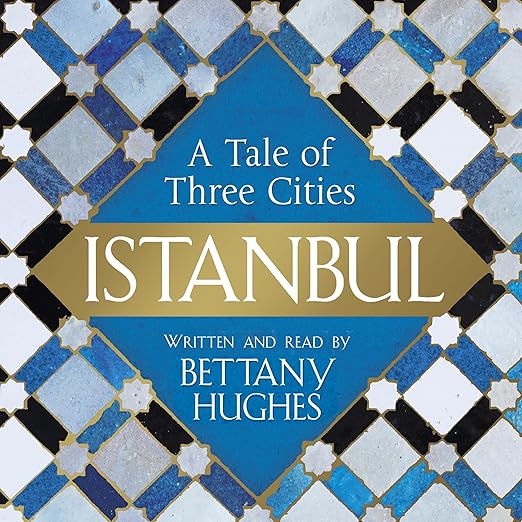
Quick Take
- Narration: Bettany Hughes reads her own work with the controlled passion of someone who has spent decades inside this material. Her voice gives the 24-hour runtime real momentum.
- Themes: Imperial crossroads, layered civilizations, the archaeology of identity
- Mood: Sweeping and immersive, occasionally overwhelming in the best way
- Verdict: One of the most ambitious and rewarding city histories available in audio, made essential by an author-narrator who knows this city the way most people know their own street.
I started listening to Istanbul on a flight, which felt appropriate in a way I did not fully appreciate until Hughes began describing the city’s position as the hinge between continents, between empires, between worlds. By the time the plane landed I had consumed two hours of a twenty-four hour book and felt, already, that I had been handed a new way of thinking about how places accumulate meaning across time. That experience of enlargement, of suddenly seeing more than you knew was there, is what the best historical writing produces, and Hughes sustains it across an extraordinary span.
Hughes is a British historian and broadcaster best known for her television work on ancient civilizations, and her writing here carries that quality of wanting to show as well as tell. She is not content to list what happened in Byzantium or Constantinople or Istanbul: she wants to place you in the grain market, the hippodrome, the courtyard, the harbor, in ways that make the past feel physically inhabited rather than academically catalogued. The detail that archaeologists have measured forty-two human habitation layers beneath the modern city surfaces early in the book and functions as a structural principle for everything that follows.
A City That Has Lived Forty-Two Human Layers Deep
Hughes moves through those layers with the discipline of an excavator, not dwelling so long on any one period that the others crowd out, but giving each its due weight and sensory texture. The coverage of the Byzantine period is particularly detailed, and one reviewer noted that the section from Byzantium through the Ottoman conquest of 1453 is the richest part of the book. Hughes traces the city’s role as the capital of the Eastern Roman Empire with genuine political and military depth, and her account of the Fourth Crusade and the Venetian sack of 1204 is as good an explanation of that extraordinary episode as I have encountered outside specialist literature.
She has the rare ability to make medieval power politics feel as visceral and immediate as current events, and she never lets the reader forget that these were not abstractions. Phoenicians, Genoese, Venetians, Jews, Vikings, Azeris: Hughes gives each community she discusses a texture beyond their role in the larger story. The city she describes is not simply a backdrop for empires but an active participant in the events that shaped it, its position on the water, its walls, its markets, functioning as historical agents in their own right.
What Author-Narration Does for a Book This Dense
There is a real risk with author-narrated audiobooks, particularly at this length. Twenty-four hours with a narrator who cannot modulate pace or energy is genuinely punishing. Hughes avoids this almost completely. She reads with the cadences of someone who has spoken about this material in public for years: she knows which sentences to slow down for, which names require a pause for the listener to absorb, and when to let a particularly striking fact breathe before moving on.
The effect is of being in a private lecture from someone who loves their subject without sentimentalizing it. Hughes is not a booster for any particular version of the city: she covers the cruelty and inequality alongside the architectural and intellectual achievement, and her voice does not change register when the history turns dark. One reviewer highlighted her attention to women’s experience in the city across different periods, which is handled with more seriousness than is common in books of this type. That consistency is one of the things that makes the narration trustworthy across a run this long.
Scope, Selectivity, and What Sits Outside the Frame
A book covering six thousand years of a city’s history must be selective, and some reviewers have noted that the Ottoman and modern periods receive less intensive treatment than the ancient and Byzantine sections. That is a fair observation. Hughes’s deepest expertise is in the ancient world, and the book’s center of gravity reflects that. The sections on Phoenician and early Greek settlement are dense with archaeological specificity, while the chapters on the late Ottoman empire and the Republican period move at a faster clip.
This is worth knowing before you commit. If your primary interest is twentieth-century Istanbul or the contemporary political situation under Erdogan, the book addresses this material but does not linger there. The historical weight falls on the periods that left the most physical and documentary evidence, which is also the period where Hughes is at her scholarly best.
Who Belongs in the Audience for This One
This is not an entry-level history. At twenty-four hours, it demands real commitment, and it rewards listeners who can give it sustained attention rather than treating it as background. Those planning to visit Istanbul, or who have recently returned from it, will find the book transformative in the way that great travel writing can be: it does not just describe the city, it changes the resolution at which you see it.
Readers who struggle with densely layered chronology may find the early sections challenging, since Hughes moves between archaeological strata and historical periods in ways that require active orientation. But anyone with a genuine appetite for this scale of history, the kind that thinks in centuries rather than decades, will find this one of the more rewarding listens they commit to. One reviewer prepared for a three-week vacation with this book and described it as making everything they saw more legible. That is probably the best measure of what a city history can do.
Frequently Asked Questions
Is this audiobook suitable for someone with no prior knowledge of Byzantine or Ottoman history?
It is accessible but not simple. Hughes explains context as she goes, and no specialist knowledge is required. However, the book covers a very long span of history at considerable depth, and listeners completely unfamiliar with the broad outlines of Roman, Byzantine, and Ottoman chronology may find the early chapters require patience and occasional re-listening to orient themselves.
How does Bettany Hughes narrate her own book across 24 hours?
Hughes reads with the disciplined energy of a practiced public lecturer rather than a performance narrator. She is never flat, and she modulates pace skillfully around particularly dense or significant passages. Given the runtime, this is no small achievement. A few reviewers found the density of the text challenging in audio form, but the narration itself is widely praised.
Does the book cover modern Istanbul and the contemporary political situation in Turkey?
Yes, but this material receives less intensive treatment than the ancient and Byzantine sections, which reflect Hughes’s deepest scholarly expertise. The book ends in the contemporary period and addresses Erdogan-era Turkey, but listeners primarily interested in the modern city may find the weight of the book falls elsewhere.
Is this audiobook appropriate as preparation for a trip to Istanbul?
Multiple reviewers mention reading it specifically as trip preparation and found it highly effective. Hughes’s attention to physical place, the harbors, the markets, the monuments, gives the history a geographical specificity that makes it useful as a companion to walking the city. The depth of historical context it provides is far greater than a conventional guidebook.