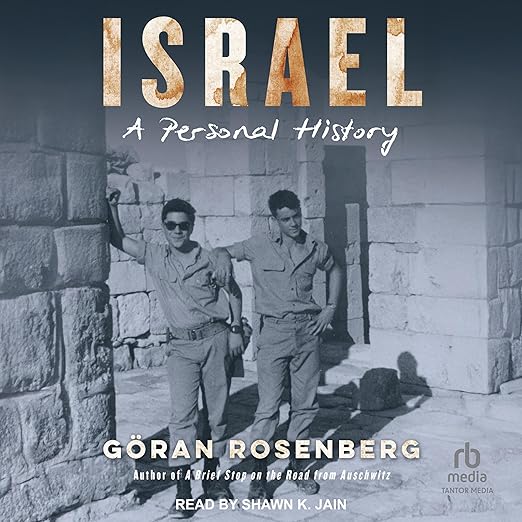
Goran Rosenberg's Israel - narrated by Shawn K. Jain in this audiobook edition - begins where his internationally acclaimed childhood memoir A Brief Stop on the Road from Auschwitz ended. That earlier book documented his father's survival of the Holocaust and subsequent suicide in a small Swedish industrial town in 1960. This continuation picks up with the aftermath: a single mother emigrating with two children to Israel, fully absorbed into the world of pioneer Zionism, shaped by its ethos, enchanted by its vision. What follows is not a celebration but a decades-long process of questioning, excavation, and reckoning with what that vision required and what it destroyed in the process of its realization.
One Reviewer Found the First Half Unsatisfying
Rosenberg is a Swedish journalist and intellectual, not a professional historian, and his approach to this material reflects that formation. The first half of the audiobook - which one reviewer found unsatisfying - is devoted to the intellectual history of European Zionism: the writers, politicians, and theorists whose arguments shaped the movement before statehood. This is exactly the material a journalist trained in political biography would foreground, and it is dense with figures who are largely unfamiliar to non-specialist listeners. Rosenberg's justification for this approach is coherent: you cannot understand the contradictions of the Israeli state without understanding the contradictions between the various Zionist visions that competed to define it. But the density of this section requires patience from listeners who came for the personal memoir, and the nine-and-a-half-hour runtime gives that patience a genuine test.
The second half delivers that memoir more fully. Rosenberg traces his own journey from idealistic young immigrant to disillusioned observer, encountering the gap between Zionism's promise and its consequences for Palestinians - the ethnic violence, dispossession, and erasure of villages that the synopsis names directly. This is politically explicit material, and listeners should enter knowing that. Rosenberg is not presenting a balanced retrospective of the Israeli-Palestinian conflict; he is presenting his own formation, disillusionment, and the intellectual framework through which he came to understand what he had lived inside. One reviewer found this tendentious; others will find it honest. The difference in those responses says as much about the reader's prior position as it does about Rosenberg's arguments.
A Son of Survivors Who Broke With the Dream
Shawn K. Jain's narration is well-suited to this material. The audiobook requires a voice that can hold intellectual argument and personal memory in the same breath without making the transitions feel jarring, and Jain manages this consistently across the full runtime. The nine-hour-and-forty-three-minute duration gives Rosenberg enough space to develop his argument without compression, and the audiobook format suits a text that rewards slow processing - the ability to pause and return, or to replay a particularly dense political-historical passage, is an asset here rather than a limitation when the arguments are this layered.
The unique value of this audiobook is precisely the personal stakes Rosenberg brings to a history that is often argued in the abstract. As the son of Holocaust survivors who emigrated to Israel as a child, who lived inside the Zionist project and eventually broke with it intellectually, he is writing from a position that very few authors occupy. That does not make his account definitive or beyond critique - the lone review on record is a two-star assessment from a reader who found the book propagandistic - but it makes his perspective irreducible to standard ideological categories. This is not a politician's memoir or a polemicist's argument. It is the autobiography of someone who trusted a dream completely and then spent decades understanding what the dream had cost, told by a narrator whose measured delivery gives the weight of that reckoning its full due.
Jain Keeps Hebrew and Swedish Names Consistent
Listeners should be aware of two structural features that shape the listening experience significantly. First, the book is as much an intellectual history of ideas as it is a personal memoir; the two modes alternate and intersect throughout the runtime, and the balance shifts in ways that will suit some listeners better than others. Second, Rosenberg's political conclusions are not implicit. He names ethnic violence, oppression, discrimination, and dispossession as consequences of Zionism's realization, and he does so with the specificity of someone cataloging what he witnessed and researched rather than summarizing a debate position. Listeners who want a politically neutral account of Israeli history will not find it here. Listeners who want to understand how a child of Holocaust survivors processed the gap between the dream they emigrated toward and the reality they encountered will find this audiobook uniquely positioned to deliver exactly that.
Jain's narration handles the Hebrew and Swedish proper names and places that appear throughout with reasonable consistency, maintaining the personal geography of the memoir without losing the listener in unfamiliar nomenclature. The dual registers of intellectual argument and personal recollection are held together by Jain's steady delivery throughout.
Honest About What He Lived, Not Neutral
This audiobook is for readers who engage seriously with modern Israeli and Jewish intellectual history, and particularly for those interested in firsthand accounts of how the Zionist generation that established Israel and its early immigrants processed the gap between ideology and outcome. Listeners familiar with Rosenberg's earlier memoir A Brief Stop on the Road from Auschwitz will find this a natural and emotionally resonant continuation. Those with an existing interest in the political autobiography of Jewish European intellectuals of the postwar generation will find this an important and demanding text.
Listeners who want history presented without explicit authorial perspective, or who are looking for a balanced survey of the Israeli-Palestinian conflict, will find this audiobook frustrating. Rosenberg is not trying to be neutral. He is trying to be honest about what he lived and what he concluded, and the distinction matters for setting appropriate expectations before the first chapter begins.
Good to Know
Do I need to have listened to A Brief Stop on the Road from Auschwitz before this audiobook?
It helps considerably. Israel begins where that memoir ends, and Rosenberg assumes familiarity with his father's story and the family's Swedish context. The audiobook can be followed without the predecessor, but the emotional stakes of the personal memoir sections are deepened significantly by the earlier book.
Is this audiobook primarily a political argument or a personal memoir?
It is genuinely both, in alternating modes. The first half leans heavily into intellectual history and political biography of European Zionism. The second half is more directly personal memoir. Rosenberg's own political conclusions are explicit throughout; this is not a neutral account.
How does the audiobook handle the most politically sensitive material about Palestinian displacement?
Rosenberg addresses ethnic violence, dispossession, and the erasure of Palestinian villages directly and by name. Shawn K. Jain delivers this material with the same measured register as the rest of the text, without dramatizing or softening it. Listeners who find the subject politically charged should know that Rosenberg's perspective is clearly identified with the critical-Zionist position.