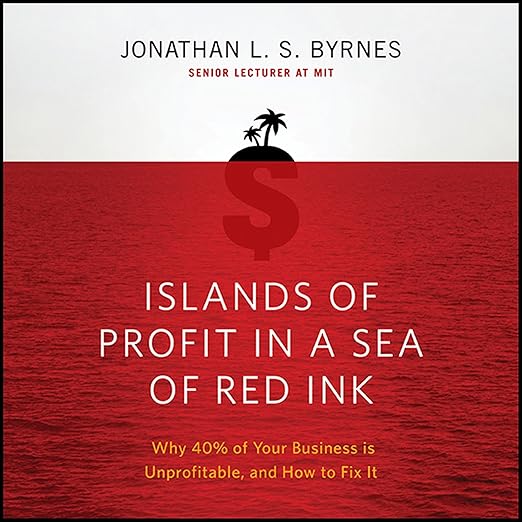
Quick Take
- Narration: Erik Synnestvedt reads the business content clearly and at a pace that suits analytical material; his delivery is professional without personality, which works for the instructional register.
- Themes: Profitability management as a discipline, customer and product portfolio analysis, rethinking revenue mythology
- Mood: Energizing and intellectually rigorous; the kind of business book that makes you want to open a spreadsheet immediately after
- Verdict: A practical, insight-dense business audiobook best suited to managers and executives; those without P and L responsibility will find the applications harder to translate directly.
I first heard about Jonathan Byrnes and his work at MIT through a colleague who described his approach to profitability as the most clarifying thing she had encountered in twenty years of management consulting. That is the kind of recommendation that either over-promises and disappoints or turns out to be exactly right. Islands of Profit in a Sea of Red Ink is, in most respects, exactly right. I listened to it across three sessions spread over a working week, which meant that by the time I reached the final chapters I was already applying the framework to situations I was dealing with in real time. That is the appropriate test of a business book.
Byrnes’s central claim is simultaneously obvious in retrospect and genuinely counterintuitive before you encounter it: in any business, roughly 40 percent of activity is unprofitable, and profit increases of 30 percent or more are accessible without radical restructuring. The problem is that most management frameworks are built around revenue and cost as opposing forces rather than around profitability at the transaction, customer, and product level. Byrnes calls the discipline of understanding and acting on that granularity profitability management, and the book is both the case for why it matters and a practical framework for how to implement it.
Our Take on Islands of Profit in a Sea of Red Ink
The three myths Byrnes dismantles early in the book are worth understanding before you start, because they set up everything that follows. The first is that revenues are inherently good and costs inherently bad; this is the thinking that allows unprofitable customers and product lines to persist indefinitely because they contribute to the top line. The second is that all customers deserve the same service quality; Byrnes argues this is both economically irrational and operationally destructive. The third is that if everyone does their job well, the company will prosper; this myth ignores the structural misalignments that allow unprofitability to persist even when individuals are performing well. Each myth gets a full chapter of dismantling, and the cumulative effect of that demolition is productive rather than merely critical.
Why Listen to Islands of Profit in a Sea of Red Ink
The book’s strongest quality is practical specificity. Byrnes draws on decades of work with actual clients, and the case material feels real rather than illustrative. One reviewer noted that there is genuine heart in the book’s treatment of people and leadership alongside the financial analysis, and that is accurate; Byrnes does not treat profitability management as a purely technical exercise. The sections on customer segmentation and supply chain profitability are particularly dense with immediately actionable thinking. Erik Synnestvedt’s narration keeps up with the material without imposing himself on it, which is the right approach for this kind of content. The nine-hour runtime covers a substantial amount of ground without feeling stretched.
What to Watch For in Islands of Profit in a Sea of Red Ink
One reviewer noted directly that this book was developed from executive training courses at MIT and is aimed primarily at the C-suite: CEOs, CFOs, COOs, and their direct reports. That is an accurate characterization of the target audience, and it matters for setting expectations. Managers without P and L responsibility or without authority over customer and product portfolio decisions will find much of the material intellectually interesting but harder to apply directly. Another reviewer described it as an addition to 80/20 principle thinking rather than a departure from it, which is a useful frame: if you are familiar with the Pareto principle applied to business, Byrnes is working the same underlying insight with more operational specificity and a larger dataset behind his conclusions.
Who Should Listen to Islands of Profit in a Sea of Red Ink
This is most immediately useful for senior managers, business owners, and executives who have authority over pricing, customer relationships, and product mix. It is also valuable for consultants and analysts who advise that level of leadership. The application is broad across industries; Byrnes’s client base has ranged across manufacturing, distribution, retail, and services. Those in the early stages of their careers will find it a useful conceptual foundation to return to when they have more organizational leverage to act on it. The combination of myth-busting clarity and case-based practicality makes this among the more credible business audiobooks in the profitability space, and the nine-hour runtime is calibrated well for the volume of material it covers.
Frequently Asked Questions
Is this book primarily theoretical or does it provide operational tools for implementing profitability management?
Byrnes balances both. The conceptual framework is clearly explained, but the book draws heavily on client case material and provides specific approaches to customer segmentation, supply chain analysis, and portfolio management. Reviewers describe it as immediately actionable, which suggests the operational tools are present and usable.
How does this book relate to the 80/20 principle if I am already familiar with that framework?
One reviewer describes it explicitly as an addition to 80/20 thinking with more operational specificity. Byrnes is working the same underlying insight, that a minority of customers and products generate a disproportionate share of profit, but with a more granular analytical apparatus and a focus on profitability management as a distinct discipline.
Is this suitable for small business owners, or is it calibrated primarily for large corporate environments?
The case material and the language skew toward larger organizations with complex customer and product portfolios. Small business owners will find the conceptual framework valuable, but some of the operational specifics, particularly around supply chain and enterprise customer management, will be harder to translate to smaller scale contexts.
Erik Synnestvedt narrates. Does the narration support or detract from the analytical density of the content?
Synnestvedt reads clearly and at a pace appropriate for business content. His delivery is professional rather than engaging, which suits material that requires the listener’s cognitive attention rather than emotional investment. The narration facilitates the content without adding to it.