Quick Take
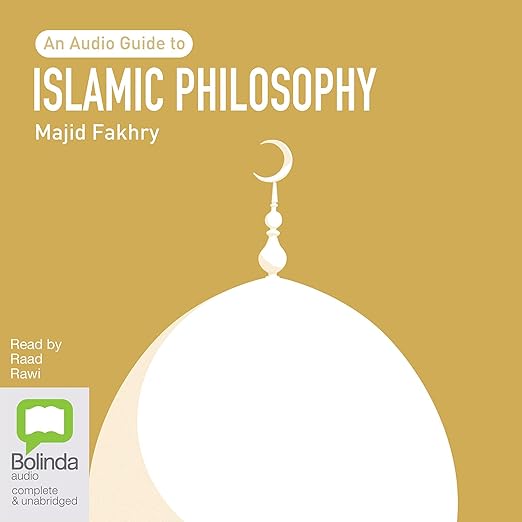
- Narration: Raad Rawi brings cultural authenticity and measured authority to dense intellectual material, an ideal fit for this subject.
- Themes: the reconciliation of Greek rationalism with Islamic theology, the development of Sufi mysticism, the long conflict between reason and faith
- Mood: Dense and scholarly, with passages of genuine intellectual beauty
- Verdict: A rigorous and comprehensive introduction to a field most Western listeners know almost nothing about, demanding but genuinely rewarding for the philosophically curious.
I came to Islamic Philosophy the way I come to most dense intellectual history: with a cup of strong tea, a notebook, and the expectation that I would need to rewind. Majid Fakhry is one of the foremost scholars of Islamic philosophy in the English-speaking world, and this audiobook draws on his decades of scholarship to chart a field that stretches from the eighth-century introduction of Greek philosophy into the Muslim world all the way to the twentieth century. That is a thirteen-hundred-year arc, covered in just over seven hours. The compression is ambitious. It mostly works.
The central question Fakhry asks, and never stops asking, is how Muslim thinkers across fourteen centuries have attempted to reconcile philosophy with faith. This is not a uniquely Islamic problem. The same tension animated Aquinas in the Christian tradition and Maimonides in the Jewish one. But the Islamic engagement with Greek philosophy, particularly with Aristotle, produced some of the most sophisticated intellectual syntheses in human history, and those syntheses were largely lost to Western audiences after the medieval period. Fakhry restores the full picture.
Our Take on Raad Rawi as Narrator for This Material
The casting of Raad Rawi is one of the best decisions Bolinda made in producing this audiobook. Rawi is a British-Iraqi actor whose voice carries both the warmth of familiarity with the material and the precision of someone who knows what it means to correctly render Arabic proper nouns for an anglophone audience. There is nothing worse than hearing a narrator mispronounce al-Kindi or al-Farabi with the confidence of someone who has never considered the question. Rawi handles the full roster of names, texts, and concepts with authority that itself teaches the listener something about how the tradition is held by those inside it.
The seven-hour runtime is appropriate for a survey of this scope, though it should be understood as genuinely introductory. Fakhry necessarily moves quickly through figures like Ibn Sina (Avicenna), Ibn Rushd (Averroes), and al-Ghazali who each warrant their own dedicated study. What the listener gets is a reliable map, the relationships between schools, the major controversies, the key texts, the trajectory of the tradition. That map is genuinely useful as an orientation before deeper reading.
Why Listen to Islamic Philosophy Now
There are few areas of intellectual history where the gap between public knowledge and actual scholarly richness is as large as it is in Islamic philosophy. The Western tendency to treat the Muslim world as intellectually dormant between the fall of Rome and the European Renaissance has always been a distortion, but it remains widely unchallenged in general education. Fakhry’s account makes clear that al-Farabi was doing serious political philosophy in the tenth century, that Ibn Sina produced a systematic metaphysics that rivaled anything produced in medieval Europe, and that the Sufi tradition, far from being merely devotional, developed sophisticated epistemological arguments about the limits of discursive reason.
The audiobook is particularly good on the conflict between the Mutazilites, the pro-philosophical rationalists who believed reason and revelation were compatible, and the Asharites, who insisted on the primacy of divine will over rational categories. That conflict was not purely theoretical. It shaped political theology in ways that still reverberate. Fakhry treats these not as abstract historical curiosities but as live arguments whose outcomes mattered enormously for how Muslim societies understood themselves.
What to Watch For in the Treatment of Mysticism and Sufism
The chapters on Sufi thought are among the most intellectually surprising in the audiobook, at least for listeners who come in with only a devotional image of Sufism. Fakhry shows how figures like al-Ghazali and Ibn Arabi were engaging with the deepest problems of epistemology and ontology, not simply offering spiritual comfort but making substantive arguments about the nature of knowledge and being that challenged the philosophical rationalists on their own ground. The tension between mystical and rationalist strands within Islamic philosophy is one of the book’s most productive intellectual threads.
Who Should Listen to Islamic Philosophy
This audiobook is for philosophically curious listeners who want a rigorous, scholarly introduction to a tradition they have likely encountered only in fragments or caricature. It is not for casual listeners seeking an easy entry, the material is dense, and Fakhry assumes at least some familiarity with basic philosophical vocabulary. Those who have read introductory works on ancient Greek philosophy will find their bearings more quickly, since Fakhry’s narrative begins with the Greek inheritance and follows its transformation through successive generations of Islamic thinkers. There are no reviews on the Audible listing, which is worth noting, this is a specialized academic title that may not have the broad visibility its quality deserves.
Frequently Asked Questions
Is Islamic Philosophy by Majid Fakhry accessible to listeners without a philosophy background?
It is demanding. Fakhry assumes some philosophical vocabulary and does not slow down to define basic terms. Listeners who have encountered ancient Greek philosophy or basic epistemology will find their footing faster. Complete newcomers to philosophy may want a lighter introduction first.
Does the audiobook cover modern Islamic philosophy, or does it focus primarily on the medieval period?
Fakhry charts the tradition from the eighth century through to modern times, as the synopsis states. The medieval period receives the most attention given its density of major figures, but the book does not stop at the Renaissance. Twentieth-century Islamic philosophical thought is addressed, though more briefly.
How does Raad Rawi handle the extensive Arabic names and philosophical terminology in this audiobook?
With considerable skill and cultural authority. Rawi’s pronunciation of Arabic proper nouns, texts, and philosophical terms is consistent and confident, which significantly aids comprehension and gives the listener a sense of how the tradition is held by those with genuine familiarity.
Is this the full Fakhry text, or an abridged version of his longer scholarly work?
This appears to be Fakhry’s shorter introductory volume rather than his comprehensive scholarly work. At seven hours and twenty-five minutes, it functions as a survey and orientation rather than an exhaustive academic treatment. Those who want depth on individual figures will need to supplement with additional reading.